In today’s fast-changing business environment, tax compliance has become more complicated than ever. With the implementation of the Goods and Services Tax (GST), businesses of all sizes are expected to follow uniform tax rules across India. However, interpreting GST laws correctly can sometimes be confusing, especially when new business models, imports, or cross-border transactions are involved. That’s where the GST Advance Ruling Mechanism comes into play. It allows taxpayers to get clarity on tax matters before making transactions, helping them avoid disputes, penalties, and unnecessary litigation.
At Rajendra Law Office LLP [International Attorneys Firm], our team of tax and legal experts assists businesses, NGOs, and multinational companies in obtaining GST advance rulings efficiently and strategically. This article explains the mechanism in simple terms and how it can protect your business from future tax complications.
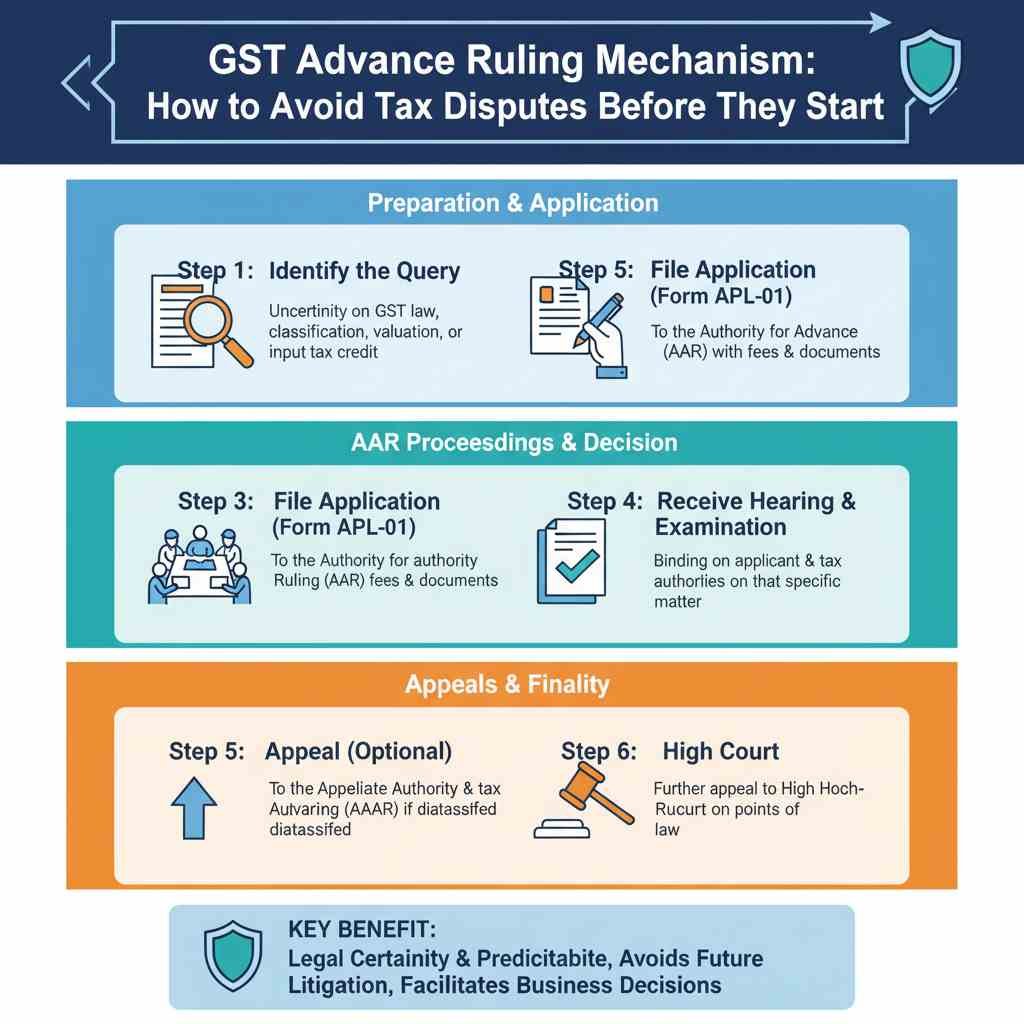
GST Advance Ruling Mechanism: How to Avoid Tax Disputes Before They Start: Rajendra Law Office LLP
What Is the GST Advance Ruling Mechanism?
The Advance Ruling Mechanism under GST is a legal process through which a taxpayer can obtain a written decision from tax authorities on specific questions related to GST law.
It is governed by Chapter XVII (Sections 95–106) of the Central Goods and Services Tax (CGST) Act, 2017. The ruling provides legal certainty about how GST applies to a particular transaction or activity, ensuring that taxpayers act in full compliance.
In simple words, it helps you ask the government:
“What will be the GST implication if I do this transaction?”
— and receive an official, legally binding answer before you proceed.
Why the Advance Ruling System Is Important
Every business decision—whether it’s setting up a branch, importing goods, or providing services across states—has tax implications. Without clarity, businesses often face notices, penalties, or audits.
The Advance Ruling system helps prevent these by:
- Giving legal certainty before entering into transactions.
- Reducing the risk of future disputes with tax departments.
- Ensuring consistent tax treatment across similar transactions.
- Saving time, effort, and litigation costs.
This proactive approach promotes transparency and builds trust between taxpayers and authorities. It is especially valuable for businesses with complex or high-value transactions.
Who Can Apply for an Advance Ruling?
Any registered taxpayer or even a person intending to register under GST can apply for an advance ruling. This includes:
- Individuals and Proprietors running small or medium businesses,
- Companies, including startups and multinational corporations,
- Partnership Firms and LLPs,
- Charitable Institutions and NGOs, and
- NRIs or foreign entities planning to conduct business in India.
Whether you are manufacturing goods, exporting services, or leasing property, you can seek an advance ruling for greater clarity and compliance.
Issues Covered Under Advance Ruling
You can seek an advance ruling for various matters under GST, such as:
- Classification of goods or services.
- Applicability of a GST rate or exemption.
- Determination of time and value of supply.
- Admissibility of input tax credit (ITC).
- Whether an activity amounts to supply under GST.
- Requirement for registration.
- Tax liability on specific transactions.
- Place of supply or nature of transaction (interstate or intrastate).
- Applicability of notifications issued by the government.
- Any other question related to GST law interpretation.
By obtaining clarity in advance, you minimize the chance of receiving tax notices or audit queries later.
How to Apply for an Advance Ruling
Applying for an advance ruling is a straightforward process. However, precision in drafting and documentation is crucial.
Here’s a simple step-by-step overview:
- Prepare the Application
- Use Form GST ARA-01 and submit it to the Authority for Advance Ruling (AAR) of your respective state.
- Clearly describe your question and provide supporting documents.
- Pay the Prescribed Fees
- A nominal fee (currently ₹5,000 each under CGST and SGST) is payable.
- Authority Review and Hearing
- The AAR examines your question and may schedule a hearing to seek clarifications.
- Issuance of Ruling
- The authority provides a written ruling, usually within 90 days, specifying how the GST law applies to your case.
- Appeal, if Necessary
- If you are not satisfied, you can appeal to the Appellate Authority for Advance Ruling (AAAR) within 30 days using Form GST ARA-02.
At Rajendra Law Office LLP, we guide clients through each step—ensuring the application is drafted clearly, legally sound, and backed with strong documentation to obtain the desired outcome.
Binding Nature of Advance Ruling
An advance ruling is legally binding on both the applicant and the concerned jurisdictional GST officer. This means once the ruling is issued, neither party can deviate from it for that particular transaction.
However, it is binding only for the specific applicant and the state where it is issued. If a business operates in multiple states, separate applications may be required.
This legal certainty ensures peace of mind, as businesses can plan transactions confidently without fearing future tax surprises.
Benefits of Seeking an Advance Ruling
The advantages of using the Advance Ruling mechanism are significant:
- Prevention of Tax Disputes: Get clarity before entering into a transaction.
- Avoidance of Litigation: Minimize costly and time-consuming tax cases.
- Transparency and Trust: Demonstrates honest tax practices.
- Reduced Compliance Risk: Helps you comply with GST laws accurately.
- Time and Cost Savings: Avoids lengthy back-and-forth with tax officials.
- Ease of Business: Encourages smoother business operations and decision-making.
- Certainty for NRIs and Foreign Companies: Provides clarity for cross-border transactions and import-export activities.
For multinational businesses and NGOs, advance rulings serve as a shield—offering predictability and protecting them from unexpected liabilities.
Common Challenges in Advance Ruling Applications
Although the process appears simple, it requires expert handling. Many applications get rejected or receive unfavorable rulings due to:
- Poor drafting of questions,
- Ambiguous or incomplete information,
- Failure to align facts with GST provisions, or
- Improper documentation.
Furthermore, rulings by different state authorities sometimes differ on similar issues, creating confusion. That’s why professional legal support is essential.
Our firm, Rajendra Law Office LLP, ensures that your case is presented with complete legal clarity, accurate references, and strategic arguments—improving your chances of receiving a favorable decision.
Case Example: How Advance Ruling Prevents Disputes
Imagine a company importing specialized machinery for research. The firm is unsure whether the machinery is exempt from GST or taxable at 18%. Without clarification, it risks either underpaying or overpaying taxes.
By applying for an advance ruling, the company receives an official decision from the tax authority confirming the correct tax rate. This clarity not only ensures compliance but also helps in accurate pricing and budgeting.
Such preventive measures save businesses from audits, penalties, and interest payments later.
Advance Ruling for NRIs and Foreign Entities
For Non-Resident Indians (NRIs) and foreign companies, the Advance Ruling mechanism is extremely valuable. It helps clarify:
- Whether GST registration is required for their transactions,
- Tax liability on services provided from abroad,
- Treatment of import/export of goods and services, and
- Applicability of input tax credit for Indian operations.
NRIs investing in property, leasing offices, or entering into service contracts in India can seek an advance ruling to ensure tax compliance from the very beginning. Our international tax division assists clients across jurisdictions in understanding these complex cross-border tax obligations.
The Role of Legal Experts in the Advance Ruling Process
Legal expertise plays a crucial role in interpreting GST law correctly. A small error in drafting the question or referencing the wrong notification can lead to an adverse ruling.
At Rajendra Law Office LLP [International Attorneys Firm], our tax lawyers and GST consultants provide:
- Comprehensive evaluation of transactions before filing,
- Drafting of precise and strategic applications,
- Representation before the AAR and AAAR,
- Post-ruling advisory services, and
- Litigation support if disputes arise later.
Our goal is not only to help clients obtain rulings but also to ensure long-term compliance and tax efficiency.
Recent Developments in Advance Ruling
With increasing globalization, the government is working to streamline the Advance Ruling system by ensuring uniformity across states. The GST Council has proposed a National Appellate Authority for Advance Ruling (NAAAR) to resolve conflicting decisions between different states.
This move will strengthen the system further, providing consistency and confidence for taxpayers nationwide.
How to Avoid Future Tax Disputes
Apart from obtaining advance rulings, businesses can prevent tax disputes by:
- Maintaining accurate documentation and invoices,
- Conducting regular GST compliance reviews,
- Seeking expert opinions before entering new transactions,
- Using digital tools for GST filing and reconciliation, and
- Staying updated with amendments and notifications.
When businesses act proactively and transparently, they build a strong relationship with tax authorities and minimize litigation risks.
Frequently Asked Questions
The GST Advance Ruling Mechanism allows taxpayers to seek legal clarity on specific tax questions before carrying out transactions. It helps determine how GST laws apply to a proposed activity, such as the correct tax rate or eligibility for input tax credit. This prevents future tax disputes and ensures compliance with GST laws.
Any registered taxpayer or person planning to register under GST can apply. This includes individuals, companies, partnership firms, NGOs, and NRIs engaged in or intending to start business operations in India. It benefits businesses that deal with complex or high-value transactions requiring tax certainty.
An advance ruling can clarify issues such as classification of goods or services, applicability of tax rates, determination of supply time and value, admissibility of input tax credit, and whether an activity qualifies as a taxable supply. These rulings guide taxpayers in taking the right tax positions.
Generally, the Authority for Advance Ruling (AAR) provides a decision within 90 days of application. The ruling is legally binding on both the applicant and the jurisdictional tax officer for that transaction, ensuring certainty and protection from future disputes.
Professional legal assistance ensures that the application is drafted accurately, supported with proper documentation, and aligned with GST provisions. Lawyers at Rajendra Law Office LLP help clients obtain favorable and reliable rulings that prevent unnecessary tax litigation and financial risks.
Conclusion: Prevention Is Better Than Litigation
In the complex world of GST, uncertainty can lead to costly mistakes. The Advance Ruling Mechanism acts as a preventive tool—helping businesses gain legal clarity before any tax issue arises. It’s not just a compliance step; it’s a strategic decision that protects your business interests, financial stability, and reputation.
At Rajendra Law Office LLP [International Attorneys Firm], we believe that prevention is always better than cure. Our team of experienced tax lawyers assists clients in navigating every step of the GST advance ruling process with accuracy, efficiency, and confidence.
Read More
- SVB vs Transfer Pricing: How Customs and Income Tax Intersect in Valuation of Imports
- GST Advance Ruling and Cross-Border Transactions: What Importers and Exporters Must Know
- How to Report Income Tax Violations in India | A Legal Guide
- SVB in Indian Customs Explained: Why Businesses with Foreign Affiliates Should Stay Compliant
- Covering All Grounds: Exploring the Diversity of Criminal Cases Handled
- “Advance Rulings” page on the GST Council website