Rajendra Law Office LLP invites distinguished advocates and law firms to explore strategic legal collaboration opportunities. Our law firm tie-ups Chennai program creates mutually beneficial partnerships enhancing client service and practice capabilities. Moreover, the advocate referral network Chennai connects legal professionals across practice areas and jurisdictions. Furthermore, our legal collaboration Chennai model emphasizes ethical practices, transparent communication, and client-centric service delivery. Additionally, we seek law firm partnership Chennai arrangements with established practitioners sharing our commitment to excellence. Explore all the above in this article “Law Firm Tie-Ups in Chennai | Advocate Referral Network & Collaboration”.
The advocate collaboration opportunities extend across civil litigation, criminal defense, corporate law, and specialized practices. Subsequently, our legal network Chennai facilitates seamless client referrals, expertise sharing, and resource collaboration. Therefore, join Rajendra Law Office LLP’s professional network to expand practice reach and enhance service capabilities. Consequently, strategic alliances create competitive advantages benefiting all participating advocates and their clients substantially.
Law Firm Tie-Ups in Chennai | Advocate Referral Network & Collaboration at Rajendra Law Office LLP
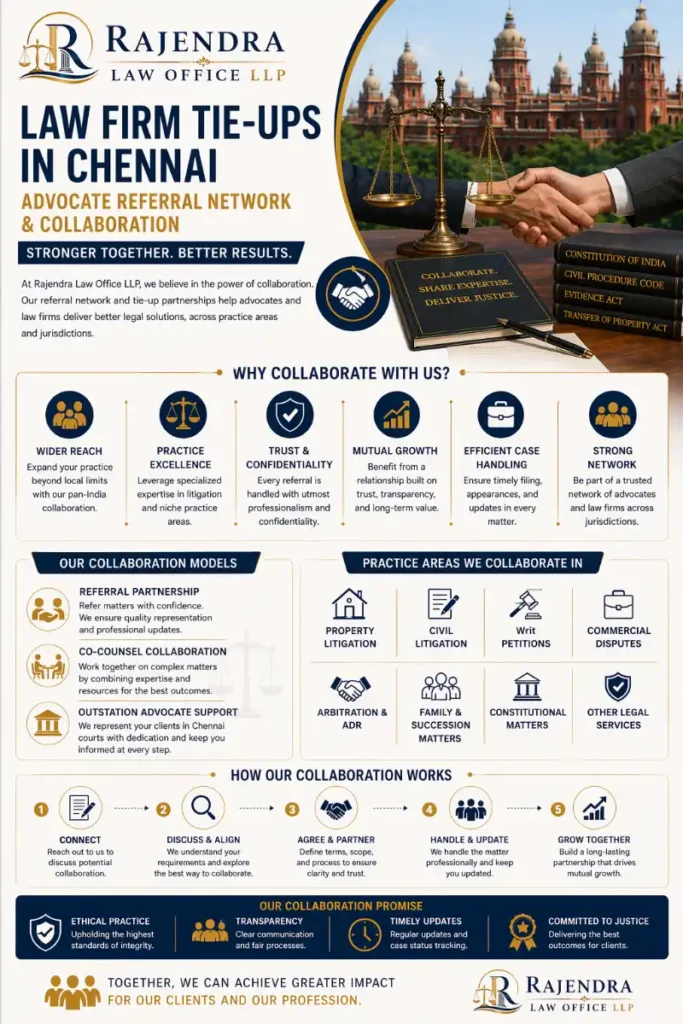
Vision for Legal Collaboration and Strategic Alliances
Rajendra Law Office LLP envisions comprehensive legal service networks serving diverse client needs across Chennai. Our law firm alliance Chennai philosophy recognizes that collaboration enhances individual capabilities and collective success. Moreover, the advocate referral system promotes professional cooperation within ethical and regulatory frameworks established by Bar Council. Furthermore, our legal professional network Chennai creates platforms for knowledge sharing, resource optimization, and practice development. Additionally, collaborative legal practice Chennai models demonstrate superior outcomes compared to isolated individual practices. The law firm cooperation Chennai initiatives include case referrals, joint representations, and complementary practice arrangements. Subsequently, strategic legal alliance Chennai creates win-win scenarios for advocates, law firms, and clients alike. Therefore, our collaboration vision transcends transactional referrals to build enduring professional relationships. Consequently, participating advocates benefit from expanded capabilities, enhanced reputations, and increased practice opportunities significantly.
Benefits of Legal Collaboration Network
Strategic collaboration delivers substantial benefits including expanded service offerings and enhanced client satisfaction. Law firm referral program participants access specialized expertise unavailable within individual practices. Moreover, professional legal network members share knowledge, best practices, and innovative approaches to legal challenges. Furthermore, inter-firm collaboration Chennai reduces practice risks through expertise complementarity and resource pooling. Additionally, advocate networking opportunities create business development channels and client acquisition pathways. The cross-referral network advocates generate reciprocal referrals expanding practice reach and revenue opportunities. Subsequently, collaborative legal services Chennai enable comprehensive solutions addressing complex multi-dimensional legal issues. Therefore, network participation enhances competitive positioning and market differentiation for member advocates. Consequently, benefits extend beyond immediate financial gains to long-term practice sustainability and professional growth.
Collaboration Models and Partnership Structures
Our legal practice collaboration encompasses diverse models accommodating varying partnership preferences and objectives. Strategic alliance law firms maintain independent practices while coordinating on specific matters or client relationships. Moreover, referral partnership advocates establish formal arrangements governing client referrals and fee arrangements. Furthermore, practice area collaboration connects specialists creating comprehensive service networks across legal domains. Additionally, geographic collaboration network extends practice reach beyond Chennai to other Tamil Nadu cities and states. The specialized practice tie-ups connect niche practitioners with complementary expertise creating full-service capabilities. Subsequently, complementary practice alliance pairs advocates whose practices naturally complement rather than compete. Therefore, flexible collaboration models accommodate diverse professional relationships and business objectives. Consequently, customized partnership structures ensure mutual benefit and sustainable long-term professional relationships.
Ethical Framework and Professional Standards
All collaboration arrangements strictly comply with Bar Council of Tamil Nadu and Bar Council of India regulations. Our ethical collaboration practices prioritize client interests above financial considerations or professional convenience. Moreover, professional integrity network ensures transparent disclosure of referral arrangements and fee structures to clients. Furthermore, conflict-free collaboration requires comprehensive conflict checking before accepting referred matters. Additionally, client consent collaboration mandates informed client approval for referral arrangements and fee sharing. The professional conduct compliance includes adherence to advertising restrictions and solicitation prohibitions. Subsequently, disclosure requirements ensure clients understand relationship between referring and receiving advocates. Therefore, ethical framework protects client interests while enabling legitimate professional cooperation. Consequently, ethical standards network creates trust foundation essential for successful long-term collaborations.
Practice Area Collaboration Opportunities
Rajendra Law Office LLP seeks collaboration across comprehensive practice areas serving diverse client needs. Our civil litigation referral network connects property dispute specialists, contract enforcement experts, and tort litigation practitioners. Meanwhile, criminal law collaboration Chennai includes defense counsel, prosecution specialists, and appellate advocates. Furthermore, corporate law firm tie-ups encompass business advisory, corporate governance, and commercial transaction specialists. Additionally, family law referral network connects matrimonial dispute experts with custody specialists and mediation practitioners. The intellectual property collaboration includes trademark attorneys, patent agents, and copyright litigation specialists. Subsequently, tax litigation referral system connects GST experts, income tax practitioners, and customs specialists. Therefore, comprehensive practice area coverage ensures clients receive specialized expertise regardless of matter complexity. Consequently, multi-practice collaboration creates full-service capabilities rivaling large metropolitan firms.
Civil Litigation Collaboration Network
Civil litigation partnerships span property disputes, contract enforcement, and tort claims across jurisdictions. Our network includes specialists in specific performance suits, partition proceedings, and easement disputes. Moreover, contract litigation experts handle breach claims, commercial disputes, and employment contract conflicts. Furthermore, tort litigation specialists address negligence claims, defamation suits, and professional liability matters. Additionally, real estate collaboration connects conveyancing specialists with litigation counsel for comprehensive property services. The civil procedure expertise under Code of Civil Procedure (CPC) ensures proper pleading and procedural compliance. Subsequently, appellate specialists handle civil appeals, revisions, and review petitions before High Court. Therefore, comprehensive civil litigation network addresses all dispute types and jurisdictional levels. Consequently, clients receive seamless service from trial through appellate proceedings across forums.
Criminal Law Referral System
Criminal defense collaboration includes trial lawyers, appellate specialists, and investigation stage counsel. Our network handles Bharatiya Nyaya Sanhita (BNS) offenses from minor violations to serious crimes. Moreover, BNSS procedure specialists ensure proper compliance with Bharatiya Nagarik Suraksha Sanhita provisions. Furthermore, white-collar crime specialists address economic offenses, fraud cases, and regulatory prosecutions. Additionally, cyber crime experts handle IT Act violations, digital fraud, and online offenses. The criminal appeals network includes High Court specialists and Supreme Court practitioners. Subsequently, bail application experts handle anticipatory bail, regular bail, and custody matters. Therefore, comprehensive criminal law coverage ensures effective defense across all offense types. Consequently, collaboration creates specialized expertise depth unavailable in individual practices.
Constitutional and Writ Practice Collaboration
Constitutional law collaboration connects writ specialists, public interest litigation experts, and administrative law practitioners. Our network handles Article 226 and 227 petitions before Madras High Court extensively. Moreover, fundamental rights litigation includes habeas corpus, mandamus, certiorari, and prohibition writs. Furthermore, public interest litigation specialists address environmental protection, consumer rights, and government accountability. Additionally, service law experts handle wrongful termination, promotion disputes, and pension matters. The administrative law specialists challenge government orders, regulatory actions, and policy decisions. Subsequently, Supreme Court specialists handle appeals from High Court constitutional bench decisions. Therefore, constitutional practice network provides comprehensive public law capabilities. Consequently, collaboration ensures access to specialized constitutional expertise for complex matters.
Commercial and Corporate Law Tie-Ups
Commercial litigation collaboration includes banking disputes, corporate conflicts, and shareholder litigation specialists. Our network addresses breach of contract claims, partnership disputes, and franchise conflicts. Moreover, banking law specialists handle loan recovery, SARFAESI proceedings, and Debt Recovery Tribunal matters. Furthermore, corporate governance experts address Companies Act compliance, NCLT proceedings, and regulatory matters. Additionally, arbitration specialists provide domestic and international commercial arbitration expertise. The securities litigation experts handle SEBI matters, insider trading, and market manipulation cases. Subsequently, insolvency practitioners address Insolvency and Bankruptcy Code proceedings and creditor rights. Therefore, comprehensive commercial law network serves business clients’ diverse legal needs. Consequently, integrated commercial services compete effectively with metropolitan full-service firms.
Specialized Practice Referral Networks
Specialized networks connect niche practitioners in emerging and technical practice areas. Tax litigation specialists include GST experts before GST Appellate Authority and tribunals. Moreover, intellectual property specialists handle trademark, patent, and copyright matters before specialized forums. Furthermore, environmental law experts address pollution control, National Green Tribunal, and environmental clearance matters. Additionally, labor law specialists handle industrial disputes, wrongful termination, and wage claims. The immigration law practitioners assist with visa matters, citizenship issues, and immigration appeals. Subsequently, cyber law specialists address data protection, privacy violations, and technology disputes. Therefore, specialized referral networks provide access to cutting-edge expertise in technical areas. Consequently, clients benefit from specialized knowledge typically available only through metropolitan specialists.
| Practice Area | Collaboration Type | Primary Forums | Referral Benefits |
|---|---|---|---|
| Civil Litigation | Case referral, Joint representation | District Courts, High Court | Specialized expertise, Resource sharing |
| Criminal Defense | Trial and appellate collaboration | Magistrate Courts, Sessions Court, High Court | Stage-specific expertise, Bail specialists |
| Corporate Law | Transactional and litigation tie-ups | NCLT, High Court, Arbitration | Comprehensive business solutions |
| Tax Practice | Multi-jurisdictional collaboration | ITAT, GST Tribunal, High Court | Specialized tax expertise |
| Constitutional Law | Strategic litigation partnerships | High Court, Supreme Court | Constitutional expertise, PIL capabilities |
Geographic and Jurisdictional Collaboration
Geographic collaboration extends practice capabilities beyond Chennai to other Tamil Nadu cities and states. Our multi-city law firm tie-ups enable seamless client service across regional locations. Moreover, interstate referral network connects advocates practicing in different states and High Court jurisdictions. Furthermore, regional legal collaboration serves clients with matters spanning multiple districts or states. Additionally, pan-India legal alliance provides national coverage for clients with multi-jurisdictional needs. The metropolitan legal network connects urban practitioners with specialized capabilities and resources. Subsequently, multi-jurisdictional collaboration addresses cross-border disputes and forum shopping opportunities. Therefore, geographic networks eliminate jurisdictional limitations of individual practitioners. Consequently, clients receive consistent service quality regardless of matter location or forum.
Chennai Legal Community Network
Chennai-based collaboration connects advocates practicing before Madras High Court and subordinate courts. Network members include specialists in original side, appellate side, and writ jurisdiction matters. Moreover, District Court specialists handle trial matters in Principal District Court and subordinate courts. Furthermore, Sessions Court practitioners address serious criminal trials and criminal appeals. Additionally, specialized tribunal practitioners handle NCLT, DRT, Consumer Forums, and administrative tribunals. The family court specialists address matrimonial disputes, custody matters, and domestic violence cases. Subsequently, revenue court practitioners handle land disputes, patta issues, and agricultural matters. Therefore, comprehensive Chennai network covers all courts, tribunals, and specialized forums. Consequently, local collaboration provides immediate response capabilities and court-specific expertise.
Referral Mechanisms and Communication Protocols
Structured referral mechanisms ensure smooth client transitions and effective matter handling. Our client referral system advocates begins with conflict checking and expertise assessment. Moreover, case referral mechanism includes detailed matter briefing and file documentation transfer. Furthermore, matter referral network protocols specify communication frequency and status reporting requirements. Additionally, lead sharing system lawyers operates transparently with clear attribution and acknowledgment. The client introduction network maintains relationship continuity while transferring primary responsibility. Subsequently, cross-referral arrangement ensures reciprocity and mutual benefit among network participants. Therefore, systematic protocols prevent misunderstandings and ensure professional service delivery. Consequently, structured processes create client confidence and professional accountability.
Communication and Coordination Protocols
Effective collaboration requires clear communication protocols and regular coordination among participants. Collaboration communication protocol specifies primary contacts, response timelines, and escalation procedures. Moreover, referral communication system ensures clients understand representation structure and fee arrangements. Furthermore, client handover process includes comprehensive briefing, document transfer, and relationship introduction. Additionally, information sharing network balances confidentiality requirements with effective collaboration needs. The coordinated communication ensures clients receive consistent messaging from all participating advocates. Subsequently, client update mechanism provides regular status reports and progress communications. Therefore, communication excellence enhances client satisfaction and collaboration effectiveness. Consequently, professional protocols prevent miscommunication and service delivery failures.
Financial Arrangements and Fee Structures
Transparent financial arrangements ensure fairness and comply with professional conduct regulations. Our referral fee structure adheres strictly to Bar Council guidelines on fee sharing. Moreover, revenue sharing agreement specifies percentages, payment terms, and billing responsibilities clearly. Furthermore, commission arrangement advocates operates within ethical boundaries ensuring client interest protection. Additionally, fee splitting arrangement requires full client disclosure and informed consent. The profit sharing collaboration allocates revenues based on contribution, effort, and expertise. Subsequently, cost sharing partnership distributes expenses proportionately among participating advocates. Therefore, clear financial terms prevent disputes and ensure sustainable collaboration. Consequently, ethical fee arrangements protect client interests while enabling legitimate professional cooperation.
Referral Compensation Models
Referral compensation varies based on matter complexity, effort division, and ongoing involvement. Commission-based referral provides one-time payment for pure client introduction without ongoing involvement. Moreover, revenue sharing involves percentage allocation for matters requiring coordinated effort. Furthermore, fee splitting divides professional fees based on work contribution and client responsibility. Additionally, retainer arrangements provide ongoing compensation for continued consultation and support. The contingency sharing applies to success-fee matters with proportionate risk and reward allocation. Subsequently, hybrid models combine elements addressing specific matter characteristics and collaboration needs. Therefore, flexible compensation accommodates diverse collaboration scenarios and contribution levels. Consequently, fair compensation ensures sustainable referral relationships and network vitality.
Quality Standards and Service Excellence
Network participation requires commitment to service quality standards and professional excellence. Quality standards collaboration establishes minimum competency requirements and service delivery expectations. Moreover, professional excellence network emphasizes continuous improvement and client satisfaction focus. Furthermore, service quality assurance includes regular feedback, performance monitoring, and corrective actions. Additionally, best practices sharing disseminates effective approaches and innovative solutions across network. The standard operating procedures ensure consistency in client communication, case handling, and documentation. Subsequently, quality control collaboration monitors adherence to standards and addresses performance deficiencies. Therefore, quality emphasis protects network reputation and ensures client satisfaction. Consequently, excellence standards differentiate network from informal referral arrangements.
Performance Monitoring and Feedback
Regular performance evaluation ensures network maintains high standards and client satisfaction. Service quality monitoring tracks client feedback, matter outcomes, and professional conduct. Moreover, performance evaluation network assesses individual contributions and identifies improvement opportunities. Furthermore, client satisfaction tracking measures service experience and identifies systemic issues. Additionally, quality metrics collaboration establishes benchmarks and performance indicators for assessment. The service standard compliance verification ensures adherence to established protocols and procedures. Subsequently, performance benchmarking compares network participants identifying best practices and excellence examples. Therefore, continuous monitoring drives improvement and maintains competitive excellence. Consequently, accountability mechanisms ensure sustained quality and client satisfaction.
Technology and Digital Collaboration Tools
Modern collaboration leverages technology platforms enhancing efficiency and communication effectiveness. Legal referral platform Chennai provides digital infrastructure for network coordination and case management. Moreover, online advocate network enables virtual collaboration transcending geographic limitations. Furthermore, digital collaboration tools facilitate document sharing, video conferencing, and project management. Additionally, legal network technology includes case management systems, client portals, and communication platforms. The referral management system tracks referrals, monitors status, and manages financial arrangements. Subsequently, cloud-based legal collaboration enables secure access to shared resources and information. Therefore, technology investment enhances network efficiency and competitive capabilities. Consequently, digital tools enable sophisticated collaboration rivaling large firm capabilities.
Resource Sharing and Infrastructure Collaboration
Collaborative resource sharing optimizes utilization and reduces individual practice costs. Library resource sharing provides access to legal references, journals, and research materials. Moreover, research database collaboration pools subscriptions to premium legal databases and resources. Furthermore, technology resource sharing includes case management software and legal research platforms. Additionally, infrastructure collaboration may include office space sharing and equipment utilization. The support staff sharing optimizes paralegal and administrative resource deployment. Subsequently, knowledge resource network creates institutional memory and collective expertise repository. Therefore, resource optimization enhances capabilities while controlling practice costs. Consequently, shared resources create economies of scale typically available only to larger firms.
Joining the Referral Network
Rajendra Law Office LLP welcomes qualified advocates and law firms to join our collaboration network. Network participation requires demonstrated professional competence, ethical practice, and client service commitment. Moreover, applicants must possess valid Bar Council enrollment and good professional standing. Furthermore, minimum experience requirements ensure network participants possess requisite expertise and maturity. Additionally, practice area alignment or geographic complementarity enhances network value proposition. The application process includes credential verification, professional reference checks, and compatibility assessment. Subsequently, network participation agreement formalizes relationship terms, responsibilities, and expectations. Therefore, selective admission maintains network quality and protects participant interests. Consequently, rigorous standards ensure network members meet high professional and ethical benchmarks.
Eligibility Criteria and Requirements
Network membership requires advocates with minimum 5 years post-qualification practice experience. Candidates must demonstrate expertise in specific practice areas or jurisdictional knowledge. Moreover, established practice with existing client base indicates professional sustainability and credibility. Furthermore, professional reputation among judiciary, Bar, and clients validates competence and integrity. Additionally, malpractice-free record and ethical practice history ensure network quality maintenance. The financial stability indicates capacity for professional practice and client service obligations. Subsequently, technology proficiency enables effective participation in digital collaboration platforms. Therefore, comprehensive eligibility criteria ensure network quality and client service excellence. Consequently, selective membership protects network reputation and participant interests.
- Minimum 5 years post-qualification practice experience
- Valid Bar Council enrollment and practicing certificate
- Demonstrated expertise in specific practice areas
- Established professional reputation and client base
- Ethical practice record without disciplinary actions
- Professional liability insurance coverage
- Technology proficiency for digital collaboration
- Commitment to quality standards and protocols
- Financial stability and professional infrastructure
- Client references and professional recommendations
Application Process and Evaluation
Network application begins with submission of comprehensive professional profile and credentials. Application package includes curriculum vitae, practice overview, and professional references. Moreover, practice area description details expertise, experience, and representative matters handled. Furthermore, client references validate service quality and professional conduct. Additionally, Bar Council certificates verify enrollment status and disciplinary history. The evaluation process assesses technical competence, ethical standards, and network compatibility. Subsequently, interview discussions explore collaboration vision, expectations, and mutual benefit opportunities. Therefore, thorough evaluation ensures successful network relationships and sustainable partnerships. Consequently, careful selection prevents future conflicts and partnership failures.
Network Participation Agreement
Formal participation agreement establishes relationship framework, responsibilities, and expectations clearly. Agreement specifies referral protocols, communication requirements, and quality standards. Moreover, financial arrangements including referral fees and expense sharing are documented transparently. Furthermore, confidentiality provisions protect client information and proprietary network knowledge. Additionally, term and termination clauses address relationship duration and exit procedures. The dispute resolution mechanism provides processes for addressing conflicts among network participants. Subsequently, amendment procedures allow agreement evolution addressing changing circumstances and needs. Therefore, comprehensive documentation prevents misunderstandings and provides dispute resolution framework. Consequently, formal agreements create professional accountability and sustainable relationships.
Ongoing Network Engagement and Development
Active network participation requires ongoing engagement beyond referral transactions. Regular networking events facilitate relationship building and professional development. Moreover, continuing legal education programs provide knowledge sharing and skill enhancement. Furthermore, practice group meetings enable specialized knowledge exchange and collaboration planning. Additionally, business development initiatives support collective marketing and client acquisition efforts. The mentorship programs connect experienced practitioners with emerging advocates. Subsequently, pro bono collaborations address community legal needs and enhance network reputation. Therefore, comprehensive engagement creates value beyond immediate referral benefits. Consequently, active participation strengthens relationships and maximizes network benefits.
Professional Development and Knowledge Sharing
Network provides platforms for continuous professional development and expertise enhancement. Joint training programs address emerging legal issues and procedural updates. Moreover, collaborative learning includes case study discussions and best practice sharing. Furthermore, skill development workshops enhance advocacy, negotiation, and client service capabilities. Additionally, knowledge workshops cover substantive law developments and practice management innovations. The continuing education partnership fulfills Bar Council CLE requirements through quality programs. Subsequently, capacity building collaboration develops specialized expertise across network participants. Therefore, professional development investment benefits individual practitioners and collective network capabilities. Consequently, learning culture distinguishes network from transactional referral arrangements.
Success Stories and Network Impact
Network collaboration has delivered exceptional outcomes for clients and participating advocates. Complex multi-jurisdictional matters received comprehensive solutions through coordinated network expertise. Moreover, specialized technical matters benefited from niche expertise typically unavailable to individual practitioners. Furthermore, client service excellence improved through resource pooling and knowledge sharing. Additionally, participating advocates expanded practice capabilities and market reach substantially. The revenue enhancement resulted from referral generation and practice expansion opportunities. Subsequently, professional satisfaction increased through collaborative relationships and shared success. Therefore, documented success demonstrates network value and competitive advantages. Consequently, proven track record attracts quality participants and sophisticated clients.
Contact Information and Network Inquiry
Advocates interested in network participation should contact Rajendra Law Office LLP directly. Reach Adv. Saravvanan R at +91-9994287060 for preliminary discussions regarding collaboration opportunities. Moreover, email inquiries to sarav@lawyerchennai.com receive prompt response with network information. Furthermore, formal applications may be submitted to rajendralawoffice@gmail.com with required documentation. Additionally, personal meetings can be arranged at West Mogappair or George Town office locations. The office telephone numbers 044-26533389 and 044-47660443 connect to network coordinators. Subsequently, network information available at www.rajendralawoffice.com websites. Therefore, multiple contact channels ensure convenient inquiry initiation and information access. Consequently, accessible communication demonstrates openness to collaboration with qualified professionals.
Office Locations and Meeting Facilities
Rajendra Law Office LLP operates from strategic Chennai locations facilitating network coordination. West Mogappair office at 8/13, 1st Floor, Bharathi Salai, West Mogappair, Chennai – 600037. Moreover, George Town office at 323/156, Andhra Insurance Building, 2nd Floor, George Town, Chennai – 600001. Furthermore, conference facilities accommodate network meetings, training programs, and collaborative discussions. Additionally, proximity to Madras High Court and District Courts enables convenient court-related coordination. The professional environments demonstrate network quality standards and client service commitment. Subsequently, meeting facilities support effective collaboration and professional relationship development. Therefore, quality infrastructure reflects network professionalism and participant expectations. Consequently, accessible locations facilitate regular interaction and relationship strengthening.
Frequently Asked Questions – Law Firm Tie-Ups | Advocate Referral Network & Collaboration
Minimum 5 years practice experience, valid Bar Council enrollment, established practice, proven expertise, ethical record, and professional references required. Application process includes credential verification and compatibility assessment.
Referral compensation varies by matter type and involvement level. All arrangements comply with Bar Council guidelines and require full client disclosure. Specific terms negotiated based on collaboration type and contribution.
Comprehensive coverage including civil litigation, criminal defense, corporate law, family law, intellectual property, tax practice, constitutional law, arbitration, and specialized practices across all courts and tribunals.
Rigorous admission criteria, ongoing performance monitoring, client feedback tracking, quality metrics, service standards compliance, and regular professional development programs ensure excellence. Non-performing participants may be removed from network.
Yes, geographic diversity strengthens network capabilities. Interstate and inter-city collaborations welcome. Network includes advocates across Tamil Nadu and other states enabling multi-jurisdictional matter handling and client service.
Professional development programs, technology platforms, resource sharing, marketing support, practice management assistance, continuing education, networking events, and business development opportunities provided to active network participants regularly.
Read More
- Hiring Junior Advocate in Chennai – Court Practice & Drafting Experience
- Litigation Associate Jobs in Chennai | Senior Associate Hiring
- Senior Advocates for Government Service Matters: How to Find the Best Law Firm? 💬
- Navigating Peace: Unveiling the Power of Arbitration Service in Chennai 🏛️
- Communication between Civil Lawyer and Client: Importance and Impact 👩⚖️
Join Rajendra Law Office LLP’s advocate referral network and unlock strategic collaboration opportunities expanding your practice capabilities and client service excellence in Chennai’s competitive legal market.