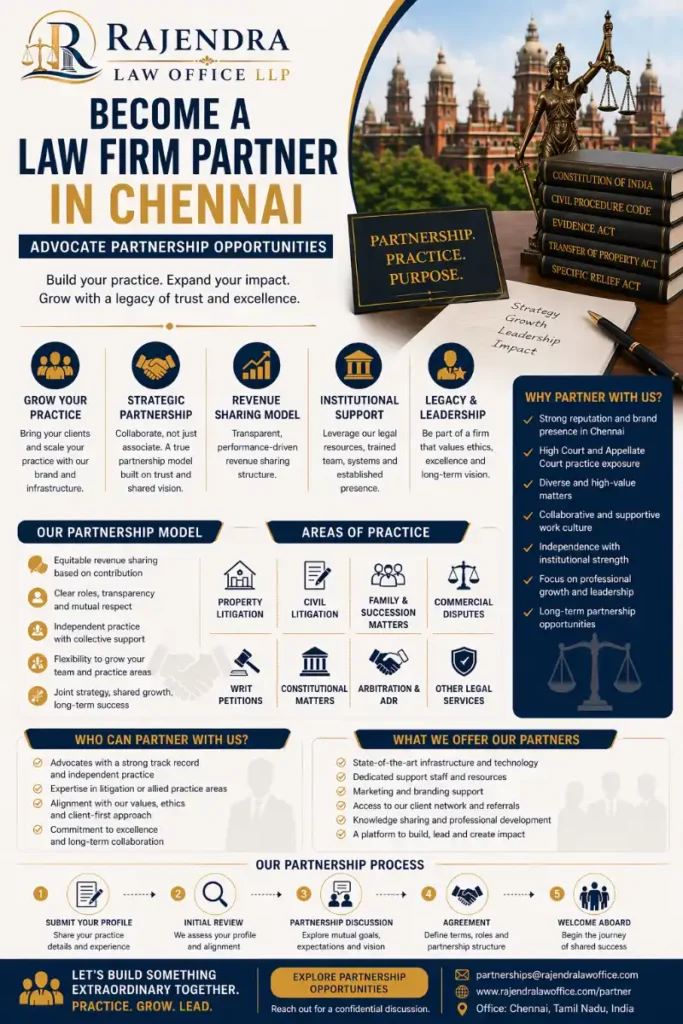
Rajendra Law Office LLP invites exceptional senior advocates to explore equity partner opportunities in Chennai’s premier litigation practice. Our law firm partner Chennai positions offer distinguished professionals the opportunity to join established legal excellence. Moreover, we seek accomplished advocates with proven track records in litigation and substantial client relationships. The advocate partnership opportunities Chennai provide equity ownership, profit participation, and practice leadership roles. Furthermore, our legal partnership Chennai model emphasizes collaborative governance, shared decision-making, and collective success. Additionally, partnership at Rajendra Law Office LLP combines professional autonomy with institutional support and resources. Consequently, becoming a law firm partner here represents career culmination and professional achievement recognition. Therefore, explore this transformative opportunity to join our distinguished partnership alongside Adv. Saravvanan R. Our commitment to excellence ensures partners enjoy rewarding practice and financial prosperity.
Become a Law Firm Partner in Chennai | Advocate Partnership Opportunities at Rajendra Law Office LLP
Partnership Vision and Strategic Direction
Rajendra Law Office LLP’s partnership model emphasizes quality legal services, client satisfaction, and sustainable practice growth. Our equity partner lawyer Chennai positions contribute to strategic planning and institutional development initiatives. Subsequently, partners participate in governance committees shaping firm direction and practice evolution. The law firm partnership Chennai structure balances individual autonomy with collective responsibility and shared success. Meanwhile, our collaborative culture values diverse perspectives and encourages innovative approaches to legal practice. Furthermore, partnership track advocate Chennai progression recognizes excellence in litigation, client service, and firm building. Additionally, equity partners share in firm profitability reflecting collective success and individual contributions. Therefore, our partnership vision attracts distinguished advocates seeking meaningful professional homes and leadership opportunities. Moreover, partners enjoy the prestige of association with Chennai’s leading litigation practice.
Partnership Structure and Governance Model
Our law firm equity partner structure includes both equity and non-equity partnership tiers. Equity partners hold ownership interests and participate in firm governance and profit distribution. Moreover, income partner lawyer Chennai positions provide enhanced compensation without equity ownership requirements. Furthermore, the two-tier partnership structure accommodates diverse career aspirations and contribution models. Additionally, managing partner law firm Chennai role rotates among senior equity partners ensuring distributed leadership. The partnership governance structure includes executive committee, practice group leaders, and administrative committees. Subsequently, all equity partners participate in major decisions through democratic voting procedures. Therefore, transparent governance ensures fairness, accountability, and collective ownership of strategic direction. Consequently, collaborative decision-making balances individual interests with institutional priorities effectively.
Distinguished Practice Platform
Partnership opportunities span diverse practice areas including civil, criminal, and commercial litigation. Our litigation partner Chennai positions handle sophisticated matters before Madras High Court and Supreme Court. Moreover, partners lead specialized practice groups in constitutional law, arbitration, and regulatory practice. Furthermore, corporate law partner Chennai opportunities include business advisory and transactional support services. Additionally, specialized partnerships exist in tax litigation, intellectual property, and banking law practice. The practice platform provides institutional support including research, technology, and administrative resources. Subsequently, partners benefit from collaborative expertise sharing and cross-practice referrals enhancing client service. Therefore, comprehensive practice infrastructure enables partners to focus on legal excellence and client relationships. Consequently, partners access sophisticated resources typically available only in larger metropolitan firms.
Client Relationships and Business Development
Partners maintain existing client relationships while accessing institutional client base and referral network. Our rainmaker partner Chennai opportunities reward business development success through enhanced profit participation. Moreover, client origination partner roles include primary responsibility for major client relationships and strategic accounts. Furthermore, partnership supports business development through marketing, branding, and client development initiatives. Additionally, partners collaborate on client pitches, proposals, and relationship management for institutional clients. The established practice partner brings portable book of business contributing to immediate revenue generation. Subsequently, firm’s reputation and market position facilitate client acquisition and relationship expansion for partners. Therefore, partnership platform amplifies individual business development capabilities through institutional credibility and resources. Consequently, partners achieve practice growth exceeding solo or small firm possibilities.
Partnership Eligibility and Qualification Criteria
Equity partnership requires senior advocates with minimum 10-15 years post-qualification litigation experience. Candidates must demonstrate exceptional legal skills, professional reputation, and ethical practice standards. Moreover, proven track record partnership demands consistent success in complex litigation and client satisfaction. Furthermore, senior advocate partnership requires substantial independent practice experience and established professional standing. Additionally, Bar Council enrollment, valid practicing certificate, and excellent professional standing are mandatory. The accomplished lawyer partnership criteria include technical excellence, business acumen, and leadership capabilities. Subsequently, candidates should possess portable client relationships or demonstrated business development capabilities. Therefore, partnership admission represents recognition of distinguished professional achievement and future contribution potential. Consequently, rigorous qualification standards ensure partnership quality and institutional reputation preservation.
Professional Experience Requirements
Partnership candidates need 10+ years experience partnership in reputable litigation practices. Senior Bar member partnership requires demonstrated expertise across multiple practice areas and jurisdictions. Moreover, extensive Madras High Court practice including regular appearances and significant matter handling. Furthermore, Supreme Court experience preferred though not mandatory for initial partnership consideration. Additionally, tribunal and specialized forum experience enhances candidacy for specialized practice partnerships. The specialist advocate partner demonstrates deep expertise in specific practice areas commanding premium billing. Subsequently, generalist partners possess broad litigation capabilities across civil and criminal matters. Therefore, experience requirements ensure partners contribute immediately to practice excellence and client service. Consequently, substantial experience foundation enables effective mentorship of junior associates and practice leadership.
Practice Expertise and Specialization
Civil litigation partner positions require expertise in property disputes, contract enforcement, and commercial litigation. Criminal litigation partner candidates demonstrate proficiency in BNS offenses and BNSS procedures. Moreover, constitutional law partner expertise includes writ practice and public interest litigation capabilities. Furthermore, commercial litigation partner Chennai specialization encompasses banking disputes and corporate conflicts. Additionally, arbitration partner Chennai candidates possess domestic and international arbitration experience. The tax practice partner Chennai requires GST, income tax, and customs litigation expertise. Subsequently, intellectual property partner needs trademark, patent, and copyright litigation capabilities. Therefore, practice specialization creates competitive advantages while broad capabilities ensure practice flexibility. Consequently, specialized expertise commands premium client fees and enhanced partnership profit participation.
Client Relationship Portfolio
Partnership candidates should possess established client relationships demonstrating business development capabilities. Portable book partner brings revenue-generating client base ensuring immediate partnership contribution. Moreover, significant client portfolio indicates professional reputation and client satisfaction track record. Furthermore, institutional client relationships provide stable revenue base and practice sustainability. Additionally, diverse client portfolio across sectors reduces concentration risk and ensures practice resilience. The client relationship management partner maintains high satisfaction levels and long-term loyalty. Subsequently, cross-selling capabilities enable expansion of services to existing clients across practice areas. Therefore, strong client relationships justify partnership investment and ensure mutually beneficial partnership arrangement. Consequently, business generation partner contributes to firm growth beyond individual practice revenue.
Professional Reputation and Standing
Partnership requires distinguished professional reputation among judiciary, Bar, and legal community. Candidates should command respect for legal expertise, ethical practice, and professional conduct. Moreover, recognition through awards, appointments, or professional leadership positions enhances partnership candidacy. Furthermore, publications, speaking engagements, and thought leadership demonstrate expertise and market visibility. Additionally, Bar Association involvement and professional service contributions indicate commitment to legal profession. The reputed law firm partnership seeks advocates whose association enhances institutional reputation and market position. Subsequently, professional standing facilitates business development and elevates firm’s competitive positioning. Therefore, reputation assessment constitutes critical partnership evaluation criterion beyond technical capabilities. Consequently, ethical reputation and professional integrity represent non-negotiable partnership requirements.
- 10-15 years post-qualification litigation experience minimum
- Established practice with portable client relationships
- Proven expertise in specific practice areas
- Extensive High Court and trial court experience
- Distinguished professional reputation and standing
- Business development capabilities and track record
- Leadership potential and mentoring abilities
- Ethical practice standards and professional conduct
- Bar Council enrollment and valid practicing certificate
- Financial capacity for capital contribution requirements
Partnership Admission Process
Partnership admission criteria include comprehensive evaluation of professional qualifications and personal attributes. The partner selection process begins with confidential expression of interest and preliminary discussions. Moreover, formal partnership application procedure requires detailed documentation of experience and qualifications. Furthermore, partnership evaluation metrics assess technical skills, business development, and cultural fit comprehensively. Additionally, partner interview process involves meetings with current partners and practice group leaders. The partnership voting procedure requires supermajority approval from existing equity partners. Subsequently, partnership probation period allows mutual assessment before permanent partnership confirmation. Therefore, thorough admission process ensures successful candidate-firm alignment and long-term partnership satisfaction. Consequently, transparent process reduces partnership admission failures and subsequent dissolution issues.
Due Diligence and Background Verification
Partnership candidacy involves thorough professional and personal background verification processes. Current partners conduct confidential reference checks with judges, senior advocates, and professional contacts. Moreover, verification includes Bar Council records review, disciplinary history checks, and litigation database searches. Furthermore, financial background assessment ensures capacity for required capital contributions and financial stability. Additionally, conflict of interest analysis identifies potential client conflicts requiring resolution before admission. The professional liability review examines malpractice history and outstanding claims or complaints. Subsequently, criminal background verification ensures no disqualifying criminal history or ongoing proceedings. Therefore, comprehensive due diligence protects partnership integrity and identifies potential issues proactively. Consequently, thorough vetting process minimizes partnership risks and ensures high admission standards.
Partnership Track for Internal Candidates
Associate to partner track provides pathway for exceptional senior associates achieving partnership eligibility. Our partnership track timeline typically spans 8-12 years from associate entry to partnership consideration. Moreover, senior associate to partner progression requires consistent excellence across multiple evaluation criteria. Furthermore, counsel to partner progression accommodates non-traditional pathways including lateral counsel admissions. Additionally, partnership eligibility advocates receive mentorship and development support preparing for partnership responsibilities. The partnership consideration process includes annual performance reviews and partnership readiness assessments. Subsequently, partnership nomination procedure involves sponsor partner advocacy and comprehensive partnership review. Therefore, internal partnership track provides clear progression pathway motivating associate excellence and retention. Consequently, promoting from within strengthens institutional culture and ensures cultural continuity.
Lateral Partner Recruitment
Lateral partner hiring Chennai targets accomplished advocates seeking enhanced platform and partnership opportunities. Our lateral equity partner recruitment focuses on practice area needs and strategic growth objectives. Moreover, experienced partner hiring emphasizes cultural fit alongside technical qualifications and business development capabilities. Furthermore, lateral partner integration includes comprehensive onboarding and institutional knowledge transfer processes. Additionally, partner-level lateral hiring typically involves negotiated terms reflecting candidate’s experience and portable business. The established partner recruitment seeks proven performers with substantial practices and client relationships. Subsequently, lateral partnerships accelerate practice development in targeted areas or geographic markets. Therefore, strategic lateral hiring complements internal development creating balanced partnership composition. Consequently, lateral partners inject fresh perspectives and expand firm capabilities and market reach.
| Partnership Type | Ownership Rights | Profit Participation | Capital Requirement |
|---|---|---|---|
| Equity Partner | Full ownership interest and voting rights | Full profit sharing based on formula | Capital contribution required |
| Income Partner | No ownership; fixed compensation | Enhanced salary; limited bonus participation | No capital contribution |
| Non-Equity Partner | Title without ownership rights | Performance-based bonus structure | Minimal or no capital requirement |
| Managing Partner | Enhanced ownership and governance role | Additional compensation for management | Standard equity partner contribution |
Partnership Compensation and Financial Structure
Law firm partner compensation Chennai combines competitive base earnings with substantial profit participation. Our equity partner profit sharing model allocates profits based on objective formula considering multiple factors. Moreover, partnership buyout price for incoming partners reflects firm valuation and equity allocation methodology. Furthermore, partner capital contribution requirements ensure financial commitment and ownership alignment with firm success. Additionally, law firm partner salary structure includes partner draw against anticipated annual profit distributions. The equity partner earnings Chennai exceed market rates for comparable experience and practice specialization. Subsequently, partnership income distribution occurs quarterly based on firm profitability and individual partner allocations. Therefore, transparent compensation framework ensures fairness and aligns partner incentives with firm performance. Consequently, competitive compensation attracts and retains exceptional legal talent in competitive Chennai market.
Profit Allocation Methodology
Partnership profit allocation balances objective metrics with qualitative contributions to firm success. Our modified lockstep partner pay provides stability while rewarding exceptional performance and business development. Moreover, partnership compensation formula considers origination, billing, collections, and qualitative contributions. Furthermore, lockstep compensation partners receive allocations based primarily on seniority and experience. Additionally, eat-what-you-kill partnership rewards individual business generation though not exclusively practiced. The partner bonus structure supplements base allocation for exceptional performance or significant accomplishments. Subsequently, profit sharing considers practice group profitability, cross-selling, and collaborative contributions. Therefore, balanced compensation approach motivates both individual excellence and collaborative firm building. Consequently, compensation methodology evolves addressing partnership feedback and competitive market dynamics.
Capital Requirements and Financial Obligations
Equity partnership requires capital contribution proportionate to ownership percentage and firm valuation. Initial capital contributions fund working capital, infrastructure investments, and partnership buyout obligations. Moreover, ongoing capital requirements may arise for practice expansion or strategic investments. Furthermore, partners guarantee firm obligations including office leases and professional liability insurance. Additionally, capital accounts accumulate retained earnings and reflect individual partner equity interests. The partnership financial commitment extends beyond capital to include personal financial stability requirements. Subsequently, capital withdrawal restrictions ensure firm financial stability and long-term sustainability. Therefore, financial obligations require careful planning and adequate personal financial resources. Consequently, capital requirements ensure partner financial alignment with firm success and sustainability.
Retirement Benefits and Exit Provisions
Partnership retirement plan provides financial security and succession planning for senior partners. Retiring partners receive capital account repayment over specified period following retirement. Moreover, partnership pension scheme may provide ongoing payments for qualifying retired partners. Furthermore, partner retirement benefits include continued health insurance and professional liability tail coverage. Additionally, emeritus partner status recognizes distinguished service while phasing out active practice responsibilities. The partnership exit strategy addresses voluntary retirement, disability, and involuntary termination scenarios. Subsequently, partner buyout provisions establish valuation methodology and payment terms for departing partners. Therefore, comprehensive exit provisions ensure fairness and financial security for retiring partners. Consequently, retirement planning enables graceful transitions preserving institutional knowledge and client relationships.
Non-Financial Partnership Benefits
Partnership value proposition extends beyond compensation to professional fulfillment and practice quality. Partners enjoy professional autonomy in case selection, strategy formulation, and client relationship management. Moreover, institutional resources including research support, technology, and administrative staff enhance practice efficiency. Furthermore, collaborative partnership culture provides intellectual stimulation through peer consultation and knowledge sharing. Additionally, professional development opportunities including CLE programs and conference attendance continue throughout partnership. The work-life balance partnership accommodates personal priorities through flexible arrangements and shared responsibility. Subsequently, partnership prestige enhances professional reputation and market positioning among clients and peers. Therefore, comprehensive benefits package addresses financial, professional, and personal dimensions of career satisfaction. Consequently, holistic partnership value attracts accomplished advocates seeking meaningful professional homes.
Practice Infrastructure and Support
Partners access comprehensive practice infrastructure including modern offices at strategic Chennai locations. West Mogappair and George Town offices provide professional environments proximate to courts and clients. Moreover, advanced legal research databases including SCC Online, Manupatra facilitate efficient research. Furthermore, case management software streamlines matter tracking, billing, and client communication. Additionally, dedicated administrative support handles filing, documentation, and routine correspondence. The technology infrastructure includes secure email, document management, and video conferencing capabilities. Subsequently, marketing and business development support includes website, branding, and client communication materials. Therefore, institutional infrastructure enables partners to focus on legal work and client relationships. Consequently, practice support enhances efficiency and enables higher-value legal work focus.
Professional Development and Growth
Partnership continuing education includes CLE programs, specialized training, and certification support. Partners attend national and international conferences maintaining contemporary practice knowledge. Moreover, practice group meetings facilitate knowledge sharing regarding substantive developments and procedural updates. Furthermore, mentorship opportunities enable partners to develop next generation of legal talent. Additionally, thought leadership support includes article publication, speaking engagement coordination, and media opportunities. The professional network access includes Bar associations, specialty organizations, and client industry groups. Subsequently, leadership development opportunities exist through firm governance, Bar association, and community involvement. Therefore, continuous professional growth ensures partners maintain competitive capabilities throughout careers. Consequently, professional development investment benefits partners, clients, and firm collectively.
Partnership Responsibilities and Obligations
Partner fiduciary duties include loyalty, care, and good faith toward partnership and fellow partners. Equity partners owe obligations to maximize firm value and protect institutional interests. Moreover, partnership obligations advocates include client service excellence and professional conduct maintenance. Furthermore, partner capital requirements ensure adequate working capital and financial stability. Additionally, partnership financial commitment includes personal guarantees for certain firm obligations. The partner liability law firm includes potential exposure for partnership debts and professional negligence. Subsequently, partnership confidentiality obligations protect client information and proprietary firm knowledge. Therefore, partnership responsibilities extend beyond individual practice to collective institutional success. Consequently, fiduciary obligations create mutual accountability among partners ensuring collaborative success.
Time Commitment and Billing Expectations
Partners maintain substantial billable hours demonstrating productivity and client service commitment. Annual billing targets reflect practice area, seniority, and business development responsibilities. Moreover, non-billable contributions including mentoring, administration, and firm building receive recognition. Furthermore, client development time receives appropriate credit within compensation formula. Additionally, pro bono service and professional association involvement enhance firm reputation and community standing. The utilization rate partners measures productive time allocation and practice efficiency. Subsequently, realization rate partnership reflects billing collectability and client satisfaction levels. Therefore, balanced expectations recognize diverse contributions to firm success beyond billable hours. Consequently, performance metrics evolve reflecting changing practice realities and competitive dynamics.
Partnership Culture and Values
Rajendra Law Office LLP partnership culture emphasizes collaboration, excellence, integrity, and mutual respect. Our supportive partnership environment values diverse perspectives and encourages open communication. Moreover, collaborative partnership model promotes knowledge sharing and collective problem-solving across practice areas. Furthermore, professional excellence remains paramount with partners maintaining highest technical and ethical standards. Additionally, client service excellence drives decision-making and resource allocation throughout partnership. The inclusive culture values contributions from all partners regardless of seniority or practice specialty. Subsequently, democratic governance ensures all equity partners participate in major strategic decisions. Therefore, positive culture attracts like-minded professionals committed to collaborative excellence. Consequently, cultural alignment constitutes critical partnership success factor beyond technical qualifications.
Firm Governance and Decision Making
Partnership governance structure balances efficiency with democratic participation and transparency. Managing partner role rotates providing distributed leadership and preventing power concentration. Moreover, executive committee handles routine decisions while major issues require full partnership vote. Furthermore, practice group leaders manage specialized practice areas with autonomy within strategic framework. Additionally, administrative committees address specific functions including recruiting, professional development, and technology. The partner voting rights ensure democratic participation with supermajority requirements for fundamental decisions. Subsequently, regular partnership meetings provide forums for discussion, updates, and collective decision-making. Therefore, governance structure balances partner autonomy with institutional cohesion and strategic direction. Consequently, effective governance enables responsive decision-making while maintaining partner engagement.
Practice Areas and Jurisdictional Reach
Partnership opportunities span comprehensive practice areas serving diverse client needs across sectors. Civil litigation partners handle property disputes, contract enforcement, and tort claims extensively. Moreover, criminal litigation partners defend BNS prosecutions and represent accused in serious offenses. Furthermore, commercial litigation encompasses banking disputes, corporate conflicts, and shareholder litigation. Additionally, constitutional practice includes writ petitions before Madras High Court and Supreme Court. The arbitration practice serves commercial clients preferring alternative dispute resolution mechanisms. Subsequently, specialized practices include tax litigation, intellectual property, environmental law, and labor disputes. Therefore, diverse practice platform attracts partners across specializations while enabling collaboration. Consequently, comprehensive capabilities position firm as full-service litigation practice serving sophisticated clients.
Court and Tribunal Practice
Partnership practice encompasses all court levels from subordinate courts through Supreme Court. Madras High Court constitutes primary practice forum with extensive original and appellate jurisdiction matters. Moreover, Supreme Court practice includes special leave petitions, appeals, and original jurisdiction cases. Furthermore, District Court and Sessions Court practice covers trials and local jurisdiction matters. Additionally, specialized tribunal practice includes NCLT, DRT, ITAT, and various regulatory forums. The consumer forum practice spans District, State, and National Commission levels. Subsequently, administrative tribunal practice addresses service law and government litigation matters. Therefore, comprehensive jurisdictional reach serves diverse client needs across dispute types. Consequently, multi-forum capabilities provide competitive advantages and enhanced client value.
Client Sectors and Industries
Partnership client base spans diverse sectors including manufacturing, services, technology, and infrastructure. Financial services clients include banks, insurance companies, and financial institutions. Moreover, real estate and construction clients require specialized property and contract litigation expertise. Furthermore, healthcare sector clients need regulatory compliance and malpractice defense capabilities. Additionally, government and public sector clients engage for constitutional and administrative matters. The corporate clients require commercial litigation, arbitration, and business dispute resolution. Subsequently, individual clients seek representation in civil, criminal, and family law matters. Therefore, diversified client base provides practice stability and cross-selling opportunities. Consequently, sector expertise development enhances service quality and competitive positioning.
Application Process and Partnership Inquiry
Interested senior advocates should initiate partnership exploration through confidential inquiry to managing partners. Our partnership application procedure maintains strict confidentiality protecting candidate privacy and professional reputation. Moreover, preliminary discussions explore mutual fit, practice compatibility, and strategic alignment. Furthermore, formal application requires comprehensive documentation including resume, practice overview, and financial information. Additionally, partnership evaluation includes multiple partner meetings assessing technical skills and cultural compatibility. The due diligence process examines professional credentials, client relationships, and financial capacity. Subsequently, partnership decision requires supermajority approval from current equity partners. Therefore, thorough process ensures successful partnerships benefiting both candidate and institution. Consequently, investment in careful partnership selection pays dividends through long-term partnership satisfaction.
Required Documentation and Information
Partnership applications require comprehensive curriculum vitae detailing professional experience and accomplishments. Candidates provide practice overview including areas of expertise, representative matters, and client base. Moreover, financial information demonstrates capacity for capital contribution and financial stability. Furthermore, professional references from judges, senior advocates, and clients verify credentials and reputation. Additionally, samples of legal work including briefs, opinions, and significant pleadings demonstrate capabilities. The client list with matter descriptions illustrates portable business and practice sustainability. Subsequently, academic credentials, Bar enrollment certificates, and professional certifications complete application package. Therefore, thorough documentation enables comprehensive partnership evaluation and informed decision-making. Consequently, complete applications facilitate efficient review and timely partnership decisions.
- Comprehensive curriculum vitae with detailed experience chronology
- Practice overview describing areas of expertise and representative matters
- Client list with matter descriptions and revenue information
- Financial statements demonstrating capital contribution capacity
- Professional references from judiciary and senior Bar members
- Legal writing samples showcasing advocacy and analytical skills
- Academic credentials and professional certifications
- Bar Council enrollment and practicing certificates
- Business plan outlining practice development vision
- Statement of interest explaining partnership motivation
Confidential Inquiry Process
Initial partnership inquiries should be directed confidentially to Adv. Saravvanan R or managing partners. Preliminary discussions occur off-site maintaining discretion and privacy for exploring candidates. Moreover, non-disclosure agreements protect confidential information exchanged during partnership discussions. Furthermore, reference checking occurs only with candidate authorization ensuring professional reputation protection. Additionally, current employer notification occurs only after serious mutual interest and candidate authorization. The confidential process respects candidate’s current professional position and relationships. Subsequently, partnership negotiations and terms discussions remain strictly confidential among participating parties. Therefore, discretion throughout process protects all parties’ interests and professional reputations. Consequently, confidential handling encourages candid exploration without premature disclosure risks.
Timeline and Decision Process
Partnership evaluation typically requires 2-3 months from initial inquiry through final decision. Initial screening occurs within 2 weeks of receiving complete application materials. Moreover, partner interviews and meetings occur over 4-6 weeks allowing thorough assessment. Furthermore, due diligence and reference verification require 3-4 weeks for comprehensive review. Additionally, partnership vote follows presentation to full partnership with recommendation from evaluation committee. The decision communication occurs promptly following partnership vote regardless of outcome. Subsequently, affirmative decisions lead to partnership agreement negotiation and finalization. Therefore, structured timeline balances thoroughness with reasonable candidate experience and expectations. Consequently, efficient process demonstrates respect for candidate’s time and professional circumstances.
Partnership Integration and Onboarding
New partner onboarding includes comprehensive orientation covering firm operations, systems, and culture. Partner integration process facilitates relationship building with current partners and key personnel. Moreover, practice transition support assists transferring client matters and establishing new practice infrastructure. Furthermore, technology training ensures proficiency with firm systems, databases, and communication platforms. Additionally, administrative orientation covers billing, expense reimbursement, and operational procedures. The cultural integration includes informal gatherings facilitating personal relationships and team building. Subsequently, buddy system partners provide ongoing support and guidance during initial transition period. Therefore, structured onboarding accelerates new partner productivity and cultural assimilation. Consequently, successful integration creates foundation for long-term partnership satisfaction and success.
Practice Transition Management
Partnership includes comprehensive support for transitioning client matters and relationships to new platform. Firm provides communication materials announcing partnership and practice continuation assurances for clients. Moreover, administrative support facilitates file transfers, conflict checks, and engagement letter updates. Furthermore, financial transition includes billing system integration and accounts receivable management. Additionally, staff transition assistance addresses paralegal and support personnel movement if appropriate. The client notification process maintains relationship continuity and reinforces service commitment. Subsequently, ongoing relationship management ensures seamless transition without service disruption. Therefore, professional transition management protects client relationships and enables smooth practice continuation. Consequently, institutional support during transition demonstrates partnership value immediately.
Contact Information and Partnership Inquiries
Partnership inquiries should be directed to Rajendra Law Office LLP through confidential channels. Contact Adv. Saravvanan R directly at +91-9994287060 for preliminary partnership discussions. Moreover, email inquiries to sarav@lawyerchennai.com receive prompt confidential response. Furthermore, formal applications may be submitted to rajendralawoffice@gmail.com with appropriate confidentiality markings. Additionally, personal meetings can be arranged at either West Mogappair or George Town office locations. The office telephone numbers 044-26533389 and 044-47660443 connect to partner offices. Subsequently, partnership information available at www.lawyerchennai.com and www.rajendralawoffice.com websites. Therefore, multiple contact channels ensure convenient confidential inquiry initiation. Consequently, accessible communication demonstrates openness to partnership discussions with qualified candidates.
Office Locations
Rajendra Law Office LLP maintains prestigious office locations serving Chennai’s legal community. West Mogappair office located at 8/13, 1st Floor, Bharathi Salai, West Mogappair, Chennai – 600037. Moreover, George Town office at 323/156, Andhra Insurance Building, 2nd Floor, Law Chamber 14, George Town, Chennai – 600001. Furthermore, both locations provide modern facilities, professional environments, and strategic court proximity. Additionally, expansion plans may include additional locations based on practice growth and client needs. The office infrastructure supports sophisticated practice with technology, library, and administrative resources. Subsequently, partners participate in facility planning and development decisions through governance process. Therefore, quality office facilities enhance professional image and client service capabilities. Consequently, strategic locations provide convenience for partners, clients, and court access.
Frequently Asked Questions – Law Firm Partner in Chennai | Advocate Partnership Opportunities
Equity partnership requires minimum 10-15 years post-qualification experience with proven litigation expertise and established client relationships. Candidates must demonstrate consistent excellence and business development capabilities throughout career.
Partnership compensation combines base draw with profit participation based on objective formula. Earnings depend on individual performance, practice profitability, and overall firm success. Specific details discussed during candidacy process confidentially.
Capital requirements vary based on firm valuation and partnership percentage. Typically represents manageable percentage of annual partner earnings. Specific amounts discussed confidentially during partnership negotiations and determined case-by-case.
Yes, we welcome qualified lateral partners from other cities and practices. Chennai relocation required for partnership. Lateral integration support includes practice transition assistance and client relationship management during transition period.
Current priorities include commercial litigation, arbitration, tax practice, intellectual property, and corporate law. However, exceptional candidates in any practice area receive consideration. Strategic fit and individual quality override rigid practice area restrictions.
Partnership evaluation requires approximately 2-3 months from initial inquiry through final decision. Process includes application review, partner interviews, due diligence, and partnership vote. Timeline may vary based on circumstances and candidate availability.
Read More
- Litigation Associate Jobs in Chennai | Senior Associate Hiring
- Hiring Junior Advocate in Chennai – Court Practice & Drafting Experience
- Mastering Labour Law: Your Trusted Legal Partner for Success ⚖️
- Navigating Securities Law: Compliance and Capital Raising 🚨
- Communication between Civil Lawyer and Client: Importance and Impact 👩⚖️
- Apply for Legal Internship in Chennai for Litigation & Drafting Experience
- Real Estate Law in Tamil Nadu: A Complete Legal Guide for Property Owners, Buyers & Investors
Explore equity partnership opportunities at Rajendra Law Office LLP and elevate your distinguished legal career to partnership excellence in Chennai’s premier litigation practice.