Rajendra Law Office LLP provides comprehensive cybercrime lawyer Chennai services addressing digital fraud, hacking, and online harassment. Our cyber law advocate Chennai team specializes in Information Technology Act cases and digital crime defense. Moreover, we offer cybercrime legal help Chennai for victims filing complaints and accused seeking defense representation. Furthermore, our expertise includes cyber FIR Chennai procedures, investigation coordination, and trial defense across jurisdictions. Additionally, we handle cybercrime complaint Chennai matters involving online fraud, social media crimes, and financial cybercrimes. The online fraud lawyer Chennai services encompass banking fraud, UPI scams, and e-commerce disputes comprehensively. Subsequently, our hacking lawyer Chennai team defends against false accusations and protects digital rights. Therefore, contact Rajendra Law Office LLP for expert cyber defamation lawyer services and digital fraud advocate representation. Consequently, our cybercrime defense lawyer expertise ensures effective legal solutions for complex digital crime matters.
Cybercrime Legal Help in Chennai – FIR, Investigation & Defence at Rajendra Law Office LLP
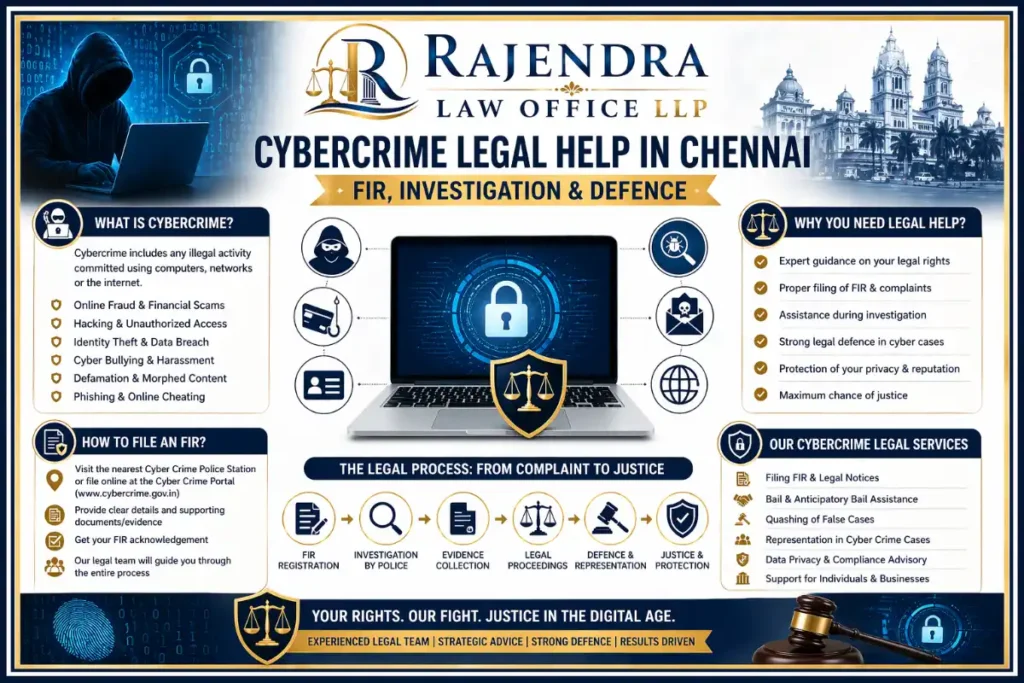
Understanding Cybercrime and Legal Framework
Cybercrime encompasses criminal activities committed using computers, internet, or digital devices targeting individuals or organizations. The Information Technology Act 2000 and IT Amendment Act 2008 govern cybercrimes in India comprehensively. Moreover, Bharatiya Nyaya Sanhita (BNS) provisions address traditional crimes committed through digital means. Furthermore, cybercrime includes hacking, online fraud, cyber defamation, identity theft, and digital harassment. Additionally, financial cybercrimes involve online banking fraud, UPI fraud, credit card fraud, and cryptocurrency scams. The IT Act lawyer Chennai expertise covers Section 66 hacking, Section 66C identity theft, and Section 66D cheating provisions. Subsequently, cyber harassment lawyer services address cyberstalking, cyberbullying, and online intimidation under relevant provisions. Therefore, understanding legal framework enables effective prosecution and defense strategies. Consequently, specialized cyber law knowledge ensures proper case handling and client protection.
Information Technology Act Provisions
IT Act Section 66 addresses computer-related offenses including hacking and unauthorized access to systems. Section 66A previously covered offensive messages but was struck down by Supreme Court. Moreover, IT Act Section 66C punishes identity theft including fraudulent use of electronic signatures or passwords. Furthermore, IT Act Section 66D addresses cheating by personation using computer resources dishonestly. Additionally, Section 66E criminalizes privacy violation through capturing, publishing, or transmitting private images. The IT Act Section 67 prohibits publishing obscene material in electronic form attracting imprisonment. Subsequently, Section 67A specifically addresses sexually explicit content involving explicit acts. Therefore, comprehensive IT Act knowledge ensures accurate charge identification and appropriate defense. Consequently, specialized cyber law expertise navigates complex statutory provisions effectively.
BNS Provisions Applicable to Cybercrimes
BNS Section 318 addresses cheating including online fraud and digital deception schemes. Cheating provisions apply when perpetrators deceive victims through digital platforms inducing property delivery. Moreover, BNS Section 319 covers cheating by personation including fake online identities and impersonation. Furthermore, defamation provisions under BNS apply to cyber defamation and online character assassination. Additionally, extortion sections address cyber extortion, ransomware attacks, and online blackmail comprehensively. The criminal breach of trust provisions apply to digital asset misappropriation and online fiduciary violations. Subsequently, forgery sections cover digital document forgery and electronic signature falsification. Therefore, BNS provisions complement IT Act creating comprehensive legal framework. Consequently, combined application ensures effective prosecution of diverse cybercrime categories.
Types of Cybercrimes and Digital Offenses
Financial cybercrimes include online banking fraud, UPI fraud lawyer cases, and credit card fraud Chennai matters. Phishing attacks involve fraudulent emails or messages deceiving victims into revealing sensitive information. Moreover, social media hacking encompasses Facebook hacking cases, Instagram account hacking, and Twitter defamation lawyer matters. Furthermore, identity theft involves unauthorized use of personal information for fraudulent purposes. Additionally, ransomware attacks encrypt victim data demanding payment for decryption keys. The malware attacks introduce malicious software stealing data or damaging systems. Subsequently, cyberstalking and cyber harassment constitute repeated unwanted digital contact causing distress. Therefore, diverse cybercrime categories require specialized legal expertise and strategic defense. Consequently, experienced cyber law advocates provide tailored solutions for specific offense types.
Filing Cybercrime Complaints and FIR Procedure
Filing cybercrime FIR Chennai requires understanding proper procedures and jurisdictional requirements. Victims should preserve digital evidence including screenshots, emails, messages, and transaction records immediately. Moreover, cyber FIR procedure involves approaching cyber cell Chennai or registering online complaints through national portal. Furthermore, written complaints should detail offense nature, evidence, and accused information comprehensively. Additionally, victims can file complaints at cyber crime police station Chennai or jurisdictional police stations. The online FIR cybercrime facility enables remote complaint registration through official government portals. Subsequently, FIR registration cyber cell triggers investigation and evidence collection processes. Therefore, proper complaint filing ensures effective investigation and case prosecution. Consequently, legal guidance during complaint stage strengthens case foundation significantly.
Cyber Cell and Investigation Agencies
Chennai cyber cell operates under Tamil Nadu Police handling cybercrime complaints and investigations. The Commissioner of Police cyber division coordinates cybercrime prevention and investigation activities. Moreover, CID cyber crime wing investigates serious and complex cybercrime cases across Tamil Nadu. Furthermore, Central Cyber Crime Unit handles cases with national or international ramifications. Additionally, local police stations accept cybercrime complaints forwarding them to specialized units when necessary. The cyber crime wing maintains technical expertise including digital forensics and electronic evidence analysis. Subsequently, investigation agencies coordinate with service providers, banks, and technology companies for evidence. Therefore, understanding agency structure facilitates effective complaint filing and follow-up. Consequently, proper agency selection expedites investigation and case resolution.
Evidence Collection and Preservation
Digital evidence collection requires technical expertise ensuring admissibility and evidential value in courts. Screenshots should capture complete information including URLs, timestamps, and relevant content comprehensively. Moreover, email evidence preservation includes maintaining original emails with headers showing sender information. Furthermore, WhatsApp chat evidence requires proper screenshots or exports maintaining conversation continuity. Additionally, transaction evidence includes bank statements, payment gateway records, and digital receipts. The server log evidence contains IP addresses, access times, and activity records crucial for investigations. Subsequently, hash value generation ensures digital evidence integrity preventing tampering allegations. Therefore, proper evidence collection strengthens prosecution and supports defense strategies. Consequently, technical legal expertise ensures evidence admissibility and effectiveness.
- Take clear screenshots showing complete URLs and timestamps
- Preserve original emails with complete headers and metadata
- Export WhatsApp/social media chats maintaining format
- Collect transaction records with reference numbers
- Document witness statements and contemporaneous evidence
- Avoid editing or modifying original digital evidence
- Store evidence securely preventing unauthorized access
- Create multiple backup copies on different media
- Maintain chain of custody documentation
- Consult cyber law experts for evidence preservation
FIR Registration Process and Requirements
FIR registration requires detailed written complaint describing offense, victim details, and available evidence. Complaints should specify IT Act sections and BNS provisions applicable to offense nature. Moreover, supporting documents including identity proof, transaction records, and communication evidence strengthen complaints. Furthermore, jurisdictional determination depends on offense location, accused location, or victim residence. Additionally, online complaint portals enable nationwide FIR registration irrespective of geographic location. The FIR copy procurement provides official record for further legal proceedings and insurance claims. Subsequently, investigation monitoring requires regular follow-up with investigating officers and cyber cell. Therefore, proper FIR registration initiates formal legal process protecting victim rights. Consequently, legal assistance during FIR stage ensures comprehensive complaint and effective investigation.
Investigation and Forensic Analysis
Cybercrime investigation Chennai involves technical analysis, digital forensics, and evidence collection across platforms. IP address tracing identifies device locations and user identities through service provider coordination. Moreover, mobile forensics Chennai extracts data from smartphones including deleted messages and application data. Furthermore, email forensics analysis reveals sender information, routing details, and message authenticity. Additionally, social media investigation tracks account activities, connections, and content sharing patterns. The bank transaction tracing follows money trails identifying beneficiaries and fraudulent fund transfers. Subsequently, digital footprint investigation reconstructs online activities establishing offense commission proof. Therefore, comprehensive investigation combines technical expertise with legal knowledge. Consequently, forensic evidence provides conclusive proof supporting prosecution or defense.
Digital Forensics and Technical Investigation
Computer forensics Chennai examines hard drives, storage devices, and system files for evidence. Forensic imaging creates exact copies of digital devices preserving original evidence integrity. Moreover, metadata analysis reveals file creation dates, modification history, and authorship information. Furthermore, network forensics examines network traffic, communication logs, and connection records. Additionally, malware analysis identifies malicious software characteristics, origins, and impact on systems. The server log analysis tracks website access, user activities, and transaction histories comprehensively. Subsequently, expert witness testimony explains technical evidence and forensic findings to courts. Therefore, forensic investigation provides scientific evidence supporting legal proceedings. Consequently, technical expertise combined with legal knowledge ensures effective case presentation.
| Crime Type | IT Act Provisions | BNS Provisions | Punishment |
|---|---|---|---|
| Hacking | Section 66 | Section 318 (Cheating) | 3 years imprisonment + fine |
| Identity Theft | Section 66C | Section 319 (Personation) | 3 years imprisonment + ₹1 lakh fine |
| Online Fraud | Section 66D | Section 318, 319 | 3 years imprisonment + fine |
| Privacy Violation | Section 66E | Defamation provisions | 3 years imprisonment + ₹2 lakh fine |
| Cyber Defamation | Section 66A (struck down), 67 | Defamation sections | 3 years imprisonment + fine |
| Child Pornography | Section 67B | POCSO Act | 5-7 years imprisonment + fine |
Legal Representation and Defense Strategies
Cybercrime defense lawyer services protect accused persons against false allegations and wrongful prosecutions. False cybercrime accusations often arise from business disputes, personal vendettas, or misunderstandings. Moreover, IT Act case defense requires technical expertise demonstrating innocence or lack of criminal intent. Furthermore, cyber defamation defense challenges evidence authenticity and establishes truth or fair comment defenses. Additionally, hacking allegation defense involves proving authorized access or technical impossibilities. The false complaint defense demonstrates malicious prosecution and absence of offense elements. Subsequently, technical defense strategies challenge digital evidence reliability, collection methods, and chain of custody. Therefore, experienced cyber defense advocates protect constitutional rights and ensure fair trials. Consequently, strategic defense prevents wrongful convictions and protects professional reputations.
Anticipatory Bail and Regular Bail
Anticipatory bail cybercrime applications prevent arrest when accused apprehends detention in cognizable offenses. IT Act offenses are generally bailable except serious offenses like child pornography under Section 67B. Moreover, anticipatory bail IT Act requires demonstrating non-involvement, cooperation willingness, and no evidence tampering risk. Furthermore, regular bail cyber case applications follow arrest seeking provisional release during trial. Additionally, bail conditions may include surrendering passports, reporting to police, and refraining from evidence tampering. The non-bailable cybercrime offenses require judicial magistrate or sessions court bail applications. Subsequently, bail cancellation occurs when accused violates conditions or commits similar offenses. Therefore, experienced cyber lawyers secure favorable bail terms protecting client liberty. Consequently, timely bail applications prevent prolonged custody and facilitate effective defense preparation.
Trial Procedure and Court Representation
Cybercrime trials occur before Metropolitan Magistrate courts or Sessions Courts depending on offense seriousness. Special courts for IT Act cases exist in some jurisdictions expediting cybercrime trials. Moreover, evidence presentation cyber cases requires technical expertise explaining digital evidence to courts. Furthermore, cross-examination digital witnesses challenges evidence authenticity, collection methods, and expert opinions. Additionally, technical expert testimony interprets forensic reports, IP addresses, and digital evidence for judicial understanding. The expert witness cyber cases include forensic analysts, cybersecurity professionals, and technology experts. Subsequently, legal arguments address statutory interpretation, evidence admissibility, and constitutional rights violations. Therefore, effective court representation combines legal knowledge with technical understanding. Consequently, experienced cyber advocates ensure proper defense and client rights protection.
Quashing Petitions and Legal Remedies
Quashing petition IT Act enables accused to approach High Court seeking criminal proceedings termination. Grounds for quashing include absence of offense ingredients, civil dispute nature, or malicious prosecution. Moreover, compromise in cyber cases enables parties to settle disputes leading to prosecution withdrawal. Furthermore, criminal complaint quashing prevents prolonged litigation when offense elements are absent. Additionally, Madras High Court cyber jurisdiction entertains quashing petitions under Section 482 BNSS. The quashing remedies protect innocent accused from harassment and wrongful prosecution consequences. Subsequently, successful quashing applications terminate proceedings without trial or conviction records. Therefore, quashing petitions provide effective remedy against false or frivolous complaints. Consequently, experienced advocates evaluate quashing prospects and pursue appropriate remedies.
Victim Rights and Compensation
Cybercrime victims possess rights to complaint filing, investigation monitoring, and legal assistance throughout proceedings. Victim protection measures include identity concealment, separate examination, and harassment prevention during trials. Moreover, cybercrime victim rights encompass timely investigation updates, FIR copies, and chargesheet access. Furthermore, victim compensation scheme provides financial relief for losses suffered due to cybercrimes. Additionally, financial loss recovery includes civil suits for damages beyond criminal compensation. The defamation compensation addresses reputation damage, mental agony, and professional loss. Subsequently, restitution orders direct convicted accused to compensate victims for actual losses. Therefore, comprehensive victim rights ensure justice delivery and loss mitigation. Consequently, victims should assert rights throughout legal process maximizing recovery prospects.
Civil Remedies and Damages Recovery
Civil damages cybercrime enable victims to claim compensation beyond criminal penalties. Tort law principles apply to cyber defamation, privacy violations, and intentional harm cases. Moreover, injunction online content prevents further publication or distribution of defamatory or private materials. Furthermore, content removal orders direct platforms to delete offensive, defamatory, or privacy-violating content. Additionally, account freezing orders prevent fraudsters from withdrawing stolen funds during investigation. The asset attachment proceedings secure properties ensuring compensation availability post-conviction. Subsequently, civil suits run parallel to criminal proceedings maximizing recovery chances. Therefore, combined criminal and civil strategies provide comprehensive legal remedies. Consequently, victims should explore all available legal avenues for complete justice.
Compensation Calculation and Award
Cybercrime compensation includes actual financial losses, consequential damages, and mental agony compensation. Financial loss calculation involves documenting direct monetary losses including fraudulent transactions and stolen amounts. Moreover, business loss recovery addresses revenue loss, client loss, and opportunity costs from cyberattacks. Furthermore, reputation loss compensation evaluates professional damage, career impact, and social standing deterioration. Additionally, mental agony damages recognize psychological trauma, stress, and emotional suffering. The punitive damages cyber cases punish egregious conduct deterring future offenses. Subsequently, legal cost recovery includes investigation expenses, advocate fees, and court costs. Therefore, comprehensive damage assessment maximizes compensation recovery. Consequently, expert legal valuation ensures appropriate compensation claims.
Platform-Specific Cybercrime Issues
Facebook fraud lawyer services address fake profiles, account hacking, and financial scams on platform. Instagram scam lawyer expertise covers influencer fraud, fake shopping pages, and account takeovers. Moreover, WhatsApp fraud Chennai includes impersonation scams, group frauds, and malicious link distribution. Furthermore, LinkedIn fraud lawyer services address fake job postings, professional impersonation, and business scams. Additionally, dating app fraud involves catfishing, romance scams, and financial exploitation. The OLX fraud lawyer Chennai handles fake seller scams, advance payment frauds, and product misrepresentation. Subsequently, platform cooperation varies affecting evidence collection and perpetrator identification. Therefore, platform-specific strategies address unique challenges and technical limitations. Consequently, experienced advocates navigate platform policies and legal frameworks effectively.
E-Commerce and Payment Fraud
Online banking fraud Chennai encompasses unauthorized transactions, account takeovers, and phishing attacks targeting banking customers. UPI fraud lawyer cases involve unauthorized QR code payments, fraudulent transaction approvals, and SIM swap frauds. Moreover, credit card fraud includes skimming, CNP fraud, and unauthorized online purchases. Furthermore, wallet fraud lawyer services address digital wallet hacking, unauthorized transfers, and promotional frauds. Additionally, e-commerce fraud includes non-delivery of goods, counterfeit products, and seller scams. The payment gateway fraud involves transaction manipulation, refund frauds, and chargeback abuse. Subsequently, financial institutions cooperation aids fund tracing and recovery proceedings. Therefore, prompt action increases fraud detection and fund recovery chances. Consequently, immediate legal consultation upon fraud discovery maximizes protection.
Corporate Cybercrime and Business Protection
Corporate cybercrime lawyer services protect businesses from data breaches, industrial espionage, and digital attacks. Business email compromise involves CEO fraud, vendor fraud, and invoice manipulation causing financial losses. Moreover, employee data theft includes proprietary information theft, customer database theft, and trade secret misappropriation. Furthermore, competitor defamation online damages business reputation through false reviews and negative campaigns. Additionally, business reputation management addresses online attacks, fake news, and coordinated defamation campaigns. The corporate espionage cyber involves hacking competitor systems, stealing confidential data, and sabotaging operations. Subsequently, cyber compliance legal ensures businesses meet data protection and cybersecurity regulatory requirements. Therefore, proactive legal strategies prevent cybercrimes and minimize business disruption. Consequently, corporate cyber law expertise protects business interests comprehensively.
Data Protection and Privacy Laws
Data protection legal obligations require businesses to implement security measures protecting customer information. IT Act Section 43A imposes liability for negligent data security causing wrongful loss. Moreover, reasonable security practices include encryption, access controls, and regular security audits. Furthermore, data breach notification requires informing affected individuals and authorities promptly. Additionally, privacy policy legal compliance ensures transparent data collection and processing practices. The CERT-In guidelines mandate incident reporting within specified timeframes for certain organizations. Subsequently, non-compliance attracts penalties including compensation liability and regulatory sanctions. Therefore, businesses must implement comprehensive data protection frameworks. Consequently, legal compliance prevents liability and maintains customer trust.
Children and Cyber Safety
Child online safety requires parental supervision, privacy settings, and age-appropriate content filtering. Cyberbullying children causes psychological trauma requiring school intervention and legal action when severe. Moreover, online predator legal action protects children from grooming, exploitation, and abuse. Furthermore, POCSO cyber cases involve child pornography, online sexual exploitation, and solicitation offenses. Additionally, gaming fraud children includes unauthorized purchases, account theft, and virtual item scams. The student cyber harassment encompasses bullying, threatening, and reputation damage among peers. Subsequently, parental control legal issues involve balancing child safety with privacy rights. Therefore, comprehensive protection combines technology, education, and legal safeguards. Consequently, vigilant monitoring and prompt intervention protect children online.
Prevention and Cyber Hygiene
Cybercrime prevention Chennai requires awareness, secure practices, and regular security updates. Strong passwords combining letters, numbers, and symbols prevent unauthorized access. Moreover, two-factor authentication adds security layer protecting accounts even if passwords compromise. Furthermore, phishing awareness prevents clicking suspicious links or sharing sensitive information. Additionally, software updates patch security vulnerabilities reducing exploitation risks. The antivirus protection detects and removes malware before causing damage. Subsequently, secure WiFi usage avoids public networks for sensitive transactions. Therefore, proactive security measures significantly reduce cybercrime victimization risks. Consequently, cyber hygiene practices protect individuals and organizations effectively.
Legal Services at Rajendra Law Office LLP
Rajendra Law Office LLP provides comprehensive cybercrime legal consultation addressing victim representation and accused defense. Our cyber law advisory includes FIR filing assistance, investigation coordination, and trial representation. Moreover, legal opinion cybercrime evaluates case merits, evidence strength, and appropriate legal strategies. Furthermore, case strategy cyber development considers technical aspects, legal provisions, and client objectives. Additionally, defense strategy IT Act combines technical expertise with constitutional law knowledge protecting client rights. The prosecution assistance supports victims throughout investigation and trial ensuring effective case presentation. Subsequently, court appearance cyber includes regular hearings, argument presentation, and procedural compliance. Therefore, end-to-end legal services provide comprehensive cybercrime solutions. Consequently, clients receive expert guidance throughout legal proceedings.
Why Choose Rajendra Law Office LLP
Rajendra Law Office LLP combines technical cyber law expertise with extensive litigation experience. Our team includes IT Act specialists understanding both legal provisions and technical aspects. Moreover, we maintain relationships with cyber cells, forensic experts, and technical consultants. Furthermore, our track record includes successful defense of false accusations and effective victim representation. Additionally, we provide 24/7 emergency consultation for urgent cybercrime matters requiring immediate action. The comprehensive approach addresses criminal prosecution, civil remedies, and reputation management collectively. Subsequently, transparent communication keeps clients informed throughout case progression. Therefore, client-centric service delivery ensures satisfaction and effective outcomes. Consequently, Rajendra Law Office LLP stands as Chennai’s trusted cybercrime legal partner.
Contact and Consultation
Immediate consultation available for cybercrime victims and accused persons facing investigations. Contact Adv. Saravvanan R at +91-9994287060 for urgent cybercrime legal assistance. Moreover, email detailed case information to sarav@lawyerchennai.com for preliminary evaluation. Furthermore, visit our offices at West Mogappair or George Town Chennai for in-person consultation. Additionally, emergency consultation available outside regular hours for time-sensitive cybercrime matters. The initial consultation evaluates case merits, evidence strength, and appropriate legal strategy. Subsequently, transparent fee structure explained upfront without hidden charges. Therefore, prompt legal intervention maximizes protection and favorable outcomes. Consequently, early consultation prevents evidence loss and preserves legal rights.
Office Locations and Reach
Rajendra Law Office LLP operates from West Mogappair at 8/13, 1st Floor, Bharathi Salai, Chennai – 600037. Our George Town office located at 323/156, Andhra Insurance Building, 2nd Floor, Chennai – 600001. Moreover, both locations proximate to cyber cells and courts facilitating efficient case handling. Furthermore, telephone numbers 044-26533389 and 044-47660443 connect to respective offices. Additionally, website www.rajendralawoffice.com provide comprehensive information. The mobile numbers +91-9994287060 and +91-9444014096 enable direct communication with advocates. Subsequently, office hours Monday-Friday 9:30 AM-5:30 PM, Saturday 9:30 AM-1:00 PM. Therefore, convenient locations and flexible timing ensure accessibility. Consequently, clients receive prompt attention and professional service.
Frequently Asked Questions – Cybercrime Legal Help in Chennai – FIR, Investigation & Defence
File FIR immediately upon discovering cybercrime. Prompt action preserves evidence and increases perpetrator identification chances. Delays weaken case and reduce fund recovery prospects in financial frauds.
Yes, file complaint against unknown persons. Investigation will identify accused through technical analysis including IP tracing and digital forensics. Provide all available evidence and details during complaint filing.
Most IT Act offenses attract up to 3 years imprisonment and fines up to ₹5 lakhs. Serious offenses like child pornography attract 5-7 years imprisonment. Punishment varies based on offense severity and circumstances.
Some cybercrimes allow compromise especially civil disputes or defamation matters. Court approval required for compromise in criminal cases. Serious offenses like child pornography are non-compoundable requiring trial completion.
Investigation duration varies from weeks to months depending on case complexity. Simple cases resolve within 2-3 months while complex international cases take longer. Regular follow-up expedites investigation progress.
Yes, through criminal restitution orders or civil suits. Criminal courts order compensation to victims from convicted accused. Civil suits enable claiming damages including financial losses, mental agony, and reputation damage comprehensively.
Read more
- Cybercrime Lawyers: Expert Legal Defense in Chennai 👨⚖️
- Quashing of FIR: Supreme Court Guidelines and Case Studies 💼
- Corporate Fraud and Supreme Court Judgments: What Businesses Need to Know 🏛️
- Cybersecurity laws: The Expert Legal Advice in Chennai 👨⚖️
- Digital Millennium Copyright Act (DMCA): The Best Legal Advice Support 🔍
- Criminal Lawyers in Chennai: Defending Your Rights and Freedom 👔
- Filing a Complaint on National Cyber Crime Reporting Portal
- Acts & Rules – Indian Cybercrime Coordination Centre
- National Cyber Crime Reporting Portal
Contact Rajendra Law Office LLP immediately for expert cybercrime legal help Chennai. Our experienced cyber law advocates provide comprehensive FIR assistance, investigation coordination, and effective defense representation across all cybercrime categories in Chennai.