
Finding the best property lawyer in Chennai requires understanding your specific legal needs. Property disputes involving land title verification, partition suits, encroachment issues, and fraudulent sale deeds demand specialized expertise. Whether you face builder disputes under RERA regulations, need representation in Madras High Court, or require assistance with revenue department matters, choosing the right advocate matters significantly. Chennai’s legal landscape encompasses District Courts, Tahsildar offices, and various forums handling property litigation. From patta corrections to criminal complaints under BNS provisions, property matters require lawyers familiar with CPC procedures, documentation analysis, and strategic planning. This comprehensive 2026 guide helps you select qualified legal counsel based on case complexity, court jurisdiction, and dispute type rather than generic rankings.
⚖️ Introduction: Don’t Just Pick a Lawyer — Pick a Strategy
Most people search “top property lawyers in Chennai” when they are already stuck in a dispute. Some face encroachment. Others deal with fraudulent sale deeds or family partition conflicts.
Here’s the blunt reality — choosing the wrong lawyer does not just delay your case. It can weaken your position permanently. Property litigation in Tamil Nadu is heavily document-driven and strategy-sensitive.
This guide does not give you a random list. It shows how to identify the right property lawyer based on your exact problem, court level, and urgency.
🧠 What Makes a Property Lawyer “The Best” in Chennai?
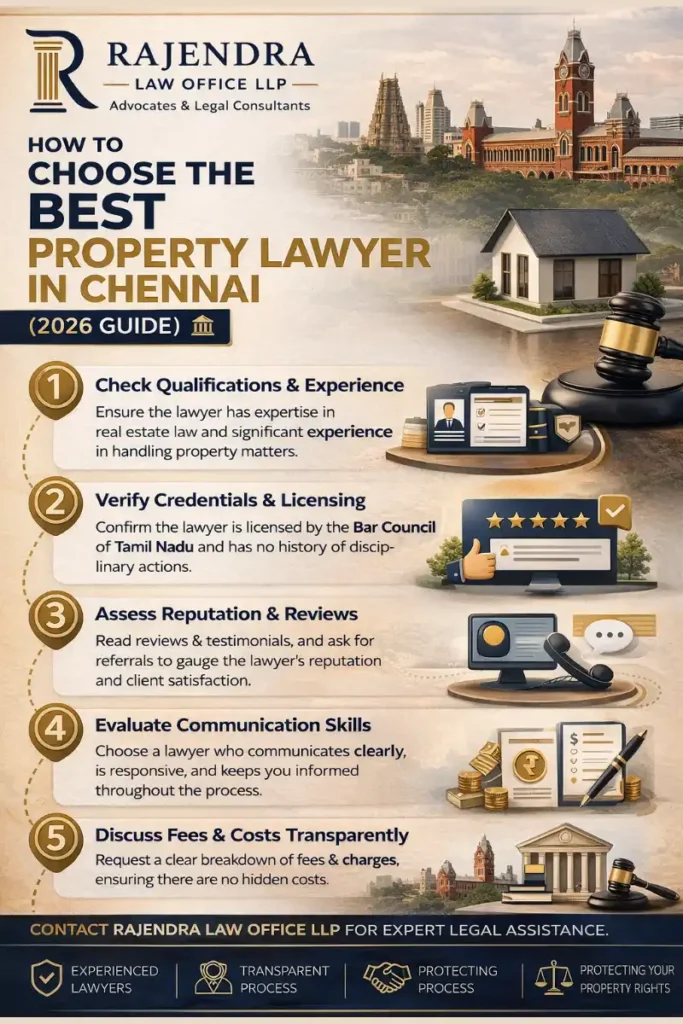
Firstly, Not popularity. Secondly, Not advertisements. Finally Not fancy offices.
The right lawyer depends on:
- Type of dispute (civil, criminal, or mixed)
- Stage of the case (pre-litigation or ongoing)
- Court involved (District Court / High Court)
- Documentation strength
Key Factors You Must Evaluate
Selecting a property lawyer requires careful assessment of multiple critical factors. Experience in property litigation specifically matters more than general legal practice. Moreover, lawyers handling land disputes understand the nuances of Tamil Nadu property laws better. Therefore, evaluate their track record in cases similar to yours. Additionally, check their familiarity with revenue department procedures and documentation. Furthermore, assess their ability to handle both civil and criminal aspects simultaneously. Consequently, a comprehensive evaluation ensures you choose the right legal representation. Court exposure demonstrates practical knowledge beyond theoretical understanding. Regular practice before Madras High Court indicates higher competency levels. Subsequently, such lawyers navigate complex procedural requirements efficiently.
- Experience in Property Litigation
- Not general practice — specific land and title disputes
- Minimum 10 years handling property matters exclusively
- Track record in Madras High Court and District Courts
- Court Exposure
- Regular practice before Madras High Court matters
- Familiarity with Chennai District Courts procedures
- Experience in Tamil Nadu Real Estate Regulatory Authority (RERA)
- Drafting Strength
- Weak pleadings = weak case
- Precision in Civil Procedure Code (CPC) compliance
- Strategic use of evidence and documentation
- Strategy Approach
- Preventive vs reactive legal planning
- Multi-dimensional case analysis capabilities
- Alternative dispute resolution expertise
- Execution Speed
- Delays can damage property rights
- Prompt filing of injunction applications when required
- Quick response to legal notices and court summons
Understanding Legal Specialization in Property Matters
Property law encompasses various specialized domains requiring distinct expertise levels. Land acquisition cases demand knowledge of government acquisition procedures and compensation rules. Similarly, partition suits require understanding of Hindu Succession Act provisions thoroughly. Encroachment matters involve both civil remedies and criminal prosecution under Bharatiya Nyaya Sanhita (BNS). Title disputes necessitate deep knowledge of registration laws and Transfer of Property Act. Additionally, builder-buyer conflicts require familiarity with RERA regulations and Consumer Protection Act. Therefore, identifying your specific issue helps select appropriately specialized legal counsel. Moreover, some lawyers excel in litigation while others specialize in documentation work. Consequently, matching expertise with your requirement becomes crucial for success.
🏠 Types of Property Disputes You May Be Facing
Before choosing a lawyer, identify your issue clearly:
📌 Common Cases in Chennai
- Partition disputes among family members
- Encroachment and illegal possession
- Fraudulent or forged sale deeds
- Patta and land record issues
- Joint ownership conflicts
- Builder disputes and title issues
- Tenancy and eviction matters
- Boundary and survey disputes
👉 Each requires a different legal approach, not a one-size-fits-all lawyer.
Partition Disputes: Family Property Conflicts
Partition cases represent the most emotionally challenging property disputes in Chennai. Family members often disagree on property division methods and valuation aspects. Hindu Succession Act governs inheritance rights for Hindu families comprehensively. Muslim Personal Law and Christian Succession Act apply to respective communities differently. Furthermore, ancestral property follows different partition rules than self-acquired property. Courts apply specific formulas for determining shares among legal heirs systematically. Additionally, preliminary decree and final decree stages require different strategic approaches. Mediation often resolves such disputes faster than prolonged court battles. However, when settlements fail, litigation becomes inevitable despite emotional costs. Therefore, lawyers experienced in family property matters handle these cases sensitively.
Encroachment Cases: Protecting Your Land Boundaries
Encroachment involves unauthorized occupation or construction on another’s property unlawfully. Such cases require immediate legal intervention to prevent adverse possession claims. Civil suits for injunction can stop ongoing encroachment activities effectively. Additionally, criminal complaints under BNS Sections 329 and 331 address trespass. Revenue authorities also possess powers to remove encroachments on government land. Tahsildar offices in areas like Ambattur, Madhavaram, and Sholinganallur handle such complaints. Furthermore, survey reports and boundary demarcation become critical evidence in trials. Therefore, engaging surveyors alongside lawyers strengthens your case significantly. Police stations including Anna Nagar, T Nagar, and Adyar assist in criminal aspects. Consequently, multi-pronged legal strategy works best for encroachment removal.
Fraudulent Sale Deeds and Forgery Cases
Forged documents represent serious property fraud requiring both civil and criminal action. Sale deeds executed through fraud, misrepresentation, or coercion can be challenged. Civil suits for declaration and cancellation of such deeds become necessary. Simultaneously, criminal complaints under BNS Section 336 (forgery) and Section 340 (cheating) apply. Sub-Registrar offices in Chennai including Egmore, Guindy, and Mylapore maintain registration records. Document examiners from Forensic Science Laboratory provide expert opinions on signature forgery. Additionally, handwriting experts testify in courts regarding document authenticity. Economic Offences Wing of Chennai Police investigates large-scale property frauds. Therefore, comprehensive legal strategy addresses both civil and criminal dimensions effectively. Moreover, quick action prevents fraudulent transferees from claiming bona fide purchaser status.
⚖️ Legal Options Available in Property Disputes
Depending on your situation, a competent lawyer may suggest:
- Civil Suit for declaration or partition
- Injunction suit to stop illegal construction
- Criminal complaint for fraud or forgery
- Writ petition in High Court (in specific cases)
- Complaint before RERA for builder disputes
- Application before Revenue Divisional Officer (RDO)
👉 Strategy matters more than filing quickly.
Civil Remedies Under Code of Civil Procedure
Civil Procedure Code provides comprehensive framework for property dispute resolution in courts. Declaration suits establish ownership rights when title is disputed or unclear. Partition suits divide jointly owned property among co-owners legally and fairly. Permanent injunction prevents defendants from interfering with plaintiff’s property rights. Temporary injunction provides interim relief during pendency of main suit proceedings. Specific performance suits compel execution of sale agreements when parties refuse. Additionally, CPC Order 39 Rules 1 and 2 govern injunction applications specifically. Courts grant such relief when prima facie case, balance of convenience, and irreparable injury exist. Furthermore, appeals against orders lie before Madras High Court under Section 96. Therefore, understanding procedural nuances becomes essential for effective litigation strategy.
Criminal Remedies Under Bharatiya Nyaya Sanhita
Property offenses attract criminal prosecution under various provisions of Bharatiya Nyaya Sanhita. Section 329 addresses criminal trespass on property without lawful authority. Section 331 covers house-trespass to commit offenses inside dwelling places. Forgery of property documents invokes Section 336 with imprisonment up to two years. Cheating in property transactions falls under Section 340 with stringent punishment. Additionally, criminal breach of trust regarding property attracts Section 316 prosecution. Complaints can be filed at jurisdictional police stations across Chennai divisions. Stations like Kilpauk, Triplicane, and Royapettah handle property-related FIRs regularly. Furthermore, Bharatiya Nagarik Suraksha Sanhita (BNSS) governs criminal procedure for investigation. Therefore, criminal action supplements civil litigation in fraud and forgery cases.
Revenue Department Interventions and Remedies
Revenue authorities possess significant powers in land disputes and record corrections. Tahsildar offices handle applications for patta corrections, mutations, and survey changes. Revenue Divisional Officer (RDO) entertains appeals against Tahsildar orders within jurisdiction. District Collector exercises supervisory powers over all revenue matters in district. Additionally, applications for removing encroachments on government land go to Tahsildar. Survey settlements determine boundaries when disputes arise between neighboring landowners. Furthermore, natham land and poramboke land issues involve revenue department exclusively. Chennai revenue divisions include Saidapet, Mambalam, Perambur, and Ambattur taluks. Therefore, revenue remedies often prove faster than court litigation for specific issues. Moreover, lawyers familiar with revenue procedures expedite these applications effectively.
RERA Complaints for Builder-Buyer Disputes
Tamil Nadu Real Estate Regulatory Authority addresses builder-buyer disputes since 2017. Homebuyers can file complaints against developers for project delays and deficiencies. RERA ensures transparency in real estate transactions and protects buyer interests. Complaints regarding non-delivery of possession within agreed timelines get priority consideration. Additionally, quality defects and deviation from approved plans attract regulatory action. Interest on delayed possession and compensation for deficiencies can be claimed. Furthermore, RERA orders are executable as civil court decrees under law. Chennai RERA office is located at EVK Sampath Building, DPI Campus. Therefore, RERA provides effective and faster alternative to traditional civil litigation. Moreover, lawyers specialized in RERA matters enhance chances of favorable outcomes.
📊 Comparison: What to Look for in a Property Lawyer
| Factor | Average Lawyer | Strategic Property Lawyer |
|---|---|---|
| Case Approach | Reactive | Preventive + Tactical |
| Drafting Quality | Standard | Detailed & Evidence-backed |
| Court Strategy | Basic | Multi-layered |
| Client Guidance | Limited | Continuous |
| Risk Assessment | Rare | Proactive |
| Documentation Review | Superficial | Comprehensive |
| Revenue Procedure Knowledge | Basic | Expert Level |
| Settlement Negotiation | Occasional | Strategic |
Documentation Analysis Capabilities
Thorough document scrutiny separates exceptional lawyers from average practitioners in property matters. Title deeds require verification of ownership chain going back minimum 30 years. Encumbrance certificates from Sub-Registrar offices reveal any existing charges or mortgages. Patta and chitta documents from revenue offices establish current legal ownership. Survey numbers and subdivision details must match across all documents consistently. Additionally, building plan approvals from Chennai Metropolitan Development Authority matter for construction. Tax receipts from Greater Chennai Corporation prove continuous possession and ownership. Furthermore, lawyers must identify forged signatures, alterations, and suspicious endorsements. Therefore, meticulous documentation analysis forms the foundation of strong property cases.
🚨 Red Flags You Should Never Ignore
Let’s be real — this is where most clients get trapped.
Avoid lawyers who:
- Promise guaranteed results
- Avoid discussing risks
- Do not review documents thoroughly
- Push immediate litigation without strategy
- Lack clarity on court process
- Cannot explain fee structure transparently
- Show unfamiliarity with recent legal amendments
- Discourage second opinion consultations
👉 If the consultation feels rushed, your case will be too.
Unrealistic Promises and Guarantee Claims
No honest lawyer can guarantee specific outcomes in property litigation matters. Court decisions depend on evidence, legal arguments, and judicial discretion ultimately. Lawyers promising 100% success rates either lack experience or practice unethically. Property cases involve multiple variables including witness credibility and documentary proof strength. Additionally, opposing party’s legal strategy and court’s interpretation affect outcomes significantly. Therefore, competent lawyers provide realistic assessment of strengths and weaknesses. They discuss possible outcomes ranging from best-case to worst-case scenarios. Furthermore, ethical practitioners explain limitation periods under Limitation Act clearly. Consequently, be wary of lawyers who downplay risks or oversimplify complex matters. Moreover, transparent communication about challenges indicates professional integrity and competence.
Inadequate Case Assessment and Hasty Litigation
Rushing into litigation without proper case evaluation often proves counterproductive and costly. Strategic lawyers conduct thorough preliminary investigation before advising court action. Document verification, title search, and encumbrance check must precede filing. Additionally, assessing evidence strength and witness availability becomes crucial initially. Alternative dispute resolution options like mediation deserve consideration before litigation. Furthermore, cost-benefit analysis helps clients make informed decisions about pursuing cases. Filing frivolous cases invites penalties under CPC Section 35A for wasting court’s time. Therefore, responsible lawyers discourage unnecessary litigation and suggest practical alternatives. Moreover, they explain procedural timelines and realistic duration for case disposal. Consequently, comprehensive initial assessment saves time, money, and emotional stress for clients.
Lack of Updated Legal Knowledge
Law evolves constantly through legislative amendments and judicial interpretations regularly. Bharatiya Sakshya Adhiniyam (BSA) replaced the Indian Evidence Act in 2023. Similarly, BNS and BNSS replaced IPC and CrPC respectively recently. Property lawyers must stay updated on such fundamental legal framework changes. Additionally, Supreme Court and Madras High Court judgments create binding precedents. Tamil Nadu amendments to central laws require specific knowledge for local practice. Furthermore, RERA regulations undergo periodic updates affecting builder-buyer disputes significantly. Therefore, lawyers attending continuing legal education programs demonstrate professional commitment. Moreover, membership in Bar Council and Bar Associations ensures regulatory compliance. Consequently, verify lawyer’s awareness of recent legal developments before engaging them.
🧩 Why Strategy Matters More Than “Top 10 Lists”
A “top lawyer” for a cheque bounce case may not be suitable for a land title dispute.
Property cases often involve:
- Revenue records
- Historical ownership
- Survey and boundary issues
- Multiple parties
- Complex evidence collection
- Coordination with revenue authorities
👉 This requires deep legal + practical understanding, not just courtroom presence.
Customized Legal Strategy Development
Every property dispute demands unique strategy tailored to specific facts and circumstances. Generic templates and standard approaches fail in complex title disputes. Lawyers must analyze property’s historical ownership chain spanning several decades meticulously. Revenue records from Taluk offices provide crucial ownership evolution and mutation details. Survey records help establish exact boundaries and prevent future encroachment claims. Additionally, interviewing neighbors and long-term residents yields valuable circumstantial evidence. Consequently, fact-finding precedes strategy formulation in methodical legal approach. Furthermore, identifying weaknesses in opponent’s case helps develop counter-strategies effectively. Therefore, bespoke legal planning addressing unique case aspects ensures better outcomes. Moreover, flexibility to adapt strategy based on case developments demonstrates professional competence.
Multi-Forum Approach in Complex Disputes
Complex property matters often require simultaneous action across multiple legal forums. Civil suit in District Court addresses ownership and possession questions comprehensively. Criminal complaint in police station targets fraud and forgery aspects separately. Revenue application before Tahsildar seeks correction of land records and patta. Additionally, RERA complaint addresses builder-related grievances for apartment buyers specifically. Writ petition in Madras High Court challenges illegal government action affecting property. Consumer forum entertains complaints against builders for service deficiencies and unfair practices. Furthermore, each forum has specific limitation periods requiring timely action. Therefore, coordinated multi-forum strategy maximizes legal remedies available to aggrieved parties. Moreover, experienced lawyers orchestrate such complex multi-dimensional litigation effectively.
🏛️ When You Should Approach a Property Lawyer Immediately
Do not delay if you are facing:
- Encroachment on your land
- Suspicious property registration
- Family disputes escalating
- Legal notice regarding property
- Government acquisition issues
- Builder threatening possession without completion
- Discovery of forged documents
- Tenant refusing to vacate
👉 Early legal intervention = stronger case positioning
Importance of Limitation Periods
Limitation Act prescribes strict time limits for filing different types of cases. Suits for possession of immovable property have 12-year limitation period generally. Declaration suits regarding title also carry 12-year limitation from accrual date. Partition suits can be filed anytime during joint ownership continuation. However, specific performance suits have only 3 years from agreement date. Additionally, appeals against lower court judgments must be filed within specified periods. Delay in filing attracts dismissal on limitation grounds without merits consideration. Furthermore, courts condone delay only in exceptional circumstances with sufficient cause. Therefore, timely consultation with lawyer prevents loss of legal rights permanently. Moreover, lawyers calculate limitation correctly considering starting point and exclusions properly.
Preventive Legal Consultation Benefits
Consulting lawyers before problems escalate proves more cost-effective than crisis management. Pre-purchase legal due diligence identifies title defects before property acquisition. Verification of seller’s ownership documents prevents future disputes and litigation. Additionally, drafting clear sale agreements protects buyer interests comprehensively. Will drafting during lifetime prevents family partition disputes after death. Furthermore, registered partnership deeds clarify joint ownership rights and obligations. Therefore, preventive legal consultation saves substantial time, money, and stress later. Moreover, lawyers identify potential legal issues invisible to laypersons effectively. Consequently, proactive approach to property matters ensures smooth transactions and ownership.
⚖️ Jurisdictional Considerations: Chennai Courts and Forums
Chennai District Courts Structure
Chennai District Courts handle most property disputes at first instance level. Principal District Court located at High Court Campus exercises original civil jurisdiction. Additional District Courts function at Saidapet, Egmore, and other locations. Sub Courts handle suits with lower pecuniary value below specific thresholds. Additionally, jurisdiction depends on property’s location within revenue boundaries. Suits involving property in Ambattur must be filed in courts having Ambattur jurisdiction. Similarly, Madhavaram, Sholinganallur, and Pallavaram have respective jurisdictional courts. Furthermore, understanding territorial jurisdiction prevents case dismissal on technical grounds. Therefore, lawyers familiar with Chennai court geography ensure proper forum selection. Moreover, they advise on appropriate court based on claim value and relief sought.
Madras High Court Jurisdiction
Madras High Court exercises appellate and original jurisdiction in property matters. Appeals from District Courts lie before High Court under CPC provisions. Writ petitions challenge government actions affecting property rights under Article 226. Original Side handles high-value property suits exceeding specified monetary limits. Additionally, High Court possesses supervisory jurisdiction over all subordinate courts. Revision petitions can be filed against District Court orders in specific circumstances. Furthermore, PILs addressing public property issues get entertained by High Court. Therefore, complex cases often require High Court intervention for effective resolution. Moreover, senior advocates practicing in High Court bring specialized expertise. Consequently, identifying cases requiring High Court approach becomes crucial strategic decision.
📞 Consultation with Rajendra Law Office LLP
At Rajendra Law Office LLP, property disputes are handled with a strategy-first approach.
What You Can Expect
- Detailed document analysis
- Case viability assessment
- Legal strategy roadmap
- Court representation (if required)
- Revenue department liaison
- Regular case updates and communication
Suitable For
- High-value property disputes
- Complex ownership conflicts
- Urgent legal intervention cases
- Multi-generational title disputes
- Commercial property litigation
👉 Consultation focuses on solutions, not just opinions
Comprehensive Service Approach
Rajendra Law Office LLP provides end-to-end legal services in property matters. Initial consultation involves thorough understanding of client’s specific situation and concerns. Document verification includes examining all title deeds, revenue records, and registration documents. Legal opinion addresses strengths, weaknesses, and recommended course of action clearly. Additionally, case preparation involves evidence collection, witness identification, and strategy formulation. Litigation support includes drafting pleadings, filing applications, and court representation. Furthermore, settlement negotiations aim at resolving disputes through mediation when possible. Therefore, clients receive holistic legal support throughout their property matter journey. Moreover, senior advocates provide expertise accumulated through decades of practice.
❓ Frequently Asked Questions
Fees vary based on case complexity, court level, and documentation involved. Simple consultation costs between ₹2,000-₹5,000. Complex litigation requires retainer agreements ranging ₹50,000-₹5,00,000 depending on property value and case duration.
It depends on the nature of the dispute and court workload. Simple injunction matters may conclude within 6-12 months. However, title suits often take 3-7 years for final disposal through all stages.
Yes, in some cases through negotiation or mediation. Family partition disputes often get resolved through mediation under court’s supervision. Settlement deeds registered properly have same legal validity as court decrees.
Sale deed, patta, encumbrance certificate, and related records. Additionally, bring survey documents, tax receipts, and previous correspondence. Complete documentation enables accurate legal assessment and strategic planning.
District Courts have original jurisdiction in most property disputes. High-value suits and appeals go to Madras High Court. Jurisdictional court depends on property location within Chennai revenue boundaries.
Generally 12 years for possession and title declaration suits. Specific performance has 3-year limitation from contract breach date. Consult lawyer immediately to avoid losing rights due to delay.
Yes, under BNS Sections 336 (forgery) and 340 (cheating). File FIR at jurisdictional police station with supporting documents. Parallel civil suit ensures comprehensive legal remedy for fraud cases.
Engage lawyer for title search examining 30-year ownership chain. Verify encumbrance certificate, patta, and survey documents. Check for pending litigation, tax dues, and building plan approvals.
Real Estate Regulatory Authority handles builder-buyer disputes effectively. Approach for possession delays, quality defects, and unfair practices. File complaint within limitation period for compensation and interest.
Yes, lawyer ensures fair division and proper legal documentation. Partition deeds require precise drafting covering all rights and obligations. Professional assistance prevents future disputes among family members effectively.
Read More
- Top 10 Property Lawyers in Chennai for Expert Legal Advice 🏛️
- Lawyer in Chennai | Senior Advocate & Best Law Firm Near Madras High Court 📖
- Best Legal Advice in Chennai | Fraudulent Sale Deed Cancellation, Patta Disputes
- Civil Litigation Lawyers in Chennai: Trusted Expert Legal Services 👨⚖️
- Expertise in Property Title and Ownership Disputes: Real Estate Advocates
🎯 Final Takeaway
Stop searching for “top 10 lawyers.”
Start identifying the right legal strategy for your problem.
Because in property law:
👉 The strongest case does not win
👉 The best-prepared case does
Property disputes demand specialized expertise, strategic thinking, and thorough preparation. Choose lawyers based on their understanding of your specific issue, not generic rankings. Documentation quality, procedural knowledge, and courtroom experience matter more than advertisements. Therefore, invest time in selecting the right legal counsel initially. Moreover, early consultation prevents costly mistakes and strengthens your legal position significantly. Consequently, informed decision-making protects your valuable property rights effectively.