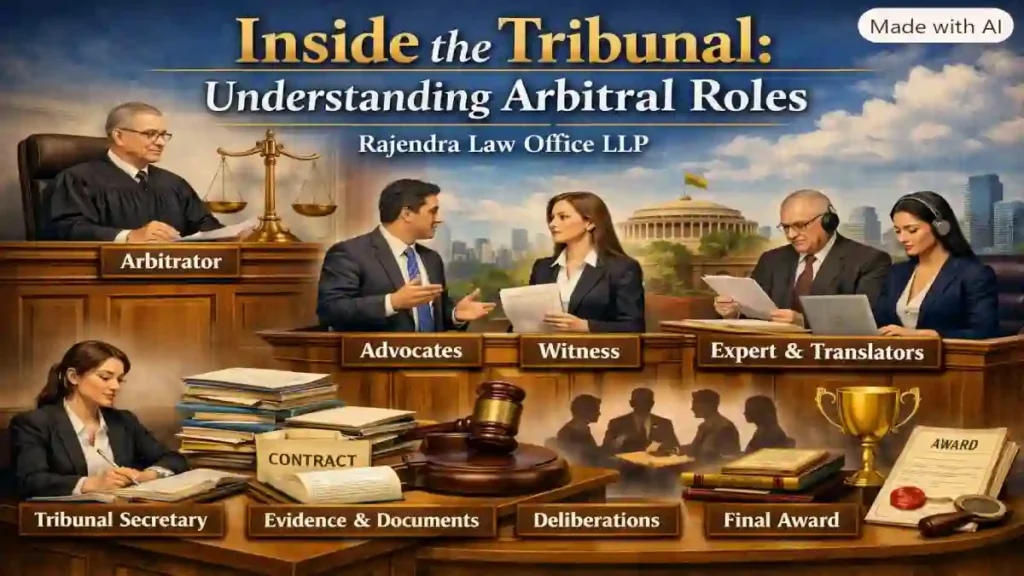
Understanding Arbitral Roles – An arbitral tribunal decides disputes referred under a valid arbitration agreement. It functions privately while exercising powers granted by the Arbitration and Conciliation Act, 1996. Therefore, the tribunal differs from an ordinary civil court in procedure and jurisdiction. The parties usually choose arbitration for speed, expertise, confidentiality, and procedural flexibility. Moreover, the tribunal must treat parties equally throughout the proceedings. It can determine procedural questions, assess evidence, hear submissions, and issue a binding award. The Act specifically addresses tribunal composition, jurisdiction, conduct, awards, enforcement, and challenges. Accordingly, arbitral roles require legal knowledge and procedural discipline. Parties should understand the tribunal’s authority before presenting claims or objections. Legal counsel can assess jurisdiction, limitation, evidence, contractual rights, interim relief, and enforcement strategy. Thus, informed representation can reduce procedural errors and protect valuable commercial interests.
Inside the Tribunal: Understanding Arbitral Roles – Rajendra Law Office LLP
Appointment and Independence of Arbitrators
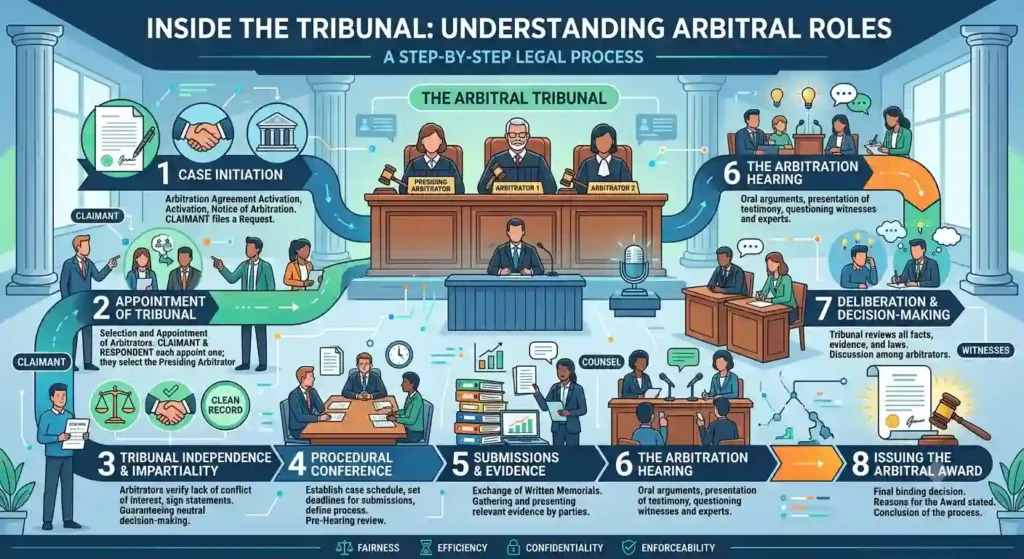
Arbitrator appointment represents a crucial stage because neutrality directly affects procedural fairness. Parties may agree upon an appointment mechanism within their arbitration agreement. However, statutory safeguards govern independence, impartiality, disclosures, and eligibility. Section 11 addresses appointment of arbitrators, while Section 12 addresses grounds for challenge. Consequently, parties should investigate potential conflicts before accepting an arbitrator. Financial relationships, professional connections, family relationships, and previous involvement may require disclosure. Moreover, the Fifth and Seventh Schedules provide important statutory guidance concerning independence concerns. An affected party can challenge an arbitrator through the prescribed statutory procedure. However, tactical objections without supporting facts can weaken credibility. Legal counsel should therefore examine disclosures against contractual terms and statutory requirements. Furthermore, parties should preserve correspondence concerning appointments and objections. Proper scrutiny at this stage can prevent costly challenges after extensive proceedings have occurred.
Jurisdiction and Procedural Authority
Competence to Decide Jurisdiction
An arbitral tribunal can generally determine questions concerning its own jurisdiction. Section 16 embodies this competence-competence principle within Indian arbitration law. Therefore, parties can raise objections concerning the existence, validity, or scope of arbitration agreements. Jurisdictional disputes may involve non-signatories, expired contracts, defective clauses, limitation, or subject-matter restrictions. Moreover, parties should raise objections within the applicable statutory framework and procedural timetable. Failure to object promptly can affect available remedies in appropriate circumstances. The tribunal may examine contractual documents, correspondence, pleadings, and surrounding circumstances. However, courts retain specific statutory powers at different arbitration stages. Counsel should therefore distinguish tribunal jurisdiction from court jurisdiction under the Arbitration Act. This distinction becomes particularly important when parties seek interim protection or challenge awards. A carefully drafted jurisdiction objection can prevent proceedings from expanding beyond contractual authority. Thus, early legal analysis remains essential for effective arbitration strategy.
Procedural Powers and Fair Hearing
Arbitral tribunals enjoy substantial procedural flexibility, but that flexibility does not eliminate fairness obligations. Section 18 requires equal treatment of parties and meaningful opportunity to present their respective cases. Accordingly, tribunals can establish suitable procedures while respecting natural justice principles. They may conduct hearings, receive documents, consider expert material, and manage procedural schedules. Furthermore, Section 19 permits tribunals to determine procedural rules subject to statutory limitations. Parties should therefore comply with procedural directions unless legitimate objections arise. Repeated non-compliance can cause adverse procedural consequences. Conversely, an unreasonable denial of hearing opportunities may support appropriate legal challenges. Counsel should monitor hearing notices, document disclosure, witness examination, expert evidence, and procedural orders. Additionally, parties should record objections contemporaneously rather than waiting for an adverse award. This approach creates a reliable procedural record for later proceedings. Ultimately, efficient arbitration requires flexibility combined with fairness, equality, and reasoned decision-making.
Roles, Responsibilities and Evidence
Duties During Arbitral Proceedings
Role of the Presiding Arbitrator
The presiding arbitrator coordinates tribunal functioning when three arbitrators constitute the tribunal. This role commonly includes managing hearings, procedural directions, deliberations, and award preparation. However, the presiding arbitrator must maintain neutrality and avoid unilateral decision-making. Each tribunal member should independently consider the evidence and legal submissions. Moreover, majority decision-making can apply where the tribunal contains multiple arbitrators. Section 29 addresses decision-making by panels under the Arbitration Act. The presiding arbitrator therefore facilitates orderly discussion without compromising other members’ independence. Parties should also understand that arbitrators remain adjudicators rather than representatives of appointing parties. Consequently, an arbitrator cannot simply advocate for the party who nominated them. Legal counsel should identify procedural irregularities promptly. Where genuine concerns arise, statutory challenge mechanisms may become relevant. A disciplined tribunal leadership structure can improve efficiency, reduce delay, and support a legally sustainable arbitral award.
Evidence, Witnesses and Expert Assistance
Evidence forms the foundation of most commercial arbitration disputes. Tribunals may examine contracts, invoices, correspondence, technical reports, electronic records, financial statements, and witness testimony. Section 26 permits tribunals to appoint experts where appropriate. Section 27 also provides for court assistance in taking evidence. Therefore, parties should develop an evidence strategy before hearings begin. Digital evidence increasingly includes emails, electronic signatures, transaction records, databases, and messaging records. The Bharatiya Sakshya Adhiniyam, 2023 now forms India’s principal statutory evidence framework for applicable proceedings. Counsel should nevertheless examine how evidentiary principles apply within the arbitration’s procedural context. Furthermore, authenticity and reliability can become decisive issues. Parties should preserve original records and maintain clear document trails. Expert witnesses should explain technical matters without becoming advocates. Ultimately, persuasive evidence combines relevance, authenticity, contractual context, and credible testimony. Proper evidence management can materially influence liability, damages, and final award outcomes.
Managing Claims and Defences
Claimant’s Role Before the Tribunal
The claimant carries the responsibility of presenting a coherent legal and factual case. Its pleadings should identify contractual obligations, breaches, losses, supporting evidence, and requested relief. Section 23 governs statements of claim and defence under the Arbitration Act. Therefore, parties should frame claims carefully within the arbitration agreement’s permitted scope. A claimant may seek monetary compensation, declaratory relief, interest, costs, or other contractual remedies. Moreover, damages require credible evidence connecting breach with actual loss. Unsupported estimates can undermine an otherwise strong contractual claim. Counsel should also examine limitation, contractual exclusions, notice requirements, conditions precedent, and mitigation principles. Where appropriate, interim protection may preserve assets or evidence pending final determination. Additionally, claimants should anticipate jurisdictional and evidentiary objections from respondents. A focused claim helps the tribunal identify the precise dispute requiring determination. Consequently, disciplined pleadings can reduce unnecessary hearings and strengthen prospects for effective enforcement.
Respondent’s Role Before the Tribunal
The respondent must answer the claimant’s allegations while preserving all available contractual and procedural defences. Common defences include denial of breach, limitation, force majeure, payment, waiver, estoppel, jurisdiction, and inadequate proof. Moreover, respondents may raise counterclaims when the arbitration agreement and applicable law permit them. Section 23 provides the statutory framework for claim and defence statements. Respondents should therefore examine every allegation against contemporaneous documents and contractual provisions. A strong defence should distinguish admitted facts from disputed facts. Furthermore, parties should avoid unnecessary admissions that later restrict their legal position. Evidence should support each material defence rather than merely repeating pleadings. Counsel should also assess whether interim relief or security measures require opposition. If procedural defects arise, objections should be recorded promptly. Consequently, an organised defence can narrow disputed issues and reduce unnecessary evidence. Effective representation ultimately helps the tribunal determine liability based upon the contractual record.
Remedies and Judicial Supervision
Interim Measures and Tribunal Powers
Court and Tribunal Interim Protection
Arbitration does not prevent parties from seeking urgent protection during disputes. Section 9 permits courts to grant specified interim measures before or during arbitration. Section 17 empowers arbitral tribunals to grant interim measures within statutory limits. Therefore, parties should select the appropriate forum based upon urgency and procedural circumstances. Relief may concern preservation of assets, security, injunctions, custody, or protection of disputed property. However, applicants should establish genuine necessity rather than merely seeking tactical pressure. Courts and tribunals consider the statutory requirements and factual circumstances surrounding requested protection. Moreover, parties should comply with interim orders unless legally challenged or modified. Breach can create serious procedural and enforcement consequences. Counsel should coordinate court proceedings with the ongoing arbitration to avoid inconsistent positions. Proper interim strategy can preserve the dispute’s subject matter until final adjudication. Thus, timely legal advice remains important when commercial assets face immediate risk.
Time Limits and Efficient Proceedings
Indian arbitration law contains mechanisms intended to promote timely completion of arbitral proceedings. Section 29A addresses the time limit for making arbitral awards. Section 29B provides a fast-track procedure in appropriate cases. Consequently, parties should monitor procedural calendars carefully throughout arbitration. Delays may arise through repeated adjournments, document disputes, unavailable witnesses, expert evidence, or procedural applications. However, strategic delay can increase costs and weaken commercial relationships. Tribunals can manage hearings through procedural directions and scheduling orders. Parties should therefore comply with deadlines and raise genuine difficulties promptly. Moreover, counsel should avoid unnecessary applications that add little evidentiary or legal value. Where statutory extensions become relevant, parties should obtain appropriate orders within prescribed requirements. Efficient case management also assists tribunals in producing reasoned awards within applicable timelines. Therefore, arbitration succeeds best when parties combine procedural flexibility with disciplined preparation. Timely advocacy ultimately protects both commercial value and litigation budgets.
Challenges, Awards and Enforcement
Tribunal Decisions and Post-Award Remedies
Making and Challenging Awards
Requirements of an Arbitral Award
An arbitral award represents the tribunal’s final determination of the matters submitted for adjudication. Section 31 governs the form and contents of arbitral awards. A proper award should address material claims, defences, evidence, and legal reasoning. Moreover, the award should clearly state the relief granted and applicable costs or interest. Parties should carefully examine the award immediately after receiving it. Errors concerning calculations or limited corrections may fall within statutory mechanisms. However, dissatisfaction with factual findings does not automatically justify judicial interference. Section 33 addresses correction and interpretation of awards and additional awards. Therefore, counsel should distinguish clerical correction from substantive challenge. Parties should also calculate limitation periods from the relevant date. Prompt legal review can identify whether statutory grounds exist for further proceedings. Ultimately, a carefully reasoned award provides the foundation for enforcement or permissible judicial challenge.
Setting Aside an Arbitral Award
Section 34 provides the principal statutory mechanism for challenging an arbitral award before the competent court. The court does not ordinarily function as a regular appellate forum over every arbitral finding. Instead, the applicant must establish recognised statutory grounds for setting aside. These grounds can involve procedural defects, invalid arbitration agreements, jurisdictional excess, public policy, or other specified circumstances. Moreover, limitation requirements make immediate legal assessment particularly important. A party should therefore avoid waiting until enforcement proceedings begin before reviewing the award. Counsel should compare the award against pleadings, contractual terms, evidence, and procedural objections. Furthermore, grounds should remain precise and supported by the arbitral record. Courts generally respect arbitration’s limited-intervention framework. However, serious statutory defects can justify judicial intervention. The appropriate strategy depends upon the award, record, jurisdiction, and applicable statutory provisions. Thus, specialised arbitration counsel can determine whether a Section 34 challenge has realistic prospects.
Enforcement and Appeals
Enforcing Domestic Arbitral Awards
A successful award becomes commercially meaningful only when the winning party can secure effective enforcement. Section 35 establishes finality subject to the Arbitration Act’s provisions. Section 36 governs enforcement of awards in the statutory framework. Therefore, award creditors should promptly assess execution requirements and possible objections. Enforcement can involve recovery of money, attachment of assets, or other legally available mechanisms. However, parties should distinguish an award’s finality from immediate practical recovery. Asset tracing may become important when the debtor resists compliance. Moreover, separate proceedings may arise concerning execution, stay, or statutory challenges. Counsel should examine the award’s operative directions carefully before initiating enforcement. Parties should also preserve evidence concerning non-compliance and communications demanding performance. A coordinated enforcement strategy can prevent unnecessary procedural delay. Consequently, arbitration advice should continue beyond the final hearing. Effective post-award representation converts a legal victory into meaningful commercial recovery.
Foreign Awards and International Arbitration
India’s Arbitration and Conciliation Act also addresses enforcement of certain foreign arbitral awards. Its Part II contains provisions concerning New York Convention and Geneva Convention awards. International arbitration therefore requires careful consideration of jurisdiction, seat, governing law, enforcement location, and contractual terms. Moreover, parties should identify assets located within jurisdictions where enforcement may become necessary. Cross-border disputes can involve corporations, NRIs, foreign investors, exporters, technology companies, and international contractors. Counsel should examine the arbitration clause before selecting procedural remedies. Additionally, foreign awards require compliance with statutory recognition and enforcement requirements in India. Documentary authenticity and procedural fairness may become significant enforcement considerations. Parties should also assess parallel proceedings in other jurisdictions. A coordinated international strategy can reduce inconsistent litigation and enforcement risks. Therefore, experienced arbitration lawyers can assist with recognition, enforcement, challenge, settlement, and cross-border asset protection. International arbitration demands both Indian statutory expertise and careful understanding of the underlying commercial relationship.
Legal Support and Alternative Resolution
Arbitration, Mediation and Settlement
Mediation Before or Alongside Arbitration
Mediation can provide a consensual alternative to continuing a contested arbitration. The Mediation Act, 2023 promotes mediation, institutional mediation, online mediation, and enforceable mediated settlements. Therefore, parties should consider settlement opportunities where commercial relationships remain valuable. Mediation allows parties to negotiate outcomes without requiring a tribunal to determine every disputed issue. Moreover, confidential discussions may help resolve payment, performance, restructuring, or future-contract concerns. Courts and tribunals can also interact with mediation mechanisms where legally appropriate. The Mediation Act identifies pre-litigation mediation and referral mechanisms within its statutory framework. However, mediation depends upon voluntary participation and genuine settlement authority. Counsel should assess commercial leverage before recommending settlement. A negotiated resolution may reduce legal costs, delay, business disruption, and reputational exposure. Consequently, arbitration strategy should not ignore alternative dispute resolution. Effective lawyers can evaluate whether litigation, arbitration, mediation, or settlement best serves the client’s objectives.
Choosing the Right Legal Support
Arbitration disputes require more than courtroom advocacy because tribunals follow specialised statutory procedures. Clients should select lawyers with experience in commercial contracts, arbitration pleadings, evidence, interim measures, awards, and enforcement. Furthermore, counsel should understand relevant civil procedure principles where courts become involved. The Code of Civil Procedure, 1908 can remain relevant to court proceedings surrounding arbitration, subject to the Arbitration Act’s specialised framework. Criminal allegations may separately invoke the Bharatiya Nyaya Sanhita, 2023 and Bharatiya Nagarik Suraksha Sanhita, 2023. These laws govern substantive offences and criminal procedure respectively. The Bharatiya Sakshya Adhiniyam, 2023 governs the current statutory evidence framework. Therefore, complex disputes may require coordinated civil, commercial, arbitration, or criminal-law advice. Clients should preserve contracts, invoices, emails, notices, minutes, payment records, and electronic evidence. Early legal support can clarify jurisdiction, limitation, forum selection, interim relief, and enforcement strategy. Ultimately, informed representation helps clients protect rights while pursuing commercially sensible outcomes.
Frequently Asked Questions
What is an arbitral tribunal?
An arbitral tribunal is an appointed adjudicatory body that resolves disputes under an arbitration agreement and the Arbitration and Conciliation Act, 1996.
Can an arbitral tribunal decide its jurisdiction?
Yes. Section 16 recognises the tribunal’s competence to rule on its jurisdiction, including objections concerning the arbitration agreement.
Can parties challenge an arbitrator?
Yes. Section 12 provides statutory grounds concerning independence, impartiality, disclosures, and eligibility. Section 13 provides the relevant challenge procedure.
Can courts interfere during arbitration?
Yes, but intervention remains limited by the Arbitration Act. Courts can provide statutory interim relief and address specified arbitration applications.
How can an arbitral award be challenged?
A party may approach the competent court under Section 34, subject to statutory grounds and applicable limitation requirements.
Are arbitration settlements legally enforceable?
Yes. Parties can settle disputes during arbitration, while mediated settlements may receive statutory enforcement under applicable provisions of the Mediation Act, 2023.
Read More
- Immigration Lawyers in India for Visa Applications
- Protecting Your Creativity: Understanding Copyright Law and Infringement Cases
- Environmental Lawyers in Chennai for Pollution Cases
- Divorce Settlement Lawyers in Chennai: Ensuring Fair Resolutions
- Legal Support for Cases Before National Company Law Tribunal (NCLT) in Chennai
- Ministry of Law and Justice