Insurance Claim Lawyers in Chennai – Insurance claim disputes arise when insurers delay, reduce, reject, or repudiate legitimate policy benefits. Policyholders may face disputes involving health insurance, life insurance, motor insurance, property insurance, travel insurance, or business policies. Furthermore, insurers must process claims according to applicable policy terms and regulatory requirements. IRDAI regulates insurers and protects policyholder interests under its statutory framework. Therefore, Chennai policyholders should review policy schedules, exclusions, endorsements, premium records, and claim correspondence. Common legal issues include unfair repudiation, inadequate settlement, delayed payment, documentation disputes, and alleged non-disclosure. Additionally, an insurer cannot justify every rejection through broad or unclear reasoning. Consequently, an insurance claim lawyer can examine contractual terms and challenge legally unsustainable decisions. Professional representation can also identify suitable forums and remedies. Thus, timely legal advice can protect policy benefits and reduce avoidable financial losses.
Insurance Claim Lawyers in Chennai: Maximizing Your Policy Benefits – Rajendra Law Office LLP
Types of Insurance Claims Requiring Legal Assistance
Insurance lawyers in Chennai handle disputes across several policy categories and claim situations. Health insurance disputes often involve cashless denial, hospital exclusions, pre-existing disease allegations, and reimbursement reductions. Life insurance disputes may concern death claims, nomination issues, policy conditions, and alleged material non-disclosure. Motor insurance matters can involve accident liability, vehicle damage, total-loss valuation, or delayed settlement. Property and business claims may involve fire, theft, flood, machinery breakdown, or business interruption losses. Travel claims can involve medical emergencies, cancellations, baggage losses, or exclusions. Furthermore, commercial policy disputes often involve complex valuation and documentation. IRDAI maintains regulatory requirements governing policyholder protection and claim servicing. Therefore, legal assessment should match the policy type, contractual wording, claim amount, evidence, and appropriate forum.
Maximizing Policy Benefits Through Legal Review
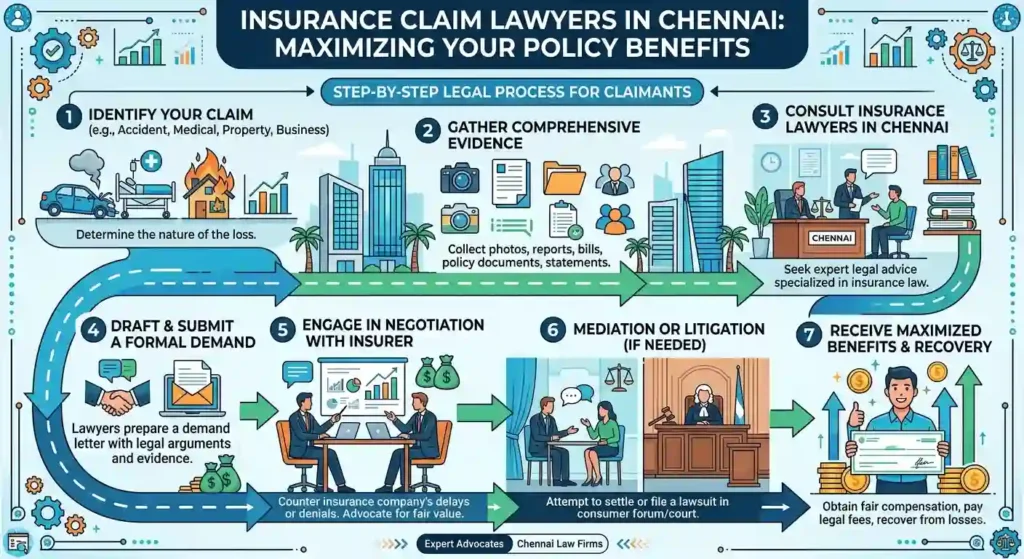
Maximizing insurance policy benefits requires more than submitting a claim form. Lawyers first examine coverage, insured risks, exclusions, deductibles, sub-limits, waiting periods, endorsements, and applicable conditions. Additionally, they compare the insurer’s decision with the actual policy wording. This approach can expose incorrect deductions, unsupported exclusions, or incomplete claim assessments. Policyholders should preserve claim forms, surveyor reports, medical records, invoices, photographs, correspondence, and payment receipts. Furthermore, claimants should avoid signing settlement documents without understanding their legal effect. A lawyer can prepare a detailed representation explaining entitlement and challenging unsupported deductions. IRDAI’s policyholder protection framework requires insurers to maintain grievance mechanisms and appropriate servicing standards. Therefore, early legal review can strengthen negotiations before formal proceedings. Ultimately, accurate documentation and focused legal arguments can improve the prospects of receiving the benefits legally payable.
Insurance Claim Dispute Resolution and Legal Remedies
Grounds for Challenging Insurance Claim Rejection
Insurance claim rejection may require challenge when the insurer misinterprets policy conditions or ignores relevant evidence. Common grounds include arbitrary repudiation, unreasonable delay, improper exclusion, inadequate investigation, and unsupported allegations of fraud. Moreover, insurers should communicate reasons for denial with reference to applicable policy conditions. IRDAI guidance specifically addresses reasoned denial and available grievance mechanisms for health insurance claims. Policyholders should therefore obtain the insurer’s written repudiation letter and claim assessment documents. A lawyer can analyse whether the stated reason actually falls within the contractual exclusion. Additionally, evidence can establish compliance with policy conditions and disclosure requirements. Where necessary, counsel can issue a formal legal representation demanding reconsideration. The representation should identify the policy clause, factual error, financial loss, and requested remedy. Consequently, a well-supported challenge can create a stronger record for subsequent proceedings before appropriate forums.
Insurance Ombudsman and Chennai Jurisdiction
The Insurance Ombudsman provides an alternative dispute resolution mechanism for eligible policyholder complaints. The Council for Insurance Ombudsmen administers Ombudsman offices under the Insurance Ombudsman Rules, 2017. A complainant generally must first approach the insurer or insurance broker. The Rules prescribe conditions concerning representation, response, limitation, and pending proceedings. Territorial jurisdiction can depend upon the insurer’s office or complainant’s residence. Therefore, Chennai residents should verify the appropriate Ombudsman jurisdiction before filing. Legal assistance can help prepare pleadings, documents, chronology, and relief requests. Additionally, the Ombudsman process may provide mediation or an award under applicable rules. The Rules also restrict parallel proceedings concerning the same subject matter. Consequently, choosing the correct forum at the beginning remains essential for effective insurance dispute resolution.
Consumer Commission Remedies for Insurance Disputes
Consumer Commissions can provide an important remedy where insurance services fall within applicable consumer protection law. The Consumer Protection Act, 2019 establishes specialised consumer dispute redressal mechanisms. Policyholders may raise allegations involving deficiency in service, unfair conduct, or wrongful claim handling. However, maintainability depends upon the claimant’s status, transaction circumstances, limitation, and other statutory requirements. Therefore, lawyers should assess jurisdiction before filing a consumer complaint. Appropriate relief may include payment of admissible claim amounts, compensation, interest, and litigation costs. Furthermore, documentary evidence should establish policy coverage, claim submission, insurer communications, and financial loss. Lawyers can also evaluate whether Ombudsman proceedings, consumer proceedings, arbitration, or civil remedies are more suitable. The correct strategy depends upon the policy, dispute value, facts, and procedural restrictions. Thus, professional advice helps prevent parallel proceedings and forum-selection mistakes. A focused consumer complaint can present the claim clearly and efficiently.
Evidence Required for Successful Insurance Claims
Insurance claim evidence often determines whether a policyholder can establish entitlement to benefits. Important records include the policy schedule, proposal form, premium receipts, claim form, discharge summary, invoices, diagnostic reports, photographs, FIR, survey reports, and insurer correspondence. Motor claims may require driving licence, registration certificate, repair estimates, and accident records. Property claims may require ownership documents, stock records, invoices, photographs, and fire or police reports. Furthermore, medical claims require relevant treatment records and hospital documents. Electronic communications should remain preserved in their original form wherever possible. The Bharatiya Sakshya Adhiniyam, 2023 governs evidence questions under India’s current evidentiary framework. Therefore, electronic records can require appropriate evidentiary handling. Lawyers should organise documents chronologically and identify contradictions within insurer assessments. Additionally, expert reports can help address valuation or technical disputes. A properly documented claim creates a stronger foundation for negotiation, grievance proceedings, consumer litigation, or other legal remedies.
Health Insurance Claim Disputes and Legal Support
Health insurance claim lawyers assist with cashless denials, reimbursement disputes, exclusions, co-payment issues, and alleged pre-existing conditions. IRDAI guidance states that insurers should settle or reject health claims within specified regulatory timelines. Insurers should ordinarily avoid repeatedly demanding documents outside applicable requirements. Therefore, claimants should preserve every document requested during claim processing. Hospital bills, prescriptions, diagnostic reports, discharge summaries, medical opinions, and correspondence can prove essential. Furthermore, claimants should obtain written reasons whenever insurers deny or reduce benefits. Lawyers can compare those reasons with the policy’s coverage and exclusions. They can also challenge unreasonable deductions and unsupported medical allegations. Additionally, urgent medical disputes may require prompt legal action to prevent financial hardship. The appropriate forum may include the insurer grievance mechanism, Bima Bharosa, Ombudsman, Consumer Commission, or court. Consequently, early legal intervention can protect both immediate reimbursement rights and broader contractual entitlements.
Life Insurance and Death Claim Disputes
Life insurance claim disputes can create serious financial consequences for nominees and legal heirs. Insurers may dispute claims through allegations concerning non-disclosure, policy conditions, nomination, documentation, or policy status. Therefore, beneficiaries should obtain the complete policy record and written claim decision. Relevant documents may include the policy bond, premium records, death certificate, nominee details, medical records, and insurer correspondence. Additionally, succession issues may arise where nomination does not resolve competing legal claims. Lawyers can examine the proposal form and underwriting documents before accepting an insurer’s allegations. Where the insurer alleges fraud or deliberate concealment, evidence becomes especially important. The Insurance Regulatory and Development Authority Act, 1999 establishes IRDAI’s statutory role in protecting policyholder interests. Consequently, legal counsel can coordinate grievance proceedings and appropriate litigation. The chosen remedy should consider limitation, jurisdiction, policy wording, claim value, and available evidence. Proper legal review can help beneficiaries pursue lawful policy benefits without unnecessary procedural delay.
Motor, Property and Commercial Insurance Claims
Motor and property insurance lawyers handle disputes involving accident damage, theft, fire, natural disasters, valuation, and business losses. Claims may involve surveyor assessments, depreciation deductions, repair costs, or total-loss calculations. Property disputes can involve inadequate sums insured, reinstatement costs, stock valuation, or disputed causation. Commercial policies may additionally cover machinery breakdown, business interruption, marine risks, or liability exposure. Furthermore, policyholders should notify insurers promptly and preserve damaged property when appropriate. Photographs, videos, invoices, survey reports, police records, and expert assessments can strengthen the claim. Where theft, arson, fraud, or forgery allegations arise, criminal-law issues may also emerge. The Bharatiya Nyaya Sanhita, 2023 and Bharatiya Nagarik Suraksha Sanhita, 2023 now govern relevant criminal offences and procedures. Therefore, appropriate police authorities may require separate engagement. However, criminal proceedings do not automatically determine contractual insurance entitlement. Legal strategy should coordinate evidence, insurance proceedings, police complaints, and civil or consumer remedies.
Bima Bharosa, IRDAI and Insurer Grievance Mechanisms
Bima Bharosa provides an important online grievance channel for insurance policyholders. IRDAI explains that Bima Bharosa enables complaint registration and status tracking. Policyholders should generally complain to the insurer before escalating unresolved grievances. IRDAI’s grievance framework allows escalation when the insurer fails to resolve the complaint satisfactorily. Therefore, claimants should retain acknowledgement numbers, emails, letters, and final responses. A lawyer can draft a precise grievance explaining coverage, claim history, disputed reasons, and requested relief. Additionally, counsel can identify whether Ombudsman or Consumer Commission proceedings remain available. Bima Bharosa does not replace statutory adjudication by courts or consumer forums. Consequently, claimants should use it strategically rather than treating registration as the final remedy. The official portal also warns users against payment requests or fraudulent QR codes. Proper grievance documentation can strengthen later legal proceedings and settlement negotiations.
Civil Courts, CPC and Insurance Litigation
Civil courts may remain relevant for insurance disputes where statutory jurisdiction permits such proceedings. The Code of Civil Procedure, 1908 generally governs civil court procedure, subject to special statutory mechanisms. Lawyers must first determine whether another forum has exclusive or concurrent jurisdiction. Furthermore, contractual disputes can involve interpretation of policy terms, indemnity obligations, damages, interest, and limitation. Arbitration clauses also require careful examination because their existence can influence dispute strategy. However, an arbitration clause does not automatically answer every jurisdictional question. Therefore, counsel should examine the policy, applicable statute, forum provisions, and nature of the dispute. Interim injunctions or other protective relief may become relevant where appropriate. Evidence must establish the contractual promise, insured event, compliance, breach, and resulting loss. Additionally, commercial insurance disputes may involve specialised commercial court procedures depending upon statutory requirements. Consequently, professional insurance litigation advice should precede filing. Choosing the correct forum can significantly influence cost, speed, jurisdiction, and available remedies.
Police Complaints and Criminal Insurance Fraud Issues
Insurance disputes sometimes involve alleged criminal conduct, including forgery, cheating, fraudulent documentation, or deliberate destruction of property. Such allegations require separate consideration under India’s current criminal-law framework. The Bharatiya Nyaya Sanhita addresses substantive offences, while the Bharatiya Nagarik Suraksha Sanhita governs criminal procedure. Therefore, parties should avoid using criminal complaints merely to pressure insurers into settlements. Genuine allegations require specific facts, supporting documents, and appropriate jurisdiction. A claimant may approach the police station having territorial jurisdiction over the alleged offence. Chennai has multiple police stations, so territorial jurisdiction should be verified from the incident location. Lawyers can assist with complaints, evidence preservation, and coordination with insurance proceedings. Furthermore, the Bharatiya Sakshya Adhiniyam governs evidentiary issues involving documents and electronic records. Consequently, criminal and insurance proceedings should maintain consistent factual positions. A carefully prepared complaint can protect legitimate interests without converting an ordinary contractual disagreement into an unsupported criminal allegation.
Insurance Legal Remedies and Strategic Representation
Insurance claim remedies depend upon the policy, dispute, claimant, amount, and applicable statutory forum. Available options may include insurer grievance proceedings, Bima Bharosa, Insurance Ombudsman, Consumer Commission, arbitration, civil litigation, or other statutory remedies. Additionally, criminal proceedings may apply where independent offences genuinely exist. Lawyers should therefore prepare a forum strategy before issuing notices or filing proceedings. The Insurance Ombudsman Rules contain specific conditions concerning prior representation and pending proceedings. Similarly, consumer litigation operates under the Consumer Protection Act, 2019 and its procedural framework. Evidence should support every material allegation and monetary demand. Furthermore, lawyers can negotiate settlements while preserving legal rights through carefully drafted communications. A strategic approach also considers limitation periods, jurisdiction, court fees, documentation, and likely defences. Consequently, professional insurance claim representation can improve clarity and reduce procedural mistakes. Rajendra Law Office LLP assists policyholders with claim review, legal notices, negotiations, grievances, and appropriate proceedings.
Why Choose Insurance Claim Lawyers in Chennai
Experienced insurance lawyers in Chennai can provide end-to-end support when insurers delay, reduce, or reject legitimate claims. Legal assistance begins with policy analysis and continues through documentation, representation, negotiation, and litigation. Furthermore, lawyers can identify whether the dispute belongs before an insurer grievance officer, Ombudsman, Consumer Commission, civil court, or another forum. They can also examine surveyor reports, medical records, valuation documents, and repudiation letters. Additionally, professional representation helps policyholders avoid inconsistent statements that insurers may later rely upon. Businesses can obtain assistance with large commercial claims, property losses, liability policies, and business interruption disputes. Individuals can receive support for health, life, motor, travel, and personal accident claims. NRIs can also obtain representation for Indian insurance disputes through appropriate legal arrangements. Consequently, timely advice can protect financial interests and preserve evidence. Rajendra Law Office LLP provides Chennai-focused insurance dispute support based on the facts, policy wording, applicable law, and available remedies.
Frequently Asked Questions About Insurance Claims
Can an insurer reject my claim without reasons?
Insurers should communicate applicable reasons and policy grounds for claim denial. A lawyer can examine whether the stated reasons properly apply to your policy.
Can I challenge a health insurance claim rejection?
Yes. You can challenge an improper rejection through insurer grievance channels, Bima Bharosa, Ombudsman proceedings, consumer remedies, or other appropriate legal proceedings.
Can I approach the Insurance Ombudsman in Chennai?
Eligibility and territorial jurisdiction depend upon applicable rules. The insurer’s office and complainant’s residence can influence the appropriate Ombudsman jurisdiction.
Can consumer forums award insurance claim compensation?
Consumer Commissions can provide statutory remedies where the complaint satisfies applicable requirements under the Consumer Protection Act, 2019.
Can a lawyer challenge an insurance settlement amount?
Yes. Counsel can review policy coverage, deductions, survey reports, valuation, exclusions, and correspondence before challenging an inadequate settlement.
Can NRIs pursue insurance claims in India?
Yes. NRIs can pursue eligible Indian insurance claims through appropriate representatives, grievance mechanisms, Ombudsman proceedings, consumer forums, or courts.
Read More
- Inside the Tribunal: Understanding Arbitral Roles
- Immigration Lawyers in India for Visa Applications
- Protecting Your Creativity: Understanding Copyright Law and Infringement Cases
- Environmental Lawyers in Chennai for Pollution Cases
- Divorce Settlement Lawyers in Chennai: Ensuring Fair Resolutions
- Insurance Regulatory and Development Authority of India (IRDAI)