
Domestic vs. International Arbitration – Disputes are a common part of business and personal relationships. However, resolving them through traditional court litigation can often be slow, expensive, and complex. As a result, many individuals and businesses today prefer arbitration, a form of alternative dispute resolution where a neutral third party decides the dispute outside the courtroom.
Arbitration has become increasingly popular because it offers flexibility, confidentiality, and faster results. However, arbitration is not the same in every situation. In fact, it can be broadly divided into domestic arbitration and international arbitration.
Understanding the difference between these two forms is essential, especially for businesses that operate across borders. While both aim to resolve disputes efficiently, they differ in procedures, legal frameworks, enforcement mechanisms, and complexity.
At Rajendra Law Office LLP, we frequently guide clients through both domestic and international arbitration matters. Therefore, this article explains the key differences, similarities, advantages, and practical considerations between domestic and international arbitration in a simple and clear way.
Domestic vs. International Arbitration: A Comparative View – Rajendra Law Office LLP
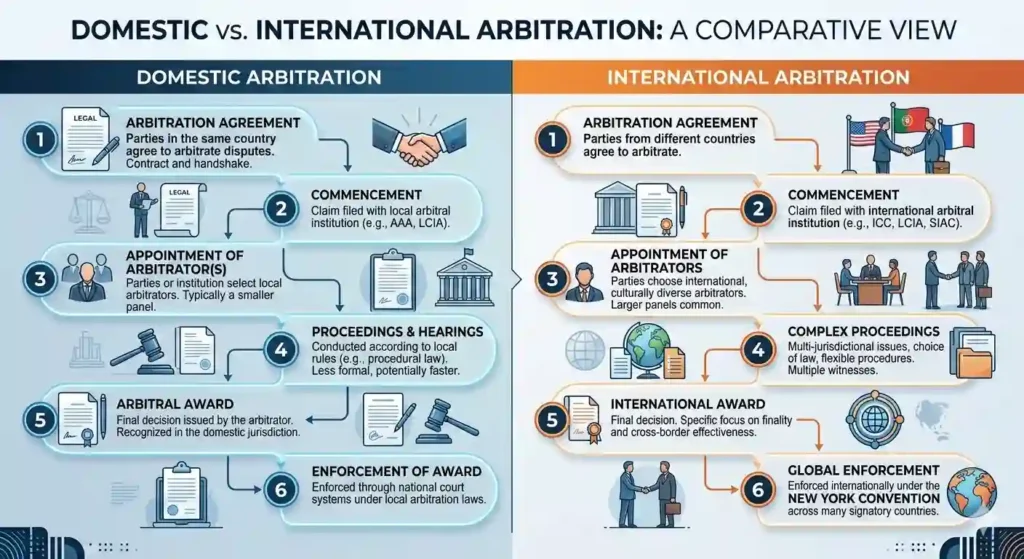
Understanding Arbitration
Before comparing the two types, it is important to understand what arbitration actually means.
Arbitration is a private dispute resolution process in which the parties agree to submit their dispute to an arbitrator or a panel of arbitrators. The arbitrator listens to both sides, examines evidence, and then issues a decision called an arbitral award.
Unlike mediation, arbitration leads to a binding decision that the parties must follow.
Many contracts today include an arbitration clause, which states that if a dispute arises, it will be resolved through arbitration instead of going to court.
In India, arbitration is mainly governed by the Arbitration and Conciliation Act, 1996.
What is Domestic Arbitration?
Domestic arbitration refers to arbitration where all parties are located within the same country and the dispute is governed by that country’s laws.
In India, arbitration is considered domestic when:
- All parties involved are Indian citizens or Indian companies
- The dispute arises within India
- The arbitration proceedings take place in India
For example, if two companies located in Chennai enter into a commercial contract and later face a dispute, they may resolve the matter through domestic arbitration.
Domestic arbitration usually follows the procedures laid down in national arbitration laws. In India, this means the Arbitration and Conciliation Act, 1996.
What is International Arbitration?
International arbitration, on the other hand, involves cross-border elements.
A dispute becomes international when:
- One of the parties is located in another country
- The contract involves international trade or transactions
- The arbitration seat is outside the country
- The dispute relates to international commercial activities
For example, suppose an Indian company signs a contract with a company in Singapore. If a dispute arises and they choose arbitration to resolve it, the process becomes international arbitration.
These disputes often involve international rules and institutions, and they may be conducted in neutral locations.
Legal Framework Governing Arbitration
One of the most important differences between domestic and international arbitration is the legal framework.
Domestic Arbitration Law
Domestic arbitration is governed by the national law of the country.
In India, the main law is:
- Arbitration and Conciliation Act, 1996
This law sets rules for:
- Appointment of arbitrators
- Conduct of proceedings
- Enforcement of awards
- Court intervention
Indian courts may also play a role in supervising the arbitration process.
International Arbitration Law
International arbitration relies on a combination of national laws and international conventions.
Some important international frameworks include:
- UNCITRAL Model Law
- New York Convention on Recognition and Enforcement of Foreign Arbitral Awards
- Institutional arbitration rules such as ICC, LCIA, and SIAC
These frameworks ensure that arbitration awards can be recognized and enforced across different countries.
Key Differences Between Domestic and International Arbitration
Although both systems aim to resolve disputes efficiently, several important differences exist.
1. Nature of Dispute
Domestic arbitration deals with local disputes within the same country.
International arbitration involves cross-border commercial disputes.
Therefore, international arbitration often includes more complex legal and commercial issues.
2. Applicable Law
In domestic arbitration, one country’s law usually governs the entire process.
However, in international arbitration:
- The contract law may belong to one country
- The arbitration seat may be in another country
- The parties may come from different countries
Because of this, multiple legal systems may be involved.
3. Arbitration Institutions
Domestic arbitration often takes place through local arbitration centers or ad hoc procedures.
International arbitration frequently involves global arbitration institutions such as:
- International Chamber of Commerce (ICC)
- Singapore International Arbitration Centre (SIAC)
- London Court of International Arbitration (LCIA)
These institutions provide structured rules and administrative support.
4. Appointment of Arbitrators
In domestic arbitration, arbitrators are usually local legal professionals or industry experts.
In international arbitration, parties often appoint arbitrators from different countries to ensure neutrality.
For example, an Indian and European company may appoint a neutral arbitrator from a third country.
5. Language of Proceedings
Domestic arbitration usually takes place in the official or common language of the country.
However, international arbitration commonly uses English or another mutually agreed language.
This helps parties from different countries participate effectively.
6. Enforcement of Awards
Enforcement is another major difference.
Domestic arbitral awards are enforced within the country under national laws.
International arbitral awards, however, rely on international treaties for enforcement. The most important one is the New York Convention, which allows arbitration awards to be enforced in more than 160 countries.
Because of this, international arbitration is often preferred for global commercial disputes.
Advantages of Domestic Arbitration
Domestic arbitration offers several practical benefits.
Faster Resolution
Domestic disputes usually involve fewer legal complexities. Therefore, proceedings can be completed more quickly.
Lower Costs
Because the process is local, expenses related to travel, foreign lawyers, and international institutions are reduced.
Familiar Legal Environment
Parties are already familiar with the legal system, language, and procedures, which simplifies the process.
Easier Evidence Collection
Since witnesses and documents are located within the same country, gathering evidence becomes easier.
Advantages of International Arbitration
International arbitration also provides important advantages, especially for global businesses.
Neutral Forum
International arbitration offers a neutral platform where neither party has an advantage based on home country courts.
Global Enforcement
Through international conventions, arbitration awards can be enforced in many countries worldwide.
Flexibility
Parties have the freedom to choose:
- Arbitration rules
- Location of arbitration
- Arbitrators
- Language of proceedings
Confidentiality
International arbitration maintains a high level of confidentiality, which is particularly important in commercial disputes.
Challenges in Domestic Arbitration
Despite its advantages, domestic arbitration may face certain challenges.
Court Intervention
In some cases, parties approach courts during arbitration proceedings, which may cause delays.
Procedural Delays
Although arbitration is meant to be faster than litigation, delays may still occur due to procedural issues.
Limited Global Enforcement
Domestic awards may not always be easily enforceable outside the country.
Challenges in International Arbitration
International arbitration also presents its own difficulties.
Higher Costs
International proceedings often involve:
- Foreign legal counsel
- Institutional fees
- Travel expenses
This can make the process more expensive.
Complex Legal Issues
Multiple legal systems may apply, which increases complexity.
Cultural and Legal Differences
Different legal traditions, business practices, and languages can sometimes create misunderstandings.
Role of Arbitration Lawyers
Experienced arbitration lawyers play a crucial role in both domestic and international disputes.
At Rajendra Law Office LLP, our legal professionals assist clients in:
- Drafting arbitration clauses in contracts
- Representing parties in arbitration proceedings
- Selecting appropriate arbitration institutions
- Enforcing arbitral awards
- Handling cross-border disputes
Proper legal guidance ensures that arbitration proceedings remain efficient and legally sound.
Importance of a Well-Drafted Arbitration Clause
A clear arbitration clause can prevent many disputes later.
A strong arbitration clause should specify:
- The seat of arbitration
- Number of arbitrators
- Applicable arbitration rules
- Language of proceedings
- Governing law of the contract
Without these details, parties may face confusion and delays during arbitration.
Therefore, businesses should always seek professional legal advice when drafting arbitration clauses.
Arbitration in the Modern Business World
In today’s global economy, businesses increasingly rely on arbitration to resolve disputes.
International trade, cross-border investments, and multinational partnerships create complex legal relationships. As a result, arbitration provides a reliable and efficient dispute resolution mechanism.
Many governments, including India, are actively promoting arbitration to reduce the burden on courts and improve the ease of doing business.
Recent legal reforms have also strengthened India’s position as an emerging arbitration hub.
Frequently Asked Questions
The main difference lies in the nature of the parties and the scope of the dispute. Domestic arbitration occurs when all parties involved are from the same country and the dispute arises within that country. The proceedings are governed primarily by national arbitration laws. For example, in India, domestic arbitration is regulated by the Arbitration and Conciliation Act, 1996.
Businesses should consider international arbitration when entering into cross-border contracts or global commercial transactions. This method provides a neutral forum where neither party has an advantage based on its home country’s courts. Additionally, international arbitration allows parties to choose the place of arbitration, applicable law, language of proceedings, and arbitrators with relevant expertise.
Yes, arbitration is generally faster than court litigation. Arbitration proceedings are more flexible because the parties can decide timelines, hearing procedures, and evidence rules. Unlike court cases, which may take several years due to heavy caseloads and procedural delays, arbitration often leads to quicker resolution. Moreover, arbitrators focus solely on the specific dispute, which allows them to issue decisions more efficiently.
Yes, arbitration awards are legally binding and enforceable. In domestic arbitration, the award can be enforced through the courts of the same country under national arbitration laws. In international arbitration, enforcement is supported by international treaties such as the New York Convention, which allows arbitral awards to be recognized and enforced in many countries around the world.
Although arbitration is less formal than court litigation, having experienced legal representation is highly recommended. Arbitration lawyers help parties draft strong arbitration clauses, present legal arguments, submit evidence, and ensure compliance with procedural rules. In complex domestic or international disputes, legal expertise becomes even more important because arbitration often involves contractual interpretation, commercial regulations, and procedural strategy. A skilled arbitration lawyer can also help enforce arbitral awards and protect the client’s legal and financial interests throughout the dispute resolution process.
Conclusion
Arbitration has become one of the most important methods of resolving disputes in modern legal systems. Both domestic arbitration and international arbitration provide effective alternatives to traditional court litigation.
While domestic arbitration is simpler, faster, and more cost-effective for local disputes, international arbitration offers neutrality and global enforceability for cross-border conflicts. However, each type of arbitration has its own legal framework, procedures, and challenges. Therefore, parties must carefully evaluate their needs and draft appropriate arbitration agreements. With proper legal planning and professional guidance, arbitration can provide a fair, efficient, and confidential solution to disputes.
At Rajendra Law Office LLP, we are committed to helping clients navigate both domestic and international arbitration with clarity and confidence. Our experienced legal team ensures that disputes are resolved effectively while protecting the interests of our clients in India and across the world.
Read More
- Finding the Right Defense: How to Select Your Criminal Defense Attorney
- Wills and Trusts Lawyers in Chennai: Securing Your Legacy
- Dispelling Myths: Common Misconceptions About Criminal Defense Lawyers Service
- Discover the Best Lawyers in Chennai: Excellence in Legal Representation
- Navigating the Criminal Defense Process: Essential Steps and Considerations
- Ministry of Law and Justice – Arbitration and Conciliation Act, 1996
- Expert Arbitration Services: Resolve Disputes with The Best Lawyers in Chennai 📚
- Understanding Arbitration Awards: Supreme Court’s Approach 📜
- Arbitration Lawyers in Chennai for Dispute Resolution 🔍
- Navigating Peace: Unveiling the Power of Arbitration Service in Chennai 🏛️
- Domestic Violence Cases: How the Supreme Court Interprets Protection Laws 👨⚖️
- Expanding Globally: Legal Considerations in International Business