At Rajendra Law Office LLP, we guide clients carefully through every stage of the criminal justice system. In this article, we explain the essential steps and important considerations in simple language, so you clearly understand what happens and how to respond wisely.
Navigating the Criminal Defense Process: Essential Steps and Considerations – Rajendra Law Office LLP
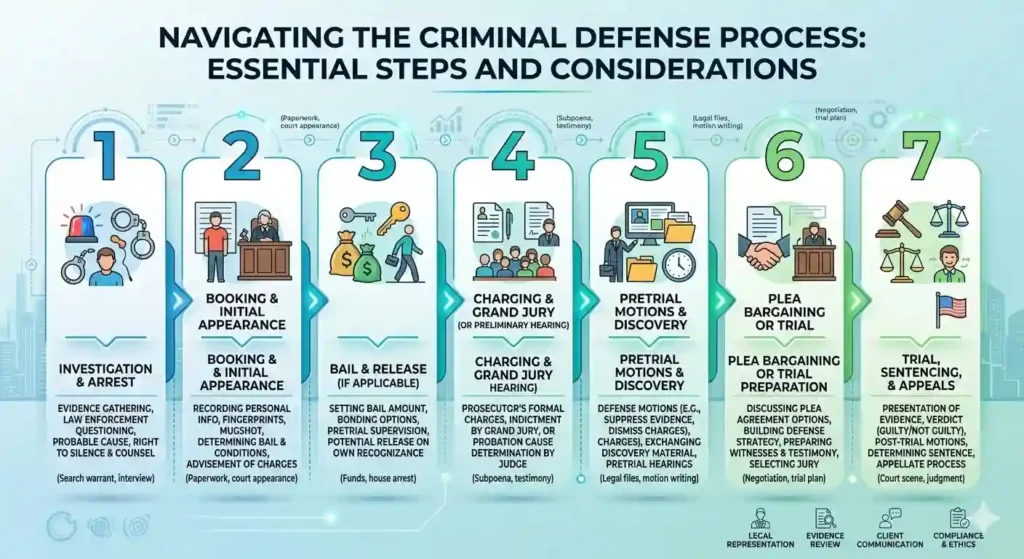
Understanding the Nature of Criminal Charges
First and foremost, you must understand the type of charge filed against you. Criminal offences in India generally fall under the Indian Penal Code and other special laws. Offences may range from minor bailable offences to serious non-bailable crimes.
Therefore, the seriousness of the charge determines the legal strategy, possible punishment, and court procedure. A proper legal review of the FIR (First Information Report) becomes the starting point of your defense.
Step 1: Registration of FIR
The criminal process usually begins with the registration of an FIR under the Code of Criminal Procedure. The police record the complaint and begin investigation.
At this stage, you must act carefully. Avoid giving unnecessary statements. Instead, consult a criminal defense lawyer immediately. Early legal advice can prevent mistakes that may harm your case later.
Step 2: Investigation by Police
After registering the FIR, the police start investigating. They may collect documents, record witness statements, conduct searches, or seize materials.
However, you still have rights. For example, you have the right to legal representation during questioning. Additionally, police must follow lawful procedures while conducting searches or arrests.
Therefore, always cooperate respectfully but assert your legal rights firmly.
Step 3: Arrest and Bail
Not all cases lead to immediate arrest. In some cases, police may issue a notice under Section 41A of the Code of Criminal Procedure instead of arresting you.
If arrest becomes necessary, you have the right to apply for bail. Bail allows temporary release while the trial continues. Courts consider factors such as:
- Nature of the offence
- Past criminal record
- Possibility of tampering with evidence
- Risk of fleeing
In serious cases, anticipatory bail can protect you from arrest. Therefore, quick legal action is essential.
Step 4: Filing of Charge Sheet
Once the investigation concludes, the police file a charge sheet before the court. This document contains details of allegations, witness statements, and evidence collected.
At this stage, your lawyer carefully examines the charge sheet. If the evidence appears weak or legally flawed, your advocate may file a discharge petition.
Thus, early scrutiny of documents can significantly strengthen your defense.
Step 5: Framing of Charges
If the court finds sufficient grounds, it frames formal charges. This means the court officially informs you about the accusations.
You then plead guilty or not guilty. Naturally, most accused persons plead not guilty and choose to contest the case.
From this point onward, the trial formally begins.
Step 6: Trial Proceedings
The trial stage involves examination of witnesses and presentation of evidence. The prosecution first presents its witnesses. Your defense lawyer cross-examines them to test credibility and expose inconsistencies.
After prosecution evidence concludes, you may present defense witnesses or documents if necessary.
Throughout the trial, courts follow procedures under the Code of Criminal Procedure to ensure fairness.
Therefore, preparation, strategy, and courtroom skill play a crucial role at this stage.
Step 7: Final Arguments and Judgment
After evidence is completed, both sides present final arguments. The defense lawyer highlights contradictions, lack of proof, and legal gaps.
Remember, the burden of proof lies on the prosecution. They must prove guilt beyond reasonable doubt. If doubt exists, the court must acquit the accused.
Finally, the judge delivers the judgment—either conviction or acquittal.
If Convicted: Sentencing and Appeal
If the court convicts you, the next stage is sentencing. The court considers:
- Nature of offence
- Circumstances of the case
- Personal background
- Mitigating factors
However, conviction does not mean the end. You have the right to appeal before a higher court. Appellate courts review legal errors, evidence assessment, and procedural irregularities.
Therefore, even after conviction, legal remedies remain available.
Importance of Legal Strategy
Every criminal case is unique. Therefore, a one-size-fits-all approach does not work.
A strong legal strategy may include:
- Seeking anticipatory bail
- Filing quash petitions
- Challenging illegal investigation
- Cross-examining effectively
- Negotiating plea arrangements (where legally permitted)
At Rajendra Law Office LLP, we design defense strategies based on facts, law, and long-term consequences.
Protecting Your Constitutional Rights
The Constitution of India protects fundamental rights. Under Constitution of India, you have the right to:
- Remain silent
- Legal representation
- Fair trial
- Protection against self-incrimination
Understanding these rights prevents misuse of authority and ensures due process.
Common Mistakes to Avoid
During criminal proceedings, many individuals unknowingly damage their case. Therefore, avoid these common mistakes:
- Discussing case details publicly
- Posting about the case on social media
- Contacting witnesses directly
- Ignoring court summons
- Delaying legal consultation
Instead, maintain discipline and rely on professional guidance.
Role of Documentation and Evidence
Proper documentation can change the outcome of a case. Preserve:
- Communication records
- CCTV footage
- Financial statements
- Medical reports
- Call logs
Timely preservation prevents loss of critical evidence.
Emotional and Social Impact
Criminal cases not only affect legal standing but also impact personal and professional life. Stress, stigma, and uncertainty can take a toll.
Therefore, emotional support and clear communication with your lawyer become equally important. Confidence grows when you understand each stage clearly.
How Rajendra Law Office LLP Assists You
At Rajendra Law Office LLP, we stand firmly beside our clients from the first notice to final judgment. We:
- Provide confidential consultations
- Analyze FIR and evidence carefully
- File bail and anticipatory bail applications
- Conduct strategic cross-examinations
- Handle appeals before higher courts
Most importantly, we focus on protecting your rights and reputation.
Preventive Legal Advice
Prevention is always better than cure. If you sense potential legal risk—such as business disputes turning criminal or false allegations—seek early legal advice.
Proactive legal planning often prevents escalation into full criminal proceedings.
Frequently Asked Questions
First, remain calm and avoid making detailed statements without legal advice. An FIR registered under the Code of Criminal Procedure starts the investigation process. Therefore, you should immediately consult a criminal defense lawyer. Early legal guidance helps protect your rights, prevents self-incrimination, and allows you to plan the next steps strategically, including applying for anticipatory bail if required.
Bail depends on the nature of the offence. In bailable offences, bail is generally granted as a right. However, in non-bailable offences, the court decides based on seriousness, evidence, and risk factors. Courts consider whether the accused may tamper with evidence or flee. Therefore, a properly drafted bail application and strong arguments significantly improve the chances of release.
During trial, the prosecution presents witnesses and evidence first. Your defense lawyer then cross-examines those witnesses to test their credibility. After that, the defense may present its own evidence if necessary. The burden of proof lies on the prosecution to establish guilt beyond reasonable doubt under the Indian Penal Code and related laws. If doubt exists, the court must acquit the accused.
Under the Constitution of India, you have the right to remain silent, the right against self-incrimination, and the right to a fair trial with legal representation. These rights ensure due process and protect individuals from unlawful treatment.
Yes. If convicted, you have the legal right to file an appeal before a higher court. The appellate court reviews legal errors, evidence assessment, and procedural fairness before delivering its decision.
Conclusion
Navigating the criminal defense process may appear complex. However, with the right knowledge and legal support, you can face it confidently. Each stage—from FIR to judgment—follows structured legal procedures designed to ensure fairness.
Therefore, never panic. Instead, act quickly, stay informed, and consult experienced legal professionals.
At Rajendra Law Office LLP, we guide you through every step with clarity, strength, and dedication. When your freedom and reputation are at stake, informed action makes all the difference.
Read More
- Environmental Law: Compliance and Protection Strategies
- Demystifying Different Types of Bail: A Comprehensive Guide
- Consumer Protection Lawyers in Chennai: Advocates for Consumer Rights
Demystifying Criminal Law: Understanding Legal Proceedings and Cases - Family Lawyers in Chennai: Compassionate Legal Support for Your Family
- National Legal Services Authority