
Mastering Mergers and Acquisitions – M&A transaction structure: Mergers and acquisitions require careful planning before parties sign binding documents. Companies may choose share purchases, asset purchases, amalgamations, or court-approved schemes. Each structure creates different tax, liability, regulatory, and governance consequences. Therefore, legal teams should assess commercial objectives before selecting the transaction route. Share acquisitions transfer ownership interests and may preserve the target’s existing contracts. Conversely, asset acquisitions can isolate selected assets and liabilities. Section 230 of the Companies Act, 2013 governs compromise and arrangement procedures. Section 232 addresses mergers and amalgamations through statutory processes. Additionally, listed companies face SEBI requirements and disclosure obligations. CCI approval may also arise where competition thresholds or deal-value conditions apply. The Competition Commission’s 2024 framework introduced important combination regulations and criteria. Rajendra Law Office LLP helps clients select structures that balance control, risk, compliance, and commercial objectives.
Mastering Mergers and Acquisitions: Legal Insights and Strategies – Rajendra Law Office LLP
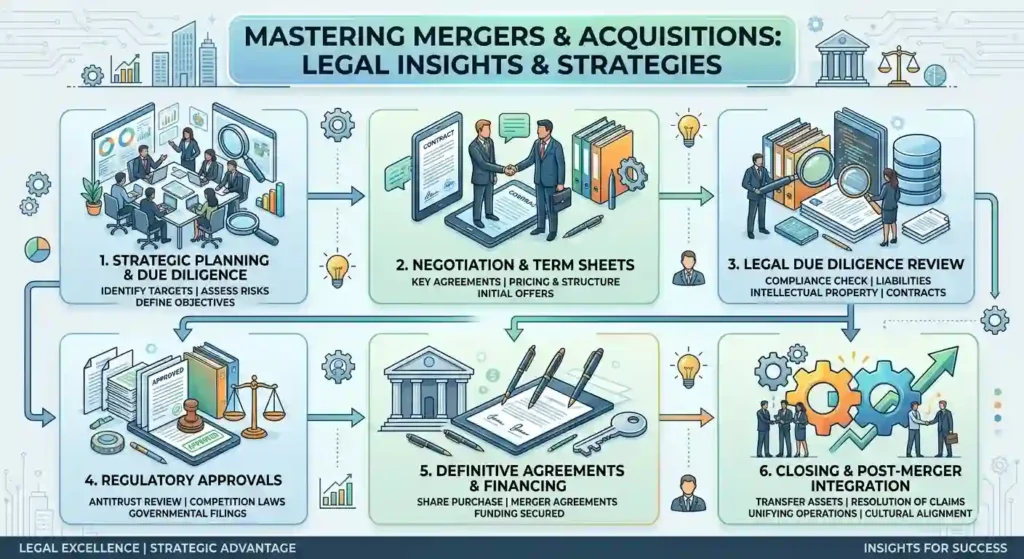
Due Diligence and Risk Identification
M&A due diligence: Due diligence identifies legal risks before parties commit substantial capital. Lawyers examine corporate records, contracts, litigation, intellectual property, employment matters, property, taxation, and regulatory approvals. Furthermore, financial statements require legal review for undisclosed liabilities and contingent claims. Regulatory due diligence should identify licences, permits, sector restrictions, and government approvals. Therefore, counsel should prepare a transaction-specific due diligence checklist. Key areas commonly include:
- Corporate ownership and authority.
- Material contracts and termination rights.
- Pending litigation and regulatory notices.
- Intellectual property ownership.
- Employee obligations and disputes.
- Tax exposures and statutory defaults.
Additionally, lawyers should investigate related-party transactions and shareholder arrangements. Change-of-control clauses can create unexpected termination risks. Environmental obligations may also affect valuation and post-closing liabilities. Consequently, due diligence findings should influence price, warranties, indemnities, conditions precedent, and closing arrangements. Rajendra Law Office LLP provides structured legal due diligence for Indian and cross-border acquisitions.
Share Purchase Agreements
SPA legal protection: A Share Purchase Agreement records the principal rights and obligations of acquisition parties. It should clearly identify consideration, transferred securities, completion conditions, warranties, indemnities, and termination rights. Furthermore, representations should accurately describe the target’s legal and commercial position. Buyers typically seek protection against undisclosed liabilities and inaccurate disclosures. Sellers, however, require appropriate limitations on liability and post-closing claims. Therefore, negotiations should address caps, baskets, survival periods, exclusions, and claim procedures. Conditions precedent may include regulatory approvals, lender consents, shareholder approvals, and third-party permissions. Additionally, restrictive covenants can regulate conduct between signing and closing. Escrow arrangements may secure contingent liabilities or deferred consideration. Non-compete and confidentiality provisions require careful drafting under applicable Indian law. Consequently, a professionally drafted SPA can reduce ambiguity and future disputes. Rajendra Law Office LLP assists promoters, investors, companies, and strategic acquirers with negotiation and documentation.
Regulatory Compliance
Companies Act Requirements
Companies Act compliance: Indian mergers and amalgamations frequently require compliance with the Companies Act, 2013. Sections 230 and 232 provide statutory mechanisms for schemes involving companies. The National Company Law Tribunal generally supervises these scheme proceedings. Therefore, companies must prepare notices, disclosures, financial information, valuation materials, and scheme documents carefully. Shareholder and creditor approvals may become necessary according to statutory requirements. Furthermore, regulatory authorities can receive notices and raise objections during proceedings. The Registrar of Companies and Official Liquidator may participate where applicable. Additionally, listed companies require coordination with SEBI and stock exchange requirements. The transaction should also satisfy accounting, tax, and corporate governance obligations. Consequently, early legal planning reduces procedural delays and documentation defects. Counsel should examine the company’s constitutional documents and shareholder rights before proposing a scheme. Rajendra Law Office LLP provides legal assistance for NCLT merger petitions, corporate approvals, documentation, hearings, and implementation.
Competition Commission Approval
CCI merger control: Competition law can significantly affect Indian mergers and acquisitions. Section 5 of the Competition Act defines combinations subject to prescribed thresholds and conditions. Section 6 regulates combinations that may cause an appreciable adverse effect on competition. The CCI currently operates under its updated 2024 combination framework. Therefore, transaction parties should conduct merger-control analysis before signing or implementing a deal. Deal value thresholds can matter alongside traditional asset and turnover tests. Exemptions may apply to specified transactions or categories. Furthermore, the CCI can modify or prohibit combinations creating competitive harm. Parties should assess relevant markets, competitors, market shares, overlaps, and vertical relationships. Regulatory filings require accurate and complete transaction information. Consequently, early CCI analysis helps prevent implementation delays and penalties. Rajendra Law Office LLP assists businesses with combination assessment, notifications, regulatory submissions, and competition-law strategy.
SEBI and Listed Company Rules
Listed company M&A compliance: Acquisitions involving listed companies require detailed SEBI compliance. The SEBI Takeover Regulations, 2011 regulate substantial acquisitions and changes in control. SEBI’s official regulations list shows the Takeover Regulations were amended through December 2025. Listed entities must also comply with current Listing Obligations and Disclosure Requirements. SEBI records show the LODR Regulations were amended as recently as July 2026. Therefore, transaction counsel must verify current disclosure and takeover requirements. Public announcements, open offers, shareholder disclosures, and pricing rules may become relevant. Furthermore, insider trading restrictions require careful information handling during negotiations. Confidential information should remain controlled through appropriate protocols and access restrictions. Stock exchanges may require filings before specified transaction milestones. Consequently, listed-company acquisitions demand coordinated corporate, securities, and competition-law advice. Rajendra Law Office LLP advises promoters, acquirers, listed companies, and shareholders regarding regulatory compliance and transaction execution.
M&A Documentation and Closing
Valuation and Consideration
Transaction valuation: Valuation determines whether an acquisition produces acceptable commercial value for both sides. Lawyers do not replace financial advisers, but they examine valuation-related legal requirements. Companies may require independent valuation reports for statutory schemes or specific transactions. Furthermore, consideration can involve cash, shares, debt instruments, earn-outs, or combinations. Each payment method creates different legal and regulatory consequences. Therefore, transaction documents should define consideration mechanics precisely. Adjustments may address working capital, debt, cash, leakage, or closing accounts. Earn-outs require objective performance measures and dispute mechanisms. Additionally, foreign investment transactions may require compliance with FEMA and applicable RBI rules. Cross-border acquisitions can also involve tax withholding, exchange-control, and reporting requirements. Consequently, valuation should connect clearly with contractual payment protections. Rajendra Law Office LLP reviews consideration clauses, valuation documentation, adjustment mechanisms, and regulatory conditions to reduce financial disputes after closing.
Employment and Intellectual Property
Employee and IP protection: M&A transactions can create significant employment and intellectual property risks. Buyers should verify employee contracts, benefits, incentives, disputes, and statutory contributions. Furthermore, key employees may possess confidential knowledge essential to the target’s value. Intellectual property due diligence should confirm ownership, registrations, licences, assignments, and infringement risks. Software acquisitions require additional review of source-code rights and open-source compliance. Therefore, transaction documents should address confidentiality, employee retention, IP assignments, and post-closing obligations. Change-of-control provisions can affect technology licences and commercial agreements. Additionally, employee transfers may require consultation with applicable employment laws and contractual arrangements. Trademark portfolios should include registrations, oppositions, renewals, and licensing arrangements. Patent ownership should receive similar attention where technology drives valuation. Consequently, employment and IP risks should influence warranties, indemnities, and closing conditions. Rajendra Law Office LLP provides legal support for workforce, technology, trademark, copyright, patent, and confidentiality issues arising during acquisitions.
Closing and Post-Closing Obligations
Closing management: Closing converts agreed transaction terms into completed legal and commercial actions. Parties should maintain a detailed closing checklist covering every condition precedent. These may include regulatory approvals, corporate resolutions, lender consents, third-party approvals, and document execution. Furthermore, closing mechanics should specify delivery of shares, consideration, certificates, registers, and statutory filings. Companies must update corporate records and ownership information where applicable. Therefore, lawyers should coordinate transaction documents with company secretarial and regulatory teams. Post-closing obligations may include integration, deferred payments, escrow releases, indemnity claims, and continuing disclosures. Listed companies may face additional stock exchange reporting duties. Additionally, CCI conditions may influence post-closing conduct where remedies accompany approval. Consequently, closing should not be treated as the end of legal work. Rajendra Law Office LLP assists clients with closing documentation, statutory filings, post-closing compliance, indemnity claims, and transaction integration support.
Disputes, Remedies and M&A Legal Support
Resolving M&A Disputes
Shareholder and Director Disputes
Corporate governance disputes: M&A transactions can generate disputes among shareholders, directors, promoters, and investors. Common issues include valuation disagreements, voting rights, control arrangements, oppression, mismanagement, and breach of shareholder agreements. The Companies Act provides statutory remedies for qualifying corporate disputes. Therefore, parties should examine governance documents before commencing litigation. NCLT jurisdiction may become relevant for oppression and mismanagement proceedings. Additionally, contractual disputes may proceed before civil courts or arbitration forums. Arbitration clauses require careful review before initiating court proceedings. Furthermore, interim relief can protect shares, assets, confidential information, or voting rights. Evidence should include board minutes, shareholder agreements, emails, notices, and transaction documents. Consequently, early legal intervention can prevent disputes from disrupting business operations. Rajendra Law Office LLP represents shareholders, promoters, directors, and investors before NCLT, courts, arbitral tribunals, and appropriate forums.
Breach of Transaction Agreements
M&A contractual disputes: Parties may dispute warranties, indemnities, consideration adjustments, earn-outs, completion accounts, or closing conditions. A breach may create claims for damages, specific performance, indemnification, or termination. Therefore, lawyers should examine the agreement’s dispute-resolution and governing-law provisions first. Arbitration may apply where parties included a valid arbitration clause. Civil courts may retain jurisdiction for matters not reserved for arbitration. Furthermore, limitation periods can determine whether a contractual claim remains enforceable. Evidence should establish the contractual promise, breach, causation, and resulting loss. Additionally, indemnity claims require compliance with contractual notice and procedure requirements. Buyers should preserve due diligence records supporting alleged breaches. Sellers should document disclosures and contractual limitations protecting their position. Consequently, precise contract interpretation becomes central to M&A dispute resolution. Rajendra Law Office LLP provides legal representation for contractual claims, arbitration, settlement negotiations, and court proceedings arising from acquisitions.
NCLT and Tribunal Proceedings
NCLT merger jurisdiction: NCLT plays an important role in statutory merger and amalgamation schemes. Companies may also encounter NCLT proceedings involving shareholder disputes, insolvency, or corporate restructuring. Therefore, transaction counsel should understand the forum’s jurisdiction before preparing applications. NCLAT generally hears appeals from qualifying NCLT orders under applicable legislation. Insolvency-related acquisitions can additionally involve the Insolvency and Bankruptcy Code. Furthermore, transaction timelines may depend upon tribunal orders and regulatory responses. Accurate petitions, affidavits, notices, and supporting documents remain essential. Creditors and shareholders may also raise objections during scheme proceedings. Consequently, counsel should anticipate objections before filing the transaction scheme. Companies must coordinate NCLT proceedings with CCI, SEBI, MCA, and other regulatory requirements. Rajendra Law Office LLP assists companies with NCLT schemes, corporate restructuring, objections, appeals, and tribunal representation. Proper coordination can reduce inconsistent filings and transaction delays.
Legal Remedies and Strategic Support
Injunctions and Interim Relief
Protective legal remedies: M&A disputes can require immediate relief before final adjudication. Courts and tribunals may grant interim measures under applicable statutes and procedural rules. The CPC can become relevant in civil proceedings involving injunctions, contracts, property, or confidential information. Arbitration matters may involve interim relief under the Arbitration and Conciliation Act. Furthermore, NCLT and other tribunals possess statutory powers for specified corporate disputes. Therefore, applicants should establish urgency, legal rights, threatened harm, and appropriate relief. Typical protection may address asset transfers, share dealings, confidential information, management actions, or contractual breaches. Evidence should demonstrate the immediate risk rather than merely describe commercial disagreement. Additionally, applicants should consider whether monetary compensation could adequately address the harm. Consequently, interim applications require precise drafting and credible supporting documents. Rajendra Law Office LLP assists clients with injunctions, stays, interim applications, arbitration measures, and urgent corporate dispute representation before competent forums.
Criminal and Regulatory Issues
Fraud and regulatory violations: M&A transactions may reveal fraud, forgery, dishonest concealment, misappropriation, or other criminal conduct. The Bharatiya Nyaya Sanhita, 2023 now provides the principal criminal law framework. The BNSS governs criminal procedure, while the BSA governs evidence. Therefore, alleged criminal conduct requires separate analysis from ordinary contractual breaches. Police complaints may become appropriate when facts disclose cognisable offences. However, commercial disagreements should not automatically become criminal complaints. Lawyers should examine intent, conduct, evidence, and statutory ingredients before recommending police action. Furthermore, regulatory violations may require complaints before SEBI, CCI, MCA, RBI, or other authorities. Digital evidence can become important in proving communications and transactions. Consequently, legal strategy should coordinate criminal, civil, arbitration, and regulatory remedies carefully. Rajendra Law Office LLP assists clients with regulatory representations, police complaints, evidence preservation, and related litigation. Early assessment can protect businesses from escalating legal and reputational risks.
Cross-Border M&A Transactions
International acquisition compliance: Cross-border M&A transactions involve additional regulatory, tax, currency, and jurisdictional issues. Foreign investment rules may apply depending upon the investor, sector, instrument, and transaction structure. FEMA and RBI regulations can govern foreign exchange aspects. Furthermore, tax treaties and withholding obligations may affect transaction economics. Data transfers and intellectual property arrangements may require additional compliance analysis. Sanctions, anti-bribery obligations, and export controls can also affect international transactions. Therefore, cross-border due diligence should examine both Indian and foreign legal requirements. Dispute clauses should clearly specify governing law, arbitration rules, seat, and enforcement mechanisms. Additionally, parties should consider recognition and enforcement of foreign awards or judgments. Consequently, international M&A requires coordinated multi-jurisdictional legal advice. Rajendra Law Office LLP supports Indian companies, foreign investors, NRIs, and multinational businesses with transaction structuring, regulatory approvals, documentation, and dispute resolution. Careful planning reduces cross-border enforcement and compliance risks.
M&A Legal Support by Rajendra Law Office LLP
End-to-end transaction assistance: Successful M&A requires legal support from initial negotiations through post-closing integration. Rajendra Law Office LLP assists promoters, companies, investors, shareholders, directors, and foreign participants. Our services cover due diligence, transaction structuring, term sheets, SPAs, merger schemes, regulatory filings, and closing documentation. Furthermore, we assess CCI, SEBI, MCA, FEMA, NCLT, and sector-specific requirements. Dispute support can include arbitration, civil litigation, NCLT proceedings, regulatory representations, and interim relief. Criminal issues may require coordination with police authorities under BNS and BNSS. Additionally, evidence review follows applicable principles under the BSA. We also assist with post-closing indemnity claims and contractual disputes. Therefore, clients receive coordinated advice throughout the transaction lifecycle. Our approach focuses on commercial objectives, legal compliance, risk allocation, and enforceability. Consequently, early legal involvement can prevent expensive transaction failures and disputes. Rajendra Law Office LLP provides practical M&A legal guidance for domestic and international transactions across India.
Frequently Asked Questions
What laws govern mergers and acquisitions in India?
The Companies Act, Competition Act, SEBI regulations, FEMA, tax laws, and sector rules can apply. The correct framework depends upon transaction structure and parties.
Does every merger require CCI approval?
Not every merger requires notification. CCI rules contain thresholds and exemptions. Therefore, parties should assess asset, turnover, deal value, market impact, and applicable exemptions.
What is NCLT’s role in mergers?
NCLT supervises statutory merger and amalgamation schemes under the Companies Act. It considers stakeholder approvals, regulatory observations, objections, and statutory compliance before sanctioning eligible schemes.
Do listed-company acquisitions require SEBI compliance?
Yes, applicable acquisitions can trigger takeover, disclosure, listing, and insider-trading requirements. Current SEBI regulations should be reviewed before executing listed-company transactions.
Can M&A disputes go to arbitration?
Yes, where a valid arbitration agreement covers the dispute. Contract terms determine arbitration scope, procedure, seat, governing law, and available interim remedies.
Can Rajendra Law Office LLP handle cross-border M&A?
Yes. Legal support can cover structuring, due diligence, agreements, FEMA issues, regulatory approvals, dispute clauses, arbitration, and cross-border enforcement considerations.
Conclusion
Strategic M&A legal guidance: Mergers and acquisitions create opportunities while introducing significant legal, regulatory, financial, and governance risks. Therefore, transaction planning should begin before parties sign binding commitments. Companies must assess the Companies Act, competition law, SEBI rules, FEMA, taxation, and sector regulations. The CCI’s 2024 framework introduced important changes affecting merger-control analysis. Listed transactions also require attention to current SEBI requirements and amendments. Furthermore, NCLT, NCLAT, courts, arbitration tribunals, and regulators may become relevant during disputes. BNS, BNSS, and BSA can apply where transactions involve alleged criminal conduct and evidence issues. Consequently, professional legal advice can protect transaction value and reduce avoidable disputes. Rajendra Law Office LLP assists with M&A due diligence, agreements, regulatory compliance, NCLT schemes, CCI filings, SEBI matters, disputes, arbitration, and enforcement. Early legal support helps businesses negotiate stronger protections and complete transactions with greater confidence.
Read More
- Insurance Claim Lawyers in Chennai: Maximizing Your Policy Benefits
- Inside the Tribunal: Understanding Arbitral Roles
- Immigration Lawyers in India for Visa Applications
- Protecting Your Creativity: Understanding Copyright Law and Infringement Cases
- Environmental Lawyers in Chennai for Pollution Cases
- Ministry of Corporate Affairs (MCA)