Introduction: Yes — a Power of Attorney (POA) is a written, signed instrument governed primarily by the Powers-of-Attorney Act, 1882 and the agency provisions of the Indian Contract Act, 1872, by which one person (the principal) authorises another (the agent) to act on their behalf. It is one of the most commonly used — and most commonly misunderstood — legal documents in India, especially for NRIs and family property matters. This guide explains the types, execution requirements, and validity rules.
What Is a Power of Attorney?
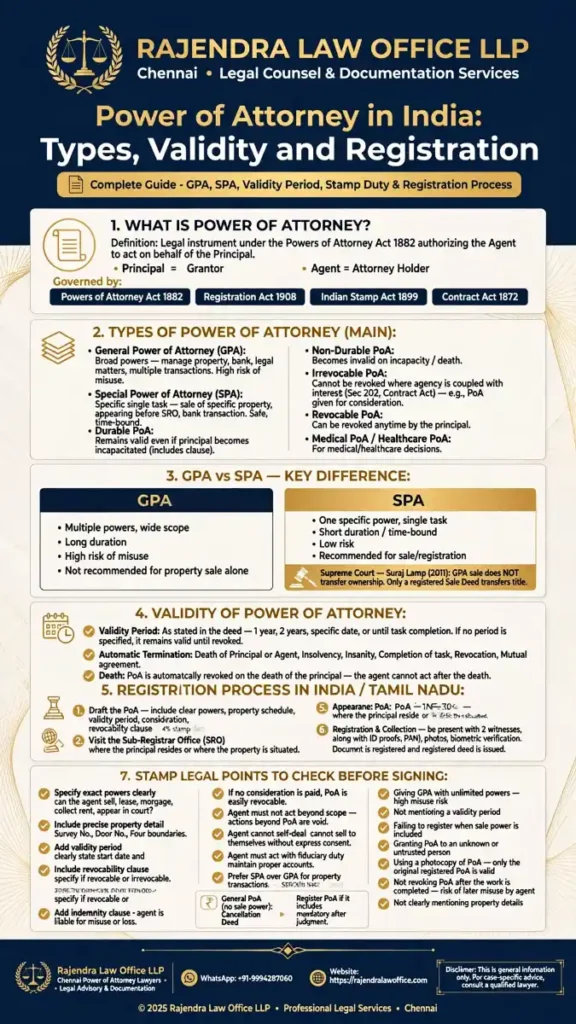
A POA is a delegation of legal authority: the principal (also called the donor) grants the agent (or donee/attorney) the power to perform specified acts — such as managing property, operating bank accounts, or representing the principal in transactions — on the principal’s behalf, as if the principal were acting personally.
Types of Power of Attorney
- General Power of Attorney (GPA): Grants broad authority over a class of acts — financial, property, and legal affairs generally — rather than a single transaction.
- Special/Limited Power of Attorney (SPA): Authorises the agent to perform only a specific, defined task, such as selling one particular property or representing the principal in one court case.
- Durable Power of Attorney: Remains valid even if the principal later becomes mentally incapacitated (this must be expressly stated; a POA does not automatically survive incapacity).
- Medical Power of Attorney: Authorises the agent to make healthcare-related decisions if the principal is unable to.
- Springing Power of Attorney: Becomes effective only upon a specified future event (e.g., the principal’s prolonged absence or illness).
Execution Requirements
A legally sound POA generally includes:
- Full identification of both the principal and the agent.
- First, specify the powers granted under the POA clearly and precisely. Moreover, avoid vague or excessively broad language, which can increase misuse risks and trigger future disputes.
- The validity period or the conditions under which the POA operates.
- Signatures of the principal and agent, with witness signatures (commonly at least two witnesses).
- Notarisation and, where required, registration.
Stamp Duty and Registration
Stamp duty on a POA is a state subject, so the amount varies considerably depending on the state of execution and the type of POA — a general POA generally attracts higher stamp duty than a special POA in most states, and Karnataka, for instance, charges a markedly higher rate for a POA in favour of a builder/developer compared to one in favour of a relative. Because rates change and vary by state, always confirm the current stamp duty schedule with the relevant State Government or a local advocate before execution.
Registration of a POA is not always mandatory, but it is strongly advisable — and often practically required — when the POA deals with immovable property (such as authorising the sale of land or a flat). However, Sub-Registrars or buyers’ advocates may question an unregistered POA used for property transactions. Moreover, such a POA may later complicate efforts to establish the agent’s authority.
When Does a Power of Attorney Lapse?
Unless it is a durable POA or one “coupled with an interest,” a POA generally lapses upon:
- The death of the principal.
- The insolvency of the principal.
- The principal’s unsoundness of mind.
- Revocation by the principal at any time (a general POA can typically be revoked at will).
- Completion of the specified task, for a special power of attorney.
Revoking a Power of Attorney
A principal can revoke a POA by executing a deed of revocation, ideally registered in the same manner as the original POA, and by giving notice to the agent and any third parties who may be relying on the POA (such as banks or buyers). Failing to formally notify relevant third parties can expose the principal to continued liability for the agent’s acts, even after the principal privately considers the POA revoked.
Statutory Framework at a Glance
| Aspect | Provision |
|---|---|
| Parent statute | Powers-of-Attorney Act, 1882 |
| Definition of “Power-of-Attorney” | Section 1A, Powers-of-Attorney Act, 1882 |
| Agency principles | Indian Contract Act, 1872 |
| Stamp duty | State-specific (Indian Stamp Act read with state amendments) |
| Registration for immovable property | Registration Act, 1908 (state practice varies) |
Practical Checklist
- Decide whether a general or special POA fits your actual need — avoid granting broader authority than necessary.
- Draft the powers granted in specific, unambiguous language.
- Confirm the current stamp duty rate for your state and the type of POA.
- Register the POA if it concerns immovable property, or if you want stronger evidentiary value.
- First, verify whether the NRI must execute the POA before an Indian consulate or embassy. Additionally, check whether the country requires apostille formalities before authorities accept the document in India.
- Keep a revocation plan in mind — know how you would formally revoke it if needed.
Exceptions and Cautions
- First, a POA merely authorises an agent to act and does not transfer property ownership. Therefore, the parties must complete the sale through a valid conveyance or sale deed. Moreover, the POA cannot substitute the legally required registered instrument for transferring ownership. Thus, ownership passes only through the appropriate legally valid conveyance or registered transfer.
- First, courts and revenue authorities have long scrutinised property sales conducted solely through a POA. Therefore, buyers should not treat a POA as a substitute for a registered sale deed. Instead, buyers should verify the seller’s title through a proper and legally valid conveyance. Accordingly, purchasers should rely on valid title documents rather than the POA alone
- This article reflects the general legal position; stamp duty rates and specific procedural requirements vary by state and change periodically — verify current rules before executing or relying on a POA.
What Should You Do Next?
First, have an advocate review the POA’s scope, particularly for property or high-value transactions. Additionally, seek legal review when an NRI intends to execute or use the POA. Next, confirm the applicable stamp duty and registration requirements under the relevant state law. Therefore, ensure the document satisfies legal requirements before relying on it in practice.
Frequently Asked Questions
Is a Power of Attorney the same as transferring ownership of property?
No. A POA authorises someone to act on your behalf; it does not itself transfer ownership. A registered sale deed is required to transfer property title.
Does a Power of Attorney need to be registered?
Generally, registration is not always mandatory, but authorities strongly recommend it for property-related POAs. Moreover, immovable-property transactions often require registration to ensure enforceability and legal validity.
What happens to a Power of Attorney if the principal dies?
Generally, the POA automatically lapses upon the principal’s death. However, it may survive if coupled with an independent interest that continues thereafter.
Can a Power of Attorney be cancelled?
Yes, generally at any time by the principal through a deed of revocation, with notice given to the agent and relevant third parties.
Conclusion
A Power of Attorney is a powerful and widely used legal tool, but its validity depends heavily on correct drafting, appropriate stamping, and registration where required. Understanding the difference between general and special POAs, and the circumstances under which a POA lapses or can be revoked, helps avoid disputes down the line. This article is for general legal information only and does not constitute advice on a specific document.
Disclaimer
This article is intended for general legal information only and does not constitute legal advice. Stamp duty rates and registration requirements vary by state and change periodically; please verify current rules with a qualified advocate.
Authoritative Sources / References
- Powers-of-Attorney Act, 1882 — India Code
- Indian Contract Act, 1872 (agency provisions, Sections 182–238)
- Indian Stamp Act, 1899 and applicable state stamp acts/amendments