A property transfer can fail to deliver secure ownership if the parties overlook title defects, encumbrances, authority, land-use restrictions, or registration requirements. A registered document is important, but it does not automatically cure every defect in the transferor’s title. Buyers should trace the ownership chain, verify the property description, examine possession, and check relevant public records before paying the full price. Tamil Nadu transactions may also involve patta records, planning approvals, layout status, and local registration requirements. This article explains a practical due-diligence framework. The correct checks depend on the property type, location, history, and current law. Obtain a title opinion before committing to a material transaction.
Safeguarding Property Ownership: The Legalities of Title Transfers

Legal Essentials of Property Title Transfers
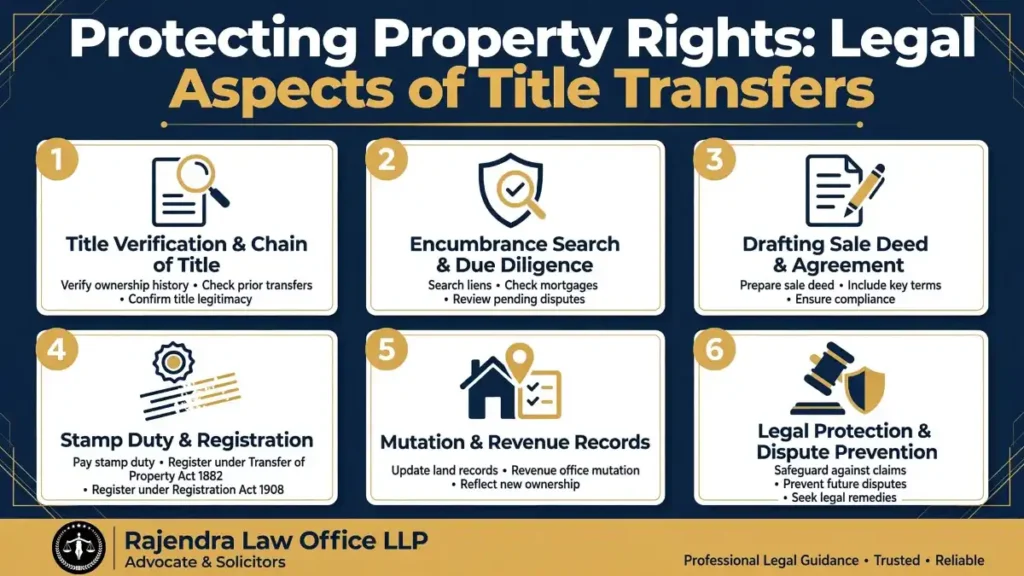
1. Trace the chain of title and verify the transferor
Start by identifying the exact property and the person or entity claiming authority to transfer it. Review the root document and subsequent conveyances, partitions, releases, settlements, gifts, court decrees, inheritance records, and other instruments relevant to the history. Check whether each transferor had legal capacity and sufficient title to convey. If a person signs through an agent, verify the power of attorney, scope, validity, and applicable registration or authentication requirements. A chain of documents is not conclusive if an underlying link is defective. The review should identify gaps, inconsistent names, missing originals, and unexplained changes in extent or boundaries.
2. Search encumbrances and compare official records
An encumbrance certificate can help identify registered transactions recorded for the relevant period, but it is not a complete guarantee of title. It may not reveal every unregistered claim, possession issue, litigation risk, or error in the source records. Compare the certificate with the title deeds, registration details, revenue records, mortgage releases, and available court or tribunal information. Confirm the correct survey number, subdivision, extent, village, boundaries, and registration jurisdiction. If a lender holds original documents, obtain evidence of discharge and release. Search periods should reflect the property history and legal advice, not a fixed number of years chosen without analysis.
3. Complete due diligence before signing or paying
Before entering a binding transaction, inspect the property and compare physical possession with the documents. Verify access, boundaries, occupants, tenants, easements, approvals, land use, building permissions, and any applicable acquisition or planning restrictions. Check whether the property is subject to litigation, attachment, tenancy, family claims, or statutory restrictions. Confirm stamp duty, registration charges, and the correct instrument with current Tamil Nadu sources. The sale agreement should allocate responsibility for title defects, approvals, vacant possession, payment milestones, and default. If material documents are missing, make completion conditional on satisfactory verification rather than relying on informal assurances.
4. Understand the difference between registration and title
Section 54 of the Transfer of Property Act, 1882 distinguishes a sale from a contract for sale. A contract for sale does not, by itself, create an interest or charge in the property. Registration gives an instrument the legal effect prescribed by the applicable statute, but registration alone does not prove that the transferor owned what they purported to transfer. A buyer must still investigate the title and the transaction’s validity. The Registration Act, 1908 and applicable Tamil Nadu amendments and rules govern registration issues. The precise consequences depend on the instrument, property, parties, and applicable law.
5. Check patta, survey, planning, and possession records
Revenue records such as patta may help identify the recorded holder and support administrative processes, but they should not be treated as a substitute for a complete title examination. Compare survey and subdivision details with the deed and physical property. For plots, review layout approval, road access, land-use classification, and planning permission where relevant. For buildings, inspect approved plans, completion or occupancy documentation where applicable, and deviations. Confirm who occupies the property and on what basis. A mismatch between revenue, registration, planning, and physical records requires explanation before completion.
6. Draft transfer documents with clear conditions
A sale agreement should identify the parties, property, consideration, payment schedule, title obligations, possession, approvals, taxes, default, termination, and completion mechanics. State which documents the seller must deliver and by what date. Identify how existing mortgages, tenants, or other encumbrances will be discharged. The final sale deed should accurately reflect the agreed transaction and property description. Avoid blank schedules, inconsistent survey numbers, or vague promises to obtain approvals later. A lawyer should confirm stamp duty and registration requirements under current law. The document should allocate risk without suggesting that contractual wording can cure an invalid title.
7. Plan for defective title and competing claims
If due diligence reveals a title gap, do not assume an indemnity alone solves it. Identify the missing link and determine whether a registered release, rectification, succession document, court order, or other lawful step is required. A seller’s representation may create contractual remedies, but it does not necessarily defeat a third party’s superior claim. Assess the evidence, limitation, possession, and forum before deciding whether to proceed. Where a dispute already exists, consider a title suit, injunction, declaration, or other remedy only after checking jurisdiction and statutory conditions. The correct remedy depends on the nature of the defect.
8. Verify the property schedule carefully
The schedule should match the title documents and current survey particulars. Check boundaries, extent, survey and subdivision numbers, door number where relevant, village, taluk, district, and common rights. A small inconsistency can create future disputes over identity or extent. Where measurements differ, obtain a qualified survey and legal advice before execution. Avoid copying an old schedule without verifying current records.
9. Review mortgages, charges, and release documents
Search for registered mortgages and other recorded interests, then ask for the underlying loan and release documentation where relevant. Confirm that the person executing a release has authority and that the release covers the correct property. A lender’s no-dues letter may not answer every registration or title question. If original documents are unavailable, identify why and assess the risk before completion.
10. Investigate possession and occupation
Inspect the property and speak to the relevant occupants through lawful, appropriate channels. Identify tenants, licensees, co-owners, caretakers, and persons claiming rights. Review leases, rent receipts, notices, and possession clauses. Vacant possession should be defined and verified if it is a contractual condition. Do not assume that a seller’s statement resolves a third party’s claim.
11. Confirm authority in inherited or jointly held property
Inheritance, wills, succession, partition, and co-ownership can complicate the power to transfer. Identify all persons whose rights may be affected and review the documents supporting their authority. A legal-heir certificate or revenue entry may not, by itself, resolve every title issue. Where a will or succession is disputed, assess the applicable personal law and procedural requirements. Obtain signatures or orders required by the facts and law.
12. Check land-use and planning restrictions
Review the applicable master plan, zoning, layout approvals, building permissions, and any restrictions on the property. A plot’s market description does not establish its lawful use. Check current official records with the competent planning or local authority. If approvals are missing or inconsistent, determine whether regularisation is legally available before treating the issue as curable.
13. Verify stamp duty and registration procedure
Rates and procedures may depend on the instrument, consideration, market value, relationship between parties, and current State amendments. Confirm current Tamil Nadu stamp duty and registration fees through official sources before execution. Check the competent Sub-Registrar, appointment and document requirements, identity and witness requirements, and any applicable electronic process. Do not rely on old online calculators without verifying their assumptions.
14. Create a written title-risk report
A title report should identify documents examined, search periods, assumptions, missing records, adverse entries, and unresolved issues. Classify each issue by severity and explain what would resolve it. Do not issue an unqualified conclusion where a key document is missing. The buyer should understand whether to proceed, seek a price adjustment, require a cure, or stop the transaction. Keep the source documents and date of searches in the file.
15. Obtain originals or explain their absence
Compare originals with certified copies and registration records where available. If an original is missing, ask who holds it and why. Assess the risk of duplicate dealings or undisclosed security. Do not treat a photocopy as conclusive without verification.
16. Check names and identity across documents
Compare names, initials, parentage, entity names, identity details, and capacity across deeds and official records. Explain spelling variations with reliable supporting documents. A mismatch may be clerical or may signal a different person. Resolve material discrepancies before execution.
17. Confirm the full consideration trail
Record the agreed price, advance, instalments, payment mode, receipts, and balance due at completion. Align the sale agreement and deed with the actual transaction. Obtain advice on tax and reporting obligations where relevant. Avoid undocumented cash arrangements or vague acknowledgements.
18. Verify powers of attorney
Check the grantor’s authority, the attorney’s identity, the scope of powers, execution, validity, revocation status, and applicable registration requirements. Confirm whether the instrument permits the specific transaction and consideration terms. Do not assume every power of attorney can transfer title.
19. Search litigation and acquisition risk
Search relevant court and tribunal records using the parties and property particulars where feasible. Check notices or official records concerning acquisition, planning, attachment, or restrictions. Searches are not infallible, so record their scope and limitations. Ask the seller to disclose known proceedings and notices.
20. Inspect access and easement rights
Confirm legal access from a public road and identify any shared pathway, easement, drainage, or utility rights. A route used informally may not establish a legally enforceable right. Review deed schedules and relevant records. Physical access should be assessed alongside legal access.
21. Do not confuse patta with conclusive ownership
Patta and other revenue records are relevant administrative evidence, but the legal effect depends on the issue and applicable law. Review the underlying title instruments and any competing claim. Seek correction of revenue records where appropriate, without treating that step as a universal cure for title defects.
22. Make completion conditional on material cures
If the seller must discharge a mortgage, obtain an approval, or provide a missing deed, specify the requirement and deadline in writing. Define the buyer’s options if the condition is not met. Consider escrow or staged payment only where lawful and practical. Avoid releasing the full price based on an unverified promise.
23. Preserve post-registration records
Keep the registered deed, registration receipt, payment records, possession evidence, tax documents, and copies of supporting title records securely. Complete relevant mutation or revenue procedures where required. Registration is a major step, but post-completion administration and record preservation still matter.
24. Address defects through the right remedy
The remedy may involve rectification, cancellation, declaration, injunction, specific performance, or another statutory route depending on the facts. Check limitation, parties, jurisdiction, and evidentiary requirements before filing. A legal notice alone does not necessarily protect every right or suspend limitation.
25. Ask for a reasoned title opinion
A useful title opinion should list the documents examined, search scope, defects, assumptions, and recommended action. Ask the lawyer to distinguish a curable defect from a serious risk. The opinion should not guarantee that no undisclosed claim can ever arise. Make the decision using the documented risk assessment.
26. Conclusion and practical next steps
Protecting property rights requires a complete chain-of-title review, searches, physical inspection, verification of authority, and accurate transfer documents. Registration and patta records are important, but neither replaces the legal analysis of ownership and competing rights. Before paying a substantial amount, obtain a written title-risk report and confirm current Tamil Nadu stamp duty, registration, planning, and land-record requirements. Resolve material defects before completion or reconsider the transaction. Rajendra Law Office LLP’s property-law page is a relevant starting point for its stated services; the final opinion must be based on the actual property documents.
A title review should go beyond one certificate
Title review is a process of testing the seller’s asserted ownership against the underlying records. Begin with the current title deed and trace the earlier conveyances, inheritance documents, partition deeds, release deeds, court orders, or other instruments through which the interest was acquired. Check whether the property description remains consistent across documents and whether each transferor had authority to transfer the interest claimed. A mismatch in names, survey numbers, extent, boundaries, or undivided shares may require clarification before the transaction proceeds.
Public-record searches should be considered alongside the documents supplied by the owner. Depending on the property, relevant checks may include registration records, encumbrances, revenue entries, municipal or planning records, approved layout or building plans, court proceedings, acquisition notices, and records concerning mortgages or charges. Revenue or tax entries can be relevant evidence but do not necessarily establish title by themselves. Likewise, an encumbrance certificate may not reveal every possible claim, possession issue, unregistered arrangement, or defect in the underlying chain of title.
If a defect is discovered, identify its legal nature before choosing a remedy. Some discrepancies may be corrected through a properly executed instrument or record update; others may require consent from co-owners, release of a charge, succession documentation, a declaration, or court proceedings. Do not assume that an indemnity clause alone cures a defective title. Record each issue, the evidence needed to resolve it, who must act, and whether the transaction should pause until resolution. Stamp duty, registration fees, limitation, and the appropriate forum should be checked under the current law applicable to the specific property.
Frequently Asked Questions
No. Registration is important, but buyers must still verify the transferor’s title, authority, encumbrances, possession, and relevant restrictions.
Patta is a relevant revenue record, but it does not replace examination of title deeds and competing legal claims.
It records certain registered transactions for the searched period. It may not reveal every unregistered claim, possession issue, or title defect.
Yes. Inspect boundaries, access, occupation, structures, and the property schedule, then compare observations with the legal documents and official records.
Section 54 of the Transfer of Property Act states that a contract for sale does not by itself create an interest or charge in the property.
It should list documents reviewed, search scope, defects, assumptions, unresolved risks, and practical steps needed before completion.