Quick answer: A civil appeal to a High Court is not simply a request to “review” a trial-court judgment. Firstly, The available remedy depends on the nature of the decree or order, the appellate provision, limitation, the court that passed the impugned decision, and the grounds available in law. A first appeal under Section 96 of the Code of Civil Procedure, 1908 (CPC) can ordinarily examine questions of fact and law, while a second appeal under Section 100 CPC is restricted to a substantial question of law. The memorandum of appeal, certified copies, grounds, limitation calculation, stay strategy and supporting record must therefore be prepared carefully before filing.
What Is a High Court Civil Appeal?
A civil appeal is a statutory remedy through which an aggrieved party asks the competent appellate court to examine an order or decree of a subordinate court. In fact, Section 96 CPC provides the ordinary framework for appeals from original decrees, subject to the exceptions contained in the CPC and other applicable laws.
The important point is that “civil appeal” is not a single procedural category. A first appeal and a second appeal have materially different scopes. Certain interlocutory orders are appealable only where the CPC or another statute expressly provides a right of appeal. Commercial disputes, family matters, property litigation, arbitration-related proceedings and special statutory proceedings may also be governed by additional legislation and court rules.
First Appeal and Second Appeal: The Basic Difference
| Issue | First Appeal | Second Appeal |
|---|---|---|
| Principal provision | Section 96 CPC | Section 100 CPC |
| Impugned decision | Generally an original decree | Generally an appellate decree |
| High Court involvement | Depends on the appellate structure and competent court | High Court is expressly contemplated by Section 100 CPC |
| Questions considered | Questions of fact and law, subject to the statute and record | Substantial questions of law |
| Evidence | Appellate court can examine the record and findings subject to appellate principles | Not a routine second trial on disputed facts |
| Drafting focus | Errors in findings, law, procedure and relief | Precisely formulated substantial question(s) of law |
When Can a Civil Decree Be Appealed?
Section 96 CPC states that, subject to the provisions of the Code and other applicable law, an appeal lies from a decree passed by a court exercising original jurisdiction to the court authorised to hear appeals from that court. An appeal may also lie from an ex parte original decree. As a matter of fact, A consent decree is subject to a statutory restriction on appeal.
Before filing, the advocate should identify exactly what has been passed: a decree, judgment, executable order, interlocutory order, preliminary decree, final decree, or an order falling within a special statutory appeal provision. Calling every adverse court order a “High Court appeal” can lead to a jurisdictional or maintainability error.
Is Every Civil Matter Directly Appealable to the High Court?
No. The correct appellate forum depends on the court that passed the impugned decision, the nature and value of the proceeding, the applicable statute, and the allocation of appellate jurisdiction. In some cases, the first appeal from a trial-court decree lies before a District Court or another designated appellate court rather than directly before the High Court.
A second appeal under Section 100 CPC is specifically a High Court remedy against an appellate decree when the statutory requirement of a substantial question of law is satisfied. Therefore, a litigant should not assume that an adverse trial judgment can always be filed directly in the High Court.
First Appeal Under Section 96 CPC
Section 96 is the central provision for an ordinary first appeal from an original decree. Moreover, The appellate court may examine the record and the legal and factual conclusions challenged in the appeal, subject to the applicable statutory limitations and established appellate principles.
A strong first appeal should identify each challenged finding separately. For example, if a property suit was dismissed because the trial court misunderstood the title documents, the memorandum should identify the documentary evidence, the relevant finding, the legal error or evidentiary error, and the consequence for the decree. Merely stating that the judgment is “wrong and contrary to law” is rarely an adequate appellate strategy.
Second Appeal Under Section 100 CPC
Section 100 CPC imposes a substantially narrower gateway. A second appeal lies to the High Court where the case involves a substantial question of law. Meanwhile, The memorandum of appeal must precisely state the substantial question of law involved. If satisfied that such a question exists, the High Court formulates it and the appeal is ordinarily heard on that formulated question, subject to the statutory proviso.
This distinction is crucial. A second appeal is not designed to provide an unrestricted re-hearing on every disputed fact. A proposed second appeal should therefore identify the legal question that materially affects the decision and explain why it meets the statutory threshold.
What Is a Substantial Question of Law?
The expression is not merely a label to be inserted into a memorandum. In fact, The proposed question must have genuine legal substance and must materially arise from the case. meanwhile, A question that simply asks the High Court to re-weigh evidence without identifying a legally significant issue is unlikely to satisfy the statutory threshold.
The Supreme Court has repeatedly explained the meaning and limits of “substantial question of law”. The formulation should therefore be based on the actual pleadings, findings, admitted facts, applicable statutory provisions and the reasoning of the first appellate court.
Limitation for a Civil Appeal
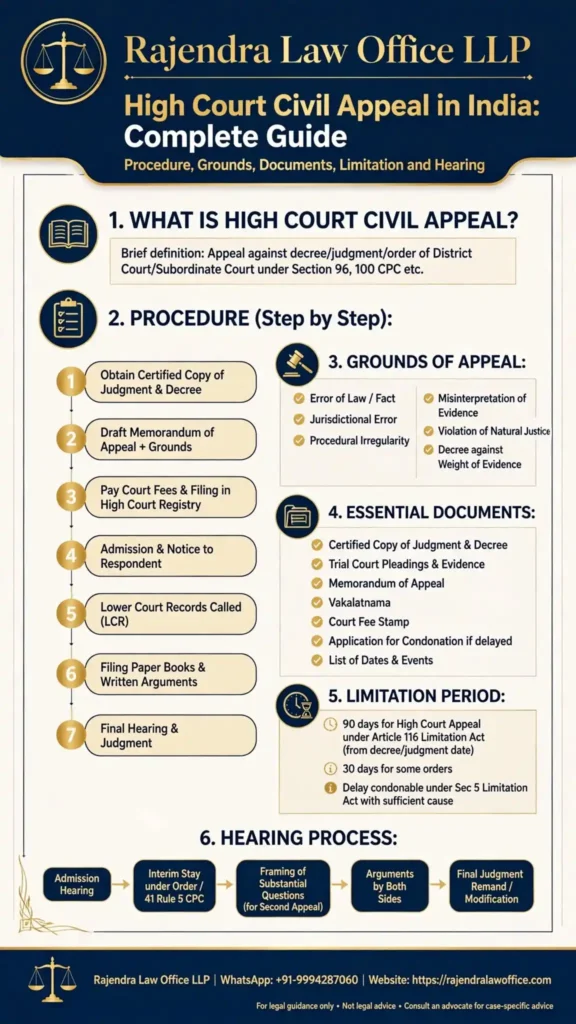
Limitation must be calculated from the specific appellate remedy and applicable entry in the Limitation Act, 1963. The commonly quoted period for an appeal to a High Court under the CPC is 90 days under the relevant limitation entry, but advocates should verify the exact Article, the nature of the decision and any special statutory provision applicable to the case before advising a client.
The limitation calculation should also account for legally excludable periods and the date from which the prescribed period begins. Certified-copy requirements and the operation of Sections 4 to 24 of the Limitation Act may become relevant depending on the circumstances.
Practical rule: do not wait until the last week. Obtain the judgment/decree, apply for the certified copy where necessary, calculate limitation independently, and prepare the appeal papers sufficiently early to address registry defects.
Documents Required for a High Court Civil Appeal
The exact filing requirements depend on the applicable High Court rules and the nature of the appeal. A typical civil appellate preparation may require:
- Certified copy of the impugned judgment.
- Certified copy of the decree or appealable order, as applicable.
- Pleadings filed before the trial court.
- Written statement and replication, where applicable.
- Issues framed by the trial court.
- Relevant documentary evidence.
- Depositions and cross-examination material where necessary.
- Applications and orders that materially affected the proceedings.
- Relevant interlocutory orders.
- Previous appellate orders, if the matter has already passed through an appellate stage.
- Limitation calculation and supporting application where delay is alleged.
- Vakalatnama and other filing documents prescribed by the relevant court.
How Should Grounds of Appeal Be Drafted?
Grounds should be specific, logically arranged and tied to the impugned findings. A useful structure is:
- Identify the finding challenged.
- State the evidence or pleading relevant to that finding.
- Explain the legal or factual error.
- Identify the statutory provision or binding principle where relevant.
- Explain how the error affected the result.
- State the relief sought from the appellate court.
For example, a property appeal may challenge an incorrect interpretation of a registered sale deed, failure to consider a material document, an incorrect burden-of-proof approach, a limitation finding, or a legally unsustainable conclusion about possession. Each ground should be traceable to the trial-court record.
Can New Evidence Be Produced in a Civil Appeal?
An appeal is generally decided on the record of the court below, but the CPC contains a specific framework governing additional evidence in appellate proceedings. Additional evidence should therefore never be treated as an automatic opportunity to repair omissions in the trial.
Where additional evidence is genuinely necessary, the appellant should identify the evidence, explain why it was not produced earlier, and establish the statutory basis for its admission. The application should be connected to the appellate issues rather than presented as an attempt to reopen the entire trial.
Can the High Court Stay the Civil Decree?
Filing an appeal does not by itself mean that execution of the decree automatically stops. Where execution or enforcement creates an immediate risk, the appellant may need to seek appropriate interim protection or stay in accordance with the CPC and applicable appellate practice.
The stay request should explain the nature of the decree, the consequences of execution, the grounds of appeal, and the urgency. In property disputes, for example, the applicant may need to address the risk of alienation, dispossession, creation of third-party interests or irreversible changes to the property.
What Happens After Filing the Appeal?
The procedural sequence varies with the court and case type, but a typical appellate process may involve:
- Preparation of the memorandum and supporting papers.
- Filing before the competent appellate registry.
- Scrutiny of the filing.
- Correction of registry defects, if any.
- Numbering or registration of the appeal.
- Initial hearing/admission stage as applicable.
- Notice to the respondent.
- Consideration of interim applications, including stay where sought.
- Preparation or transmission of the lower-court record where required.
- Final hearing.
- Appellate judgment/order.
- Further statutory remedy, if legally available.
Why Registry Scrutiny Matters
Technical defects can delay the progress of an appeal even when the substantive grounds are strong. Common issues can include missing documents, incorrect court details, defective pagination, deficient court fees, incomplete applications, filing beyond limitation, improper service documents or defects identified under the relevant High Court rules.
A pre-filing checklist is therefore not administrative trivia. It is part of appellate strategy. The filing should be checked against the applicable High Court rules and current filing requirements rather than relying solely on a generic national checklist.
Can a First Appellate Court Reconsider Evidence?
A first appellate court ordinarily has a broader scope than a second appellate court. Where findings of fact are challenged, the appellate court may examine the evidentiary record and the reasoning of the trial court in accordance with established principles. The appellant should nevertheless identify why the finding is unsustainable rather than simply asserting that the trial judge should have believed a different witness.
The strongest appellate arguments usually connect evidence to a specific legal error, ignored material evidence, misreading of a document, inconsistent findings, incorrect burden of proof or failure to apply the governing legal test.
What If the Trial Court Passed a Preliminary Decree?
Preliminary decrees require particular attention. A party should determine whether the decree has become final or whether an appeal was required at that stage. The CPC contains specific consequences where a party fails to challenge a preliminary decree and later attempts to dispute its correctness in an appeal from the final decree.
In partition and other multi-stage property proceedings, the distinction between preliminary and final decree can materially affect appellate strategy. The appeal should therefore be assessed immediately after the preliminary decree rather than waiting for all subsequent proceedings.
Common Mistakes in High Court Civil Appeals
- Assuming every adverse order is directly appealable to the High Court.
- Missing the applicable limitation period.
- Using a second appeal to argue only questions of fact.
- Failing to formulate a genuine substantial question of law.
- Submitting vague and repetitive grounds.
- Ignoring the exact findings recorded by the lower court.
- Failing to obtain the necessary certified documents.
- Assuming that filing an appeal automatically stays execution.
- Introducing new evidence without satisfying the applicable legal test.
- Ignoring High Court filing rules and registry requirements.
- Failing to assess whether settlement or mediation is commercially preferable.
- Waiting until the limitation deadline is close before instructing counsel.
How to Prepare a Strong Civil Appeal
A practical appellate preparation should begin with the judgment itself, not with a generic list of legal grounds. The advocate should prepare a finding-by-finding analysis of the impugned decision. Each adverse conclusion should be matched against the pleadings, evidence, documents, submissions and applicable law.
The next stage is remedy classification: first appeal, second appeal, appeal from order, revision, review, writ remedy or another statutory mechanism. The remedy determines the jurisdictional test and the drafting strategy.
After that, limitation and interim relief should be addressed. A legally strong appeal that is filed out of time without an adequate explanation can face a preliminary obstacle. Likewise, a successful appeal may provide limited immediate protection if the decree is being executed and no stay has been sought.
High Court Civil Appeal Checklist
| Checkpoint | Question |
|---|---|
| Decision | Is the impugned decision a decree, order or another appealable decision? |
| Forum | Which court has appellate jurisdiction? |
| Remedy | Is this a first appeal, second appeal or appeal from an order? |
| Limitation | What exact limitation provision applies? |
| Record | Are the judgment, decree and relevant lower-court papers available? |
| Grounds | Has every important adverse finding been addressed? |
| Stay | Is immediate interim protection necessary? |
| Evidence | Is any additional evidence genuinely required? |
| Procedure | Have the applicable High Court filing rules been checked? |
| Relief | Is the appellate relief precisely stated? |
Related Civil Litigation Guidance
For property-related appeals, the legal analysis should be read together with the title and transaction issues involved. Rajendra Law Office LLP has also published guidance on verifying property title before buying land in Tamil Nadu and on choosing a civil lawyer for a civil dispute. These resources address different search intents and should not be treated as substitutes for case-specific appellate advice.
Frequently Asked Questions
1. Can I appeal a civil court judgment to the High Court?
Sometimes. The correct appellate forum depends on the court that passed the decision, the nature of the decree or order, the applicable statutory provision and the allocation of appellate jurisdiction. A second appeal under Section 100 CPC is specifically a High Court remedy when the statutory substantial-question-of-law requirement is satisfied.
2. What is the difference between a first appeal and a second appeal?
A first appeal from an original decree under Section 96 CPC generally permits a broader appellate examination of facts and law. A second appeal under Section 100 CPC is narrower and requires a substantial question of law. The drafting strategy should therefore be different for the two remedies.
3. What documents are required for a High Court civil appeal?
Commonly required materials include the judgment, decree or appealable order, pleadings, relevant evidence, lower-court orders, limitation information, applications and filing documents. The exact requirements depend on the High Court rules and the particular proceeding.
4. Does filing a civil appeal automatically stay the decree?
No. Filing an appeal does not by itself create an automatic stay in every case. Where enforcement creates an immediate risk, the appellant may need to seek appropriate stay or interim protection under the applicable procedural framework.
5. Can new evidence be produced in a civil appeal?
Additional evidence may be permitted in circumstances governed by the CPC and appellate principles. It is not an automatic right to introduce material that was omitted at trial. The applicant should establish the legal basis and explain why the evidence is necessary.
6. What is a substantial question of law in a second appeal?
It is a legally significant question that satisfies the statutory threshold under Section 100 CPC. Merely describing a factual disagreement as a substantial question of law is insufficient. The proposed question should arise from the case and materially affect the appellate determination.
Legal Sources and Verification
- Section 96, Code of Civil Procedure, 1908
- Section 100, Code of Civil Procedure, 1908
- Limitation Act, 1963 — India Code
Important: Appellate limitation, maintainability, court fees, filing requirements and interim relief depend on the exact case and the applicable court rules. A litigant should have the judgment/decree and complete case record reviewed before deciding the appellate remedy.