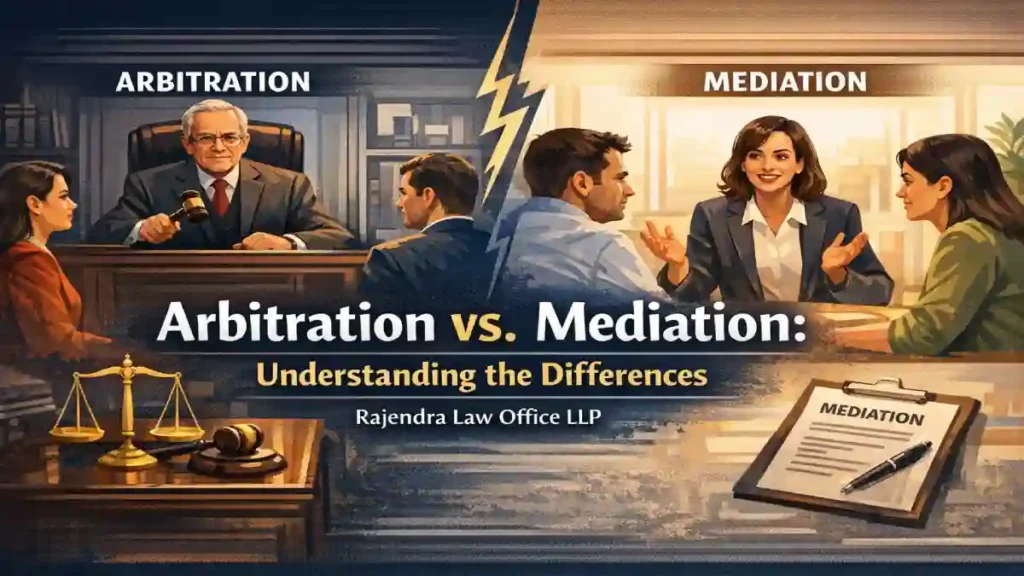
Arbitration vs. Mediation – Disputes are a natural part of business and personal relationships. Whether the issue relates to a commercial contract, partnership disagreement, property matter, or family conflict, disagreements can arise at any time. Traditionally, people approached courts to resolve disputes. However, court litigation often takes time, involves high costs, and can sometimes strain relationships further.
Because of these challenges, many individuals and businesses now prefer Alternative Dispute Resolution (ADR) methods. Among the most commonly used ADR methods are arbitration and mediation. Both aim to resolve disputes outside the courtroom, but they operate in different ways and serve different purposes.
Understanding the difference between arbitration and mediation is important before choosing the right method for resolving a dispute. Each process has its own advantages, procedures, and outcomes. At Rajendra Law Office LLP, we guide clients in choosing the most suitable dispute resolution method depending on the nature of their case.
Arbitration vs. Mediation: Understanding the Differences – Rajendra Law Office LLP

What is Arbitration?
Arbitration is a formal dispute resolution process where the parties present their case before a neutral third person called an arbitrator. The arbitrator listens to both sides, reviews the evidence, and then makes a decision called an arbitral award.
In many ways, arbitration resembles a private court proceeding. However, it is usually faster and more flexible than traditional litigation.
Arbitration often arises from a contract clause. Many business agreements include an arbitration clause stating that if a dispute occurs, the parties must resolve it through arbitration instead of going to court.
Key Features of Arbitration
First, arbitration involves a neutral decision-maker known as the arbitrator. This person may be a lawyer, retired judge, or subject-matter expert.
Second, the process is more structured than mediation. Parties submit documents, evidence, and arguments similar to a court case.
Third, the arbitrator’s decision is generally final and binding on both parties.
Finally, courts usually enforce arbitral awards, making arbitration a legally effective way to resolve disputes.
What is Mediation?
Mediation is a voluntary and cooperative process in which a neutral third party called a mediator helps the disputing parties reach a mutually acceptable settlement.
Unlike arbitration, the mediator does not impose a decision. Instead, the mediator facilitates communication between the parties and encourages them to find their own solution.
Mediation focuses on negotiation, understanding interests, and preserving relationships.
Key Features of Mediation
To begin with, mediation is an informal process compared to arbitration.
Secondly, the mediator acts as a facilitator rather than a decision-maker. The mediator helps parties communicate effectively and explore settlement options.
Thirdly, the outcome depends entirely on the parties’ agreement. If both sides agree on a solution, they sign a settlement agreement.
Finally, mediation promotes cooperation and often preserves professional or personal relationships.
Legal Framework in India
In India, arbitration is governed by the Arbitration and Conciliation Act, 1996. This law provides a clear framework for conducting arbitration proceedings and enforcing arbitral awards.
Mediation, on the other hand, has gained increasing recognition in India through court-annexed mediation programs and the recently introduced Mediation Act, 2023, which aims to promote mediation as a primary dispute resolution method.
Both methods play a crucial role in reducing the burden on courts and promoting faster dispute resolution.
Major Differences Between Arbitration and Mediation
Although both methods fall under Alternative Dispute Resolution, arbitration and mediation differ in several important ways.
1. Decision-Making Authority
One of the most important differences lies in who makes the final decision.
In arbitration, the arbitrator has the authority to make a binding decision after hearing both sides.
In mediation, however, the mediator does not decide the outcome. Instead, the parties themselves decide the settlement.
Therefore, arbitration resembles a private court judgment, while mediation focuses on mutual agreement.
2. Nature of the Process
Arbitration is generally more formal. Parties present evidence, examine witnesses, and make legal arguments before the arbitrator.
In contrast, mediation is informal and flexible. The mediator encourages open discussion and negotiation without strict procedural rules.
Because of this flexibility, mediation often feels less stressful and more collaborative.
3. Binding Nature
Another important difference relates to the binding effect.
Arbitration results in a legally binding decision called an arbitral award. Once issued, the parties must comply with it, and courts can enforce it.
On the other hand, mediation only becomes binding if the parties voluntarily sign a settlement agreement.
If mediation fails, the parties remain free to pursue arbitration or court litigation.
4. Role of the Neutral Third Party
In arbitration, the arbitrator acts like a private judge. The arbitrator listens to both sides and delivers a decision.
In mediation, the mediator acts as a facilitator who guides discussions and helps parties reach an agreement.
Thus, the role of the neutral party differs significantly between the two processes.
5. Time and Cost
Both arbitration and mediation aim to save time compared to court proceedings. However, mediation is usually faster and less expensive than arbitration.
This happens because mediation focuses on negotiation rather than formal hearings and legal procedures.
Arbitration may involve legal representation, documentation, and hearings, which can increase costs.
Nevertheless, arbitration is still faster than traditional court litigation in many cases.
6. Control Over the Outcome
In mediation, the parties maintain full control over the outcome. They decide the settlement terms together.
In arbitration, however, the arbitrator controls the final decision.
Therefore, mediation offers greater flexibility and control to the parties involved.
Advantages of Arbitration
Arbitration offers several advantages, particularly in commercial disputes.
First, arbitration ensures a final and enforceable decision. Businesses often prefer this certainty.
Second, arbitration proceedings remain confidential. Unlike court cases, arbitration does not usually become public.
Third, parties can choose an arbitrator with expertise in the relevant field, such as construction, finance, or technology.
Fourth, arbitration is generally faster than court litigation, especially in complex commercial disputes.
For these reasons, many corporate contracts include arbitration clauses.
Advantages of Mediation
Mediation also provides several important benefits.
To begin with, mediation encourages cooperation rather than confrontation. This approach often preserves business or family relationships.
Secondly, mediation is highly flexible. Parties can discuss creative solutions that courts may not offer.
Thirdly, mediation is usually quicker and less costly than arbitration or litigation.
Additionally, mediation provides a confidential environment where parties can openly discuss concerns and interests.
Because of these advantages, mediation is widely used in family disputes, partnership conflicts, and employment matters.
When Should You Choose Arbitration?
Arbitration may be the right option in certain situations.
For example, arbitration is suitable when the parties want a legally binding decision but prefer to avoid lengthy court proceedings.
Similarly, arbitration works well in commercial contracts, construction disputes, international trade matters, and corporate conflicts.
Additionally, when technical expertise is required to understand the dispute, arbitration allows parties to appoint a knowledgeable arbitrator.
When Should You Choose Mediation?
Mediation is often ideal when the parties wish to maintain a working relationship.
For instance, mediation works well in family disputes, partnership disagreements, employment conflicts, and neighborhood issues.
Furthermore, mediation helps when both sides are willing to negotiate and find a compromise.
Because mediation promotes open dialogue, it often leads to creative and mutually beneficial solutions.
Combining Arbitration and Mediation
In some cases, parties may use both methods.
For example, many dispute resolution clauses include a “mediation first, arbitration later” approach. This means the parties attempt mediation initially. If mediation fails, they proceed to arbitration.
This combined approach allows parties to attempt settlement before seeking a binding decision.
As a result, it increases the chances of resolving disputes efficiently and amicably.
Importance of Legal Guidance
Although arbitration and mediation aim to simplify dispute resolution, professional legal guidance remains important.
A lawyer can help draft proper arbitration clauses, represent clients during arbitration hearings, and ensure settlement agreements protect their interests.
Similarly, legal advice during mediation ensures that negotiated terms are fair and legally sound.
At Rajendra Law Office LLP, we assist clients in both arbitration and mediation proceedings. Our team carefully evaluates each case and recommends the most effective strategy for resolving disputes quickly and efficiently.
Frequently Asked Questions
The main difference between arbitration and mediation lies in how the final decision is made. In arbitration, a neutral third party called an arbitrator listens to both sides of the dispute, reviews the evidence, and then gives a decision known as an arbitral award. This decision is usually final and legally binding on the parties. On the other hand, mediation is a voluntary process where a neutral mediator helps the parties communicate and negotiate to reach a mutually acceptable agreement. The mediator does not impose any decision. Instead, the parties themselves decide the outcome. Therefore, arbitration works more like a private court process, while mediation focuses on cooperation and settlement through discussion.
Yes, arbitration is legally binding in India. The process is governed by the Arbitration and Conciliation Act, 1996. After hearing the case, the arbitrator issues an arbitral award. This award has the same legal value as a court judgment and is enforceable through the courts. Once the award is given, both parties must follow it. However, in limited circumstances, a party may challenge the award before a court. Overall, arbitration provides a final and enforceable resolution to disputes.
Mediation is usually preferred when the parties want to maintain a relationship after resolving the dispute. For example, it works well in family disputes, partnership disagreements, employment issues, and small business conflicts. Because mediation encourages open communication and negotiation, it often leads to peaceful and mutually beneficial solutions. Additionally, mediation is typically faster and less expensive than arbitration.
Yes, mediation can sometimes fail if the parties cannot reach a mutually acceptable settlement. In such situations, the dispute does not end permanently. The parties can still pursue other legal options, such as arbitration or court litigation.
Yes, both arbitration and mediation are generally confidential processes. Unlike court proceedings, which are usually public, these dispute resolution methods allow parties to keep sensitive information private. This confidentiality is especially beneficial in business disputes, where protecting trade secrets, financial information, and professional relationships is important.
Conclusion
Disputes are inevitable in both personal and professional relationships. However, resolving them does not always require lengthy court battles.
Arbitration and mediation offer practical alternatives that save time, reduce costs, and provide flexible solutions. While arbitration provides a structured process and a binding decision, mediation focuses on cooperation and mutually agreed settlements. Therefore, choosing between arbitration and mediation depends on several factors, including the nature of the dispute, the relationship between the parties, and the desired outcome.
With the right legal guidance, both methods can provide effective and efficient solutions. At Rajendra Law Office LLP, we remain committed to helping clients navigate dispute resolution processes with clarity and confidence. Whether through arbitration, mediation, or other legal strategies, our goal is always to protect our clients’ interests while achieving the best possible outcome.
Read More
- Unlocking Plea Bargaining: Its Role and Impact in Criminal Cases
- Employment Law: Key Legal Considerations for Employers and Employees
- Cyber Crime Lawyers in India for Online Fraud Cases
- Employment Issue Lawyers in Chennai: Defending Your Workplace Rights
- Drafting Commercial Contracts: Expert Tips for Success
- Ministry of Law and Justice – Department of Legal Affairs