
Empowering Business Transactions – In today’s fast-moving business world, transactions happen every day. Companies sign contracts, form partnerships, and invest in new opportunities. However, along with these activities, disputes can also arise. Therefore, businesses need a reliable way to resolve conflicts quickly and effectively. This is where arbitration plays an important role.
At Rajendra Law Office LLP, we help businesses handle disputes with confidence. Through arbitration, we offer a structured yet flexible method to resolve issues without going through long court procedures. In this article, we explore how arbitration empowers business transactions and why it has become a preferred choice.
Empowering Business Transactions: Exploring Arbitration’s Role – Rajendra Law Office LLP
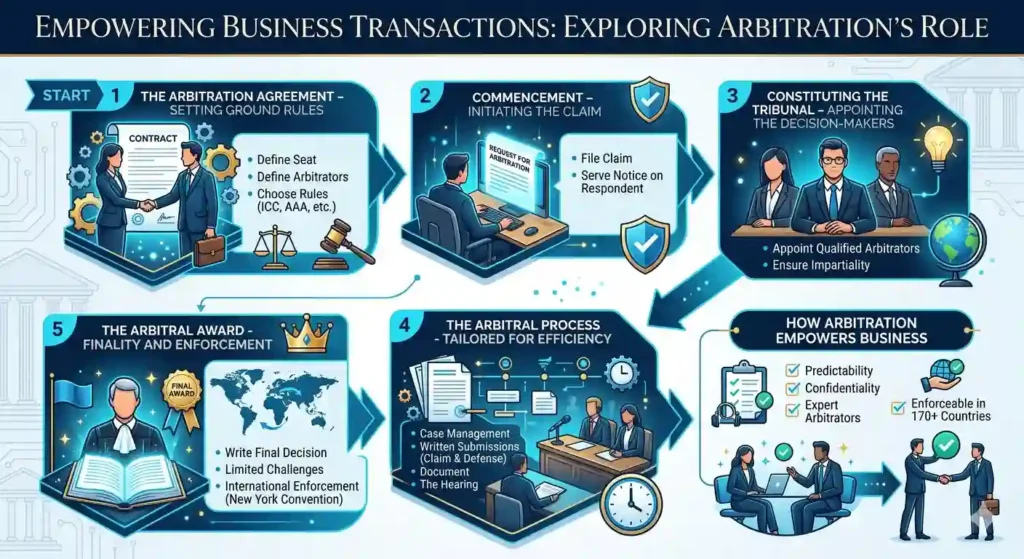
Understanding Arbitration in Simple Terms
To begin with, arbitration is a method of resolving disputes outside the traditional court system. Instead of going to court, the parties agree to appoint a neutral third person, called an arbitrator, who listens to both sides and makes a decision.
In most cases, this decision is binding. This means both parties must follow it. As a result, arbitration provides a clear and final resolution.
Moreover, arbitration is usually agreed upon in advance. Many business contracts include an arbitration clause, which states that any future disputes will be resolved through arbitration.
Why Arbitration is Important in Business Transactions
Business transactions often involve large sums of money, multiple stakeholders, and strict timelines. Therefore, disputes can create serious disruptions.
Firstly, arbitration helps save time. Court cases can take years to resolve, whereas arbitration is generally faster. This allows businesses to move forward without long delays.
Secondly, arbitration is more flexible. Parties can decide the rules, the location, and even the arbitrator. Because of this flexibility, the process becomes more convenient and efficient.
In addition, arbitration offers confidentiality. Unlike court cases, arbitration proceedings are private. This protects sensitive business information and maintains the company’s reputation.
Key Features of Arbitration
Arbitration has several unique features that make it suitable for business disputes.
1. Neutral Decision-Maker
The arbitrator acts as an independent and impartial authority. This ensures fairness in the decision-making process.
2. Binding Nature
Most arbitration awards are final and binding. Therefore, parties cannot easily challenge the decision, which brings certainty.
3. Flexibility
Parties can design the procedure according to their needs. For example, they can choose the timeline, language, and rules.
4. Enforceability
Arbitration awards are legally enforceable. In many cases, they can be enforced across countries under international agreements.
Types of Arbitration in Business
Now let us look at the different types of arbitration commonly used in business transactions.
Domestic Arbitration
This involves disputes between parties within the same country. It is governed by national laws and is widely used for local business contracts.
International Arbitration
When parties are from different countries, international arbitration is used. It provides a neutral platform and ensures fair treatment.
Institutional Arbitration
In this type, an institution manages the arbitration process. It provides rules, administrative support, and experienced arbitrators.
Ad Hoc Arbitration
Here, the parties manage the process themselves without institutional support. Although it is flexible, it requires careful planning.
How Arbitration Empowers Business Transactions
Arbitration plays a crucial role in strengthening business relationships and ensuring smooth transactions.
Firstly, it builds trust. When parties know that disputes can be resolved quickly and fairly, they feel more confident in entering agreements.
Secondly, it reduces risk. Since arbitration provides a clear dispute resolution mechanism, businesses can avoid uncertainty.
Moreover, it saves costs in the long run. Although arbitration may involve initial expenses, it often reduces the overall cost compared to lengthy litigation.
In addition, it supports international trade. Businesses from different countries prefer arbitration because it offers neutrality and enforceability.
Common Business Disputes Resolved Through Arbitration
Arbitration is used to resolve a wide range of business disputes.
- Contract disputes between companies
- Partnership disagreements
- Construction and infrastructure disputes
- Shareholder conflicts
- Intellectual property issues
Because of its flexibility, arbitration can handle both simple and complex matters effectively.
The Arbitration Process Step by Step
Understanding the process can help businesses prepare better.
Step 1: Agreement to Arbitrate
The process begins with an arbitration clause in the contract or a separate agreement.
Step 2: Appointment of Arbitrator
The parties select one or more arbitrators. In some cases, institutions assist in this process.
Step 3: Submission of Claims
Both parties present their claims, evidence, and arguments.
Step 4: Hearings
The arbitrator hears both sides. These hearings are less formal than court proceedings.
Step 5: Award
After reviewing the case, the arbitrator issues a decision, known as an award.
Challenges in Arbitration
Although arbitration offers many benefits, it also has certain challenges.
Firstly, costs can sometimes be high, especially in complex cases. Arbitrator fees and administrative expenses may add up.
Secondly, limited appeal options can be a concern. Since awards are binding, correcting errors can be difficult.
Moreover, delays can still occur if the process is not managed properly. Therefore, proper planning and legal guidance are essential.
Role of Legal Experts in Arbitration
Legal assistance is crucial for successful arbitration. At Rajendra Law Office LLP, we guide clients at every stage.
Drafting Arbitration Clauses
A well-drafted clause can prevent future complications. We ensure that the clause is clear and effective.
Case Preparation
We help gather evidence, prepare arguments, and present the case professionally.
Representation
Our legal team represents clients during hearings and ensures their interests are protected.
Enforcement of Awards
We assist in enforcing arbitration awards, both domestically and internationally.
Advantages of Choosing Arbitration Over Litigation
Many businesses prefer arbitration over traditional court litigation. Let us see why.
- Faster resolution of disputes
- Greater control over the process
- Privacy and confidentiality
- Expertise of arbitrators in specific industries
- Better preservation of business relationships
Therefore, arbitration offers a practical and efficient alternative.
Tips for Businesses Using Arbitration
To make the most of arbitration, businesses should follow some best practices.
Firstly, include a clear arbitration clause in all contracts. This avoids confusion later.
Secondly, choose experienced arbitrators. Their expertise can significantly impact the outcome.
Thirdly, maintain proper documentation. Strong evidence supports a successful claim.
Finally, seek legal advice early. Professional guidance can prevent costly mistakes.
The Growing Importance of Arbitration in India
In recent years, arbitration has gained significant importance in India. The government and judiciary have taken steps to promote it as a preferred dispute resolution method.
As a result, businesses are increasingly adopting arbitration. It aligns with global practices and supports economic growth.
Furthermore, India is becoming a hub for international arbitration. This creates new opportunities for businesses and legal professionals alike.
Frequently Asked Questions
Arbitration is a method of resolving disputes outside the court system. In business transactions, parties agree to appoint a neutral arbitrator who hears both sides and gives a decision. This process is usually based on a clause in the contract. Once a dispute arises, both parties present their evidence and arguments. After reviewing everything, the arbitrator issues an award, which is generally binding. Therefore, arbitration offers a structured and efficient way to resolve conflicts.
Businesses prefer arbitration because it is faster and more flexible than traditional court proceedings. It also provides confidentiality, which helps protect sensitive business information. Moreover, parties can choose their arbitrator and decide procedural rules. As a result, arbitration saves time, reduces long-term costs, and allows businesses to maintain professional relationships.
Yes, arbitration awards are legally enforceable. In India, they are governed by the Arbitration and Conciliation Act, 1996. Once the arbitrator issues the award, it has the same value as a court judgment. Therefore, parties must comply with the decision, and it can be enforced through the courts if necessary.
Arbitration can handle various business disputes such as contract breaches, partnership disagreements, construction conflicts, and shareholder issues. It is suitable for both domestic and international matters. Because of its flexibility, it can address both simple and complex disputes effectively.
Legal experts play a vital role in arbitration. They draft strong arbitration clauses, prepare documents, and present arguments effectively. In addition, they guide clients through each stage of the process and help enforce the final award.
Conclusion
In conclusion, arbitration is a powerful tool that empowers business transactions. It provides a fast, flexible, and reliable way to resolve disputes.
By reducing delays and ensuring fairness, arbitration helps businesses focus on growth rather than conflicts. Moreover, it strengthens trust and encourages long-term partnerships.
However, to fully benefit from arbitration, proper legal support is essential. That is why Rajendra Law Office LLP stands ready to assist you. From drafting agreements to resolving disputes, we offer comprehensive arbitration services tailored to your needs.
Read More
- Employment Lawyers in India for Disputes and Terminations
- Understanding Eminent Domain and Condemnation: Legal Implications
- Expert Divorce Lawyers in Chennai
- Arbitration vs. Mediation: Understanding the Differences
- Unlocking Plea Bargaining: Its Role and Impact in Criminal Cases
- Ministry of Law and Justice – Arbitration Law