Unlocking Divorce Mediation Benefits – Divorce mediation offers a humane, cost-effective alternative to contested court litigation for separating couples. Rajendra Law Office LLP advocates this structured process for resolving marital disputes amicably. Therefore, couples across Chennai, Coimbatore, and Tamil Nadu increasingly choose mediation over adversarial proceedings. Mediation empowers both spouses to negotiate settlement terms with a neutral third-party mediator. Furthermore, this process protects children from courtroom trauma and emotional distress effectively. The Hindu Marriage Act, 1955 (HMA), Special Marriage Act, 1954 (SMA), and the Indian Divorce Act, 1869 (IDA) all recognise mediated settlements. Additionally, Family Courts established under the Family Courts Act, 1984 actively encourage mediation before contested divorce hearings. The Bharatiya Nagarik Suraksha Sanhita, 2023 (BNSS) mandates pre-trial mediation in certain matrimonial disputes. Moreover, mediation saves litigation costs, reduces delays, and preserves co-parenting relationships post-divorce. Consequently, this article explores every dimension of divorce mediation — from legal framework to remedies. Trust Rajendra Law Office LLP for expert family law advocacy throughout Tamil Nadu today.
Unlocking Divorce Mediation Benefits: Insights from a Family Law Advocate – Rajendra Law Office LLP
Understanding Divorce Mediation: Legal Framework and Strategic Advantages
What Is Divorce Mediation and How Does It Work in Indian Law?
The Legal Basis for Mediation in Matrimonial Disputes
Divorce mediation is a voluntary, confidential dispute resolution process guided by a neutral mediator. Therefore, it differs fundamentally from litigation, where a judge imposes a binding verdict on both parties. Section 89 of the Civil Procedure Code, 1908 (CPC) mandates courts to refer disputes to Alternative Dispute Resolution (ADR). Furthermore, mediation is one of four ADR methods recognised under CPC Section 89 alongside arbitration, conciliation, and Lok Adalat. The Family Courts Act, 1984 under Section 9 empowers Family Court judges to attempt reconciliation before proceeding with divorce petitions. Additionally, the Supreme Court’s landmark ruling in K. Srinivas Rao v. D.A. Deepa (2013) directed courts to refer matrimonial disputes to mediation proactively. The Mediation Act, 2023 now provides a comprehensive statutory framework for mediation across all civil disputes in India. Moreover, Legal Services Authorities Act, 1987 enables free mediation through Lok Adalats for eligible parties. Consequently, mediation has strong legal backing across multiple Indian statutes and judicial precedents. Rajendra Law Office LLP guides clients through every stage of the mediation process confidently.
Mutual Consent Divorce vs. Mediated Contested Divorce: Key Differences
Mutual consent divorce under HMA Section 13B requires both spouses to agree on all separation terms. Therefore, it is the fastest divorce route — typically completed within 6 to 18 months in Family Court. Mediation, however, bridges the gap between contested and mutual consent divorce proceedings effectively. Furthermore, couples who initially disagree can reach a mediated settlement and then file for mutual consent divorce. This approach avoids the 3–7 year delay typical of contested divorce litigation in Indian courts. Additionally, the mandatory 6-month cooling-off period under HMA Section 13B can be waived by courts in genuine cases. The Supreme Court confirmed this waiver power in Amardeep Singh v. Harveen Kaur (2017) authoritatively. Moreover, under SMA Section 28 and IDA Section 10A, mediated settlement similarly facilitates faster mutual consent proceedings. Contested divorces proceed under HMA Section 13 grounds — cruelty, desertion, adultery, conversion, and mental disorder. Consequently, mediation converts contested disputes into agreed settlements, saving time, money, and emotional suffering significantly. Rajendra Law Office LLP expertly navigates both pathways for clients across Tamil Nadu.
Role of Family Courts in Encouraging Divorce Mediation
Family Courts in Tamil Nadu play a central role in promoting mediation for matrimonial disputes. Therefore, upon filing a divorce petition, the Family Court judge typically refers parties to a court-annexed mediator. Chennai’s Principal Family Court at Kuppam Road and Family Courts in Coimbatore, Madurai, and Salem actively refer cases. Furthermore, trained mediators — often retired judges or senior lawyers — conduct structured mediation sessions privately. The mediator does not decide the case but facilitates productive dialogue between both spouses. Additionally, mediation conducted through court-annexed centres is governed by the Mediation Rules, 2003 and the Mediation Act, 2023. Sessions are confidential, and statements made in mediation cannot be used as evidence in court proceedings. Moreover, the BSA, 2023 (Bharatiya Sakshya Adhiniyam) confirms this evidentiary privilege for mediation communications legally. If mediation succeeds, the settlement is reduced to writing and submitted to the Family Court for a consent decree. Consequently, the court passes a decree based on the mediated agreement without adversarial proceedings. This process protects both spouses’ dignity and preserves the co-parenting relationship post-divorce effectively.
Key Issues Resolved Through Divorce Mediation
Divorce mediation effectively resolves multiple interconnected family law issues simultaneously. Therefore, couples benefit from a holistic settlement rather than piecemeal courtroom orders. The following issues are commonly resolved through mediation at Rajendra Law Office LLP:
- Child Custody and Visitation: Parents negotiate joint or sole custody arrangements tailored to the child’s best interests under HMA Section 26 and Guardian and Wards Act, 1890.
- Maintenance and Alimony: Permanent or interim alimony is agreed upon under HMA Section 25, CrPC-equivalent provisions in BNSS, and Hindu Adoption and Maintenance Act, 1956.
- Division of Matrimonial Property: Self-acquired and jointly owned property distribution is negotiated, avoiding protracted civil suits under CPC Order XX.
- Stridhan and Jewellery Return: Return of wife’s Stridhan, gold jewellery, and personal belongings is documented as part of the mediated settlement agreement.
- Children’s Education and Healthcare: Financial responsibilities for children’s schooling, medical care, and extracurricular activities are clearly allocated.
- Outstanding Liabilities: Joint loans, EMIs, credit card debts, and shared financial obligations are distributed equitably during mediation sessions.
- Future Dispute Prevention: Mediated agreements include clear terms reducing the likelihood of future contempt or enforcement proceedings in court.
Furthermore, each resolved issue is documented in a legally binding Memorandum of Understanding (MoU). Consequently, the MoU forms the basis of a consent decree passed by the Family Court.
Legal Issues, Forums, and Jurisdictions in Tamil Nadu Divorce Mediation
Courts, Tribunals, and Government Departments Handling Matrimonial Matters
Tamil Nadu’s matrimonial dispute resolution ecosystem spans multiple forums and government departments. Therefore, parties must understand jurisdiction before initiating divorce mediation or litigation proceedings. The table below maps key forums to their functions and applicable laws:
| Forum / Department | Function / Jurisdiction | Applicable Law |
|---|---|---|
| Principal Family Court, Chennai | Divorce petitions, custody, maintenance, mediation referrals | Family Courts Act, 1984; HMA, 1955 |
| Family Courts (Coimbatore, Madurai, Salem, Trichy) | District-level matrimonial disputes and mediation | Family Courts Act, 1984 |
| Madras High Court | Appeals, writ petitions, revision in matrimonial matters | Constitution Art. 226/227; HMA |
| Lok Adalat / DLSA | Free mediation, pre-litigation settlement, consent decrees | Legal Services Authorities Act, 1987 |
| Mediation Centre (Court-Annexed) | Structured mediation sessions for referred matrimonial cases | Mediation Act, 2023; CPC Section 89 |
| Magistrate Court (BNSS) | Maintenance orders, DV Act protection orders | BNSS, 2023; DV Act, 2005 |
| Women’s Welfare Department, TN | Counselling, mediation, one-stop crisis centres | State Government schemes |
| Police – Women’s Helpline 181 | Domestic violence complaints, FIR registration | BNS 2023; BNSS 2023; DV Act 2005 |
| National Commission for Women (NCW) | Complaints against matrimonial harassment, mediation referrals | NCW Act, 1990 |
| Child Welfare Committee (CWC) | Child custody welfare assessments, child protection orders | JJ Act, 2015; POCSO, 2012 |
Additionally, police stations near Chennai — including Mylapore, Adyar, Anna Nagar, Velachery, and Tambaram — register DV Act complaints and BNSS-based matrimonial FIRs. Furthermore, the All Women Police Stations (AWPS) across Tamil Nadu specialise in matrimonial dispute intervention and domestic violence support.
Domestic Violence, BNS 2023, and Mediation: Finding the Right Balance
Domestic violence cases require careful evaluation before recommending divorce mediation as a resolution pathway. Therefore, mediation is inappropriate where a clear power imbalance or ongoing abuse exists between spouses. The Protection of Women from Domestic Violence Act, 2005 (DV Act) provides emergency protection orders through Magistrate Courts. Furthermore, the Bharatiya Nyaya Sanhita, 2023 (BNS) replaced IPC Section 498A with Section 85, criminalising cruelty by husbands and in-laws. Section 86 of BNS addresses dowry-related harassment and coercive behaviour in matrimonial relationships. Additionally, under BNSS Section 173, Zero FIRs for domestic violence are accepted at any police station in Tamil Nadu. All Women Police Stations in Chennai — at Egmore, Nungambakkam, and Sholinganallur — handle these complaints sensitively. Moreover, Protection Officers appointed under DV Act assist victims in obtaining residence orders, protection orders, and monetary relief. Where domestic violence is established, lawyers must prioritise DV Act remedies over mediation referrals. Consequently, Rajendra Law Office LLP carefully assesses each client’s situation before recommending mediation. We ensure that mediation never compromises the safety and legal rights of vulnerable spouses.
Maintenance Rights During and After Mediation Under BNSS and HMA
Maintenance is a fundamental right of spouses and children during and after divorce proceedings. Therefore, interim maintenance must be addressed immediately upon filing a divorce petition in Family Court. The BNSS, 2023 replaced CrPC Section 125 with a modernised provision ensuring faster maintenance adjudication. Furthermore, under BNSS maintenance provisions, courts must pass interim orders within 60 days of application. HMA Section 24 allows either spouse to claim interim maintenance during pending divorce proceedings in court. Additionally, HMA Section 25 governs permanent alimony and maintenance post-divorce decree in matrimonial cases. Mediation enables both spouses to negotiate maintenance amounts mutually, avoiding protracted court hearings. Moreover, negotiated maintenance terms agreed in mediation can be higher or more flexible than court-ordered amounts. The Hindu Adoption and Maintenance Act, 1956 also governs maintenance obligations towards children and dependent parents. Furthermore, the Mediation Act, 2023 allows maintenance settlements reached in mediation to be registered as court decrees. Consequently, mediated maintenance agreements provide certainty, enforceability, and flexibility for both parties involved.
Child Custody Mediation: Protecting Children’s Best Interests Legally
Child custody disputes are among the most emotionally charged aspects of any divorce proceeding. Therefore, mediation offers a child-centred environment where parents prioritise the child’s wellbeing over conflict. Indian courts apply the “best interests of the child” principle under the Guardian and Wards Act, 1890 consistently. Furthermore, HMA Section 26 empowers Family Courts to pass interim custody orders during pending divorce proceedings. The Juvenile Justice Act, 2015 and POCSO, 2012 apply where child welfare or safety concerns are raised. Additionally, mediation allows parents to design flexible, customised custody and visitation schedules together. Courts respect mediated custody agreements because they reflect both parents’ voluntary commitment to the child’s welfare. Moreover, Child Welfare Committees (CWC) provide welfare reports that inform mediated custody arrangements in complex cases. International child custody disputes involving NRI spouses are governed by Hague Convention principles applied by Indian courts. Furthermore, BNSS provisions ensure swift action against parental child abduction across state or international borders. Consequently, Rajendra Law Office LLP creates legally sound, child-focused custody agreements through skilled mediation advocacy for every family.
Legal Remedies Available in Divorce Mediation and Beyond
Mediation does not eliminate legal remedies — it complements them with faster, consensual outcomes. Therefore, parties retain all statutory rights even while participating in mediation sessions. The numbered list below outlines key legal remedies available in Tamil Nadu matrimonial disputes:
- Divorce Decree — Granted by Family Court under HMA Section 13 (contested) or Section 13B (mutual consent) after mediated settlement is filed as a joint petition.
- Interim Maintenance Order — Issued by Family Court under HMA Section 24 or Magistrate under BNSS maintenance provisions, protecting financial rights immediately during proceedings.
- Permanent Alimony — Ordered under HMA Section 25 or agreed in mediation, providing long-term financial security for the economically weaker spouse after divorce.
- Child Custody Order — Passed under GWA, 1890 and HMA Section 26, placing children with the parent best suited to serve their physical, emotional, and educational needs.
- Protection Order (DV Act) — Issued by Magistrate Court under DV Act Section 18, restraining abusive spouses from committing further acts of domestic violence.
- Residence Order — Issued under DV Act Section 19, ensuring the aggrieved wife’s right to reside in the shared household regardless of property ownership status.
- Restitution of Conjugal Rights — Under HMA Section 9, courts may order spouses to resume cohabitation, which can be explored in mediation before divorce proceedings.
Furthermore, Lok Adalat settlements have the same legal force as court decrees and are non-appealable, ensuring finality. Consequently, combining mediation with strategic legal remedies provides comprehensive protection for every client.
Why Choose Rajendra Law Office LLP for Divorce Mediation Support in Tamil Nadu
Our Mediation-First Approach: Process, Benefits, and Client Support
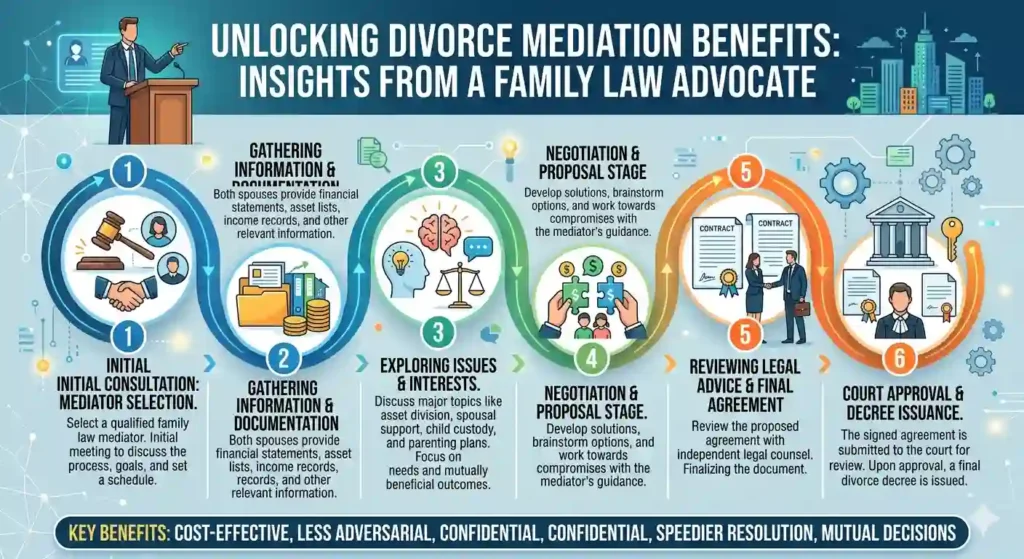
Step-by-Step Divorce Mediation Process at Rajendra Law Office LLP
Our mediation-first approach follows a structured, legally compliant process designed for client dignity. Therefore, every client receives a personalised legal strategy combining mediation with protective legal remedies. Below is our step-by-step mediation process at Rajendra Law Office LLP:
- Initial Legal Consultation: We assess the marital dispute, evaluate whether mediation is appropriate, and brief both parties on their legal rights under HMA, SMA, or IDA depending on religion.
- Document Collection: Marriage certificate, children’s birth certificates, property documents, income proofs, and DV Act evidence are compiled for mediation preparation and court filing.
- Mediation Session Scheduling: We arrange sessions at the court-annexed mediation centre, Rajendra Law Office LLP’s conference room, or a neutral venue preferred by both parties.
- Issue Mapping: All disputed issues — custody, alimony, property, Stridhan — are listed and prioritised for structured negotiation during mediation sessions by our lawyers.
- Negotiation and Settlement: Our lawyers advocate for fair terms during mediation, ensuring clients receive equitable outcomes on maintenance, custody, and property division matters.
- Drafting the Settlement MoU: A comprehensive Memorandum of Understanding is drafted covering all agreed terms, timelines, and enforcement mechanisms for complete legal clarity.
- Family Court Filing: The MoU is filed in the Family Court as a joint petition or consent terms, and the court passes a decree based on the mediated settlement agreement.
- Post-Decree Compliance Support: We monitor compliance with mediated terms and initiate enforcement proceedings under CPC Order XXI if either party defaults on agreed obligations.
Additionally, our 24×7 client support ensures you receive legal guidance at every critical stage. Consequently, clients experience a transparent, dignified, and legally secure mediation journey from start to finish.
Financial Benefits of Divorce Mediation Over Contested Litigation
Contested divorce litigation in India is expensive, time-consuming, and emotionally exhausting for both parties. Therefore, understanding mediation’s financial advantages encourages more couples to choose this pathway. A contested divorce in Chennai typically costs between ₹2 lakhs to ₹10 lakhs in legal fees and court expenses. Furthermore, it takes 3 to 7 years to resolve in Family Court, often extending to the Madras High Court on appeal. Mediation, by contrast, costs a fraction of litigation expenses and resolves most disputes within 3 to 6 months. Additionally, no court appearances are required during mediation, reducing lost workdays and travel expenses significantly. The Mediation Act, 2023 enables online mediation, further reducing costs for NRI spouses and outstation clients. Moreover, free mediation is available through District Legal Services Authorities (DLSA) across all Tamil Nadu districts. Lok Adalat settlements under the Legal Services Authorities Act, 1987 have no court fees whatsoever. Consequently, mediation democratises divorce resolution, making legal settlement accessible to all income groups. Rajendra Law Office LLP offers transparent fee structures for mediation support services across Tamil Nadu.
Psychological and Emotional Benefits of Choosing Mediation for Divorce
Divorce litigation causes severe psychological stress, social stigma, and emotional harm for all family members. Therefore, mediation’s non-adversarial approach significantly reduces mental health impact on separating spouses. Children benefit most from mediation — they avoid witnessing parental conflict in open court proceedings. Furthermore, mediation preserves respectful communication between spouses, which is essential for effective co-parenting after divorce. Courts often take years to resolve contested custody matters, prolonging children’s emotional instability significantly. Additionally, mediation sessions are private and confidential, preventing public exposure of sensitive marital information. Tamil Nadu’s One Stop Centres and Women Welfare Department provide psychological counselling alongside legal mediation support. Moreover, the Family Courts Act, 1984 allows judges to appoint counsellors to support parties during reconciliation and mediation efforts. The BNS, 2023 and BNSS, 2023 collectively support victim-sensitive handling of matrimonial criminal complaints during mediation periods. Consequently, mediation produces psychologically healthier outcomes for entire families navigating separation. Rajendra Law Office LLP integrates emotional sensitivity with legal expertise throughout every divorce mediation engagement.
NRI Divorce Mediation: Cross-Border Legal Challenges and Solutions
NRI divorce cases involve complex cross-border jurisdictional challenges that require specialised legal expertise. Therefore, Rajendra Law Office LLP provides dedicated NRI divorce mediation support across Indian and international jurisdictions. Foreign divorce decrees obtained without the Indian spouse’s participation are frequently contested in Indian Family Courts. Furthermore, the Mediation Act, 2023 enables online mediation, making remote participation feasible for NRI clients globally. Indian courts apply HMA or SMA depending on religion and the location of marriage solemnisation. Additionally, property disputes involving NRI couples require coordination between Indian courts and foreign legal systems. The Hague Convention on international child abduction applies to cases where children are wrongfully removed across borders. Moreover, Bigamy by NRI spouses is prosecuted under BNS Section 82 read with HMA Section 17 in India. Our lawyers file appropriate petitions in Chennai Family Court on behalf of deserted NRI spouses effectively. BNSS provisions enable swift issue of summons and notice to NRI respondents through diplomatic channels and e-service. Consequently, our mediation-centred approach resolves NRI divorce disputes faster than conventional adversarial litigation methods achieve.
Enforceability of Mediated Divorce Settlements: Legal Mechanisms
A mediated divorce settlement is legally enforceable once it is converted into a court consent decree. Therefore, parties can seek enforcement through CPC Order XXI if the other party defaults on agreed terms. The Mediation Act, 2023 under Section 27 allows parties to register mediation settlements as court orders directly. Furthermore, registered settlements carry the same legal weight as a decree passed after full trial in court. Contempt of court proceedings under the Contempt of Courts Act, 1971 address wilful non-compliance with mediated custody and maintenance orders. Additionally, maintenance default triggers recovery proceedings under BNSS Section 144 equivalent provisions in Tamil Nadu. Attachment and sale of the defaulting spouse’s property is ordered under CPC Order XXI Rule 30 to recover dues. Moreover, child custody violations — taking children without permission — constitute contempt and attract criminal prosecution under BNSS. The Family Court’s jurisdiction under the Family Courts Act, 1984 extends to enforcing all consent decrees arising from mediated settlements. Furthermore, BSA, 2023 governs the admissibility of mediated settlement documents as primary evidence in enforcement proceedings. Consequently, mediation provides a fully enforceable legal outcome through India’s robust court-supervised enforcement mechanisms.
Frequently Asked Questions: Divorce Mediation in India
1. What is divorce mediation in India?
Divorce mediation is a voluntary, confidential ADR process where a neutral mediator helps spouses reach a mutually agreed settlement under CPC Section 89 and Mediation Act, 2023.
2. Is mediation mandatory before divorce in India?
Family Courts under the Family Courts Act, 1984 must attempt reconciliation before divorce proceedings. Courts routinely refer cases to mediation under CPC Section 89 before trial begins.
3. How long does divorce mediation take in Tamil Nadu?
Divorce mediation in Tamil Nadu typically resolves disputes within 3–6 months, far faster than contested litigation, which can take 3–7 years in Family Courts and Madras High Court.
4. Can mediation resolve child custody disputes legally?
Yes. Mediated custody agreements under Guardian and Wards Act, 1890 and HMA Section 26 are filed in Family Court. Once approved, they are legally binding and fully enforceable consent decrees.
5. Which court handles divorce in Chennai, Tamil Nadu?
The Principal Family Court, Chennai (Kuppam Road) handles divorce petitions, custody, and maintenance. Appeals go to the Madras High Court under the Family Courts Act, 1984.
6. What is the wife’s maintenance right during mediation?
A wife can claim interim maintenance under HMA Section 24 and BNSS provisions during pending proceedings. Mediation enables negotiation of maintenance exceeding court-ordered amounts mutually.
7. Can domestic violence victims use mediation for divorce?
Mediation is inappropriate where abuse exists. DV Act, 2005 and BNS Section 85 provide protection orders. Lawyers must assess safety before recommending mediation in domestic violence cases.
8. Is free mediation available for divorce in Tamil Nadu?
Yes. Free mediation is provided by District Legal Services Authorities (DLSA) and Lok Adalats under the Legal Services Authorities Act, 1987 across all Tamil Nadu districts without court fees.
9. What happens if one party violates a mediated divorce agreement?
Enforcement is sought through CPC Order XXI. Under Mediation Act, 2023 Section 27, registered settlements equal court decrees. Contempt proceedings and attachment of property are available legal remedies.
10. How does Rajendra Law Office LLP support divorce mediation clients?
Rajendra Law Office LLP offers complete divorce mediation support — consultation, document drafting, Family Court filing, custody planning, and post-decree enforcement — across Tamil Nadu, available 24×7.
Read More
- Experienced Family Lawyers in Chennai
- RERA Compliance Lawyer Chennai for Builders: Expert Legal Support
- How to Choose the Best Property Lawyer in Chennai (2026 Guide)
- Expanding Globally: Legal Considerations in International Business
- Ethical Guardians: Understanding the Duties of Criminal Defense Lawyers
- Indian Dispute Resolution Centre