
Co-owner inherited property dispute India often begins when heirs disagree about selling jointly inherited land or a house. The disagreement may concern ownership shares, valuation, possession, timing, or the proposed buyer. First, identify how the property devolved after the owner’s death. A valid will, intestate succession, family arrangement, or earlier partition can change the analysis. Therefore, heirs should collect the death certificate, title deeds, will, succession records, tax receipts, and revenue documents. Next, prepare a dated chronology showing ownership changes and important communications. Keep favourable and unfavourable documents together for accurate legal review. Meanwhile, avoid signing sale agreements, powers of attorney, releases, or settlement papers without understanding their effect. Individual facts can change the legal position substantially. A property lawyer can examine the title chain, inheritance documents, existing encumbrances, and each heir’s legal interest. This preparation helps identify whether negotiation, partition, injunction, mediation, or another remedy suits the dispute.
What Are Your Options When Co-Owners Disagree Over Selling Inherited Property?
Identifying the Legal Ownership Position
Inherited property does not automatically create identical rights for every person claiming a family connection. The applicable succession law, nature of ownership, family structure, and documents determine each person’s interest. For Hindu families, the Hindu Succession Act provides important rules for intestate succession and coparcenary interests. Section 6 gives daughters equal coparcenary rights in Mitakshara joint Hindu families, subject to statutory conditions. However, inherited property may also arise through a testamentary disposition, separate ownership, settlement, gift, or earlier partition. Accordingly, lawyers usually examine the original title deed, previous conveyances, death records, will, legal-heir evidence, and revenue entries. Mutation records can assist administrative identification, but they do not alone settle every title question. Similarly, possession does not automatically establish exclusive ownership. Each co-owner should therefore establish the source and extent of the claimed share. A clear ownership map can reduce unnecessary allegations and help determine whether sale, partition, buyout, or settlement remains legally possible.
Check the Source of Inheritance
Start by determining whether the deceased left a registered will, unregistered will, or no will. Then examine whether the property belonged exclusively to the deceased or formed part of joint family property. These distinctions can affect the shares available to different heirs. Next, verify the title history through registered instruments and applicable government records. Check whether any earlier partition, release deed, settlement deed, gift deed, or family arrangement changed ownership. Also examine mortgages, charges, court orders, acquisition notices, leases, and pending litigation. Where a will exists, preserve the original document and supporting evidence concerning its execution. Where no will exists, identify the applicable succession rules and all relevant legal heirs. Furthermore, confirm whether any heir died before or after the succession opened. Such dates can affect devolution and representation. A careful inheritance review prevents one common error: treating family relationships as conclusive proof of property shares. Instead, the legal ownership position should follow verified documents, applicable succession law, and relevant judicial orders.
Verify Each Co-Owner’s Share
After establishing the ownership source, calculate each person’s potential share from the applicable documents and succession rules. Do not assume that every surviving relative receives an equal portion. The family tree, nature of ownership, will provisions, previous transfers, and applicable personal law can affect distribution. Therefore, prepare a simple ownership table before discussing a sale. Record each claimant’s name, relationship, supporting document, and provisional interest. Then identify disputed entries separately from established entries. This approach follows the supplied post’s recommendation to distinguish confirmed facts from assumptions. It also helps lawyers identify whether the disagreement concerns title, share calculation, possession, valuation, or sale authority. If one heir disputes another heir’s status, obtain relevant birth, marriage, death, succession, and title records. If an heir has already transferred an interest, examine the transfer instrument immediately. Section 44 of the Transfer of Property Act addresses transfers by co-owners and their resulting rights.
Understand the Effect of a Disputed Sale
A co-owner’s attempt to sell inherited property can create serious disputes when other co-owners withhold consent. The legal effect depends on what interest the person actually owns and what document was executed. Section 44 of the Transfer of Property Act recognizes a co-owner’s ability to transfer the share or interest legally held by that co-owner. However, that provision does not automatically give one co-owner unrestricted authority to convey every other co-owner’s interest. Therefore, buyers should conduct independent title verification before paying substantial consideration. Other heirs should also avoid assuming that an informal objection alone resolves the transaction. Depending on circumstances, appropriate civil remedies may include declaration, partition, injunction, cancellation, or other relief. A disputed transaction may also require examination of registration records and encumbrances. If deception, forged documents, impersonation, or dishonest inducement appears, separate criminal-law questions may arise. Those allegations require evidence and should not be made merely because family members disagree about a sale.
Why Co-Owners Commonly Disagree
Valuation and Sale Price Conflicts
Many inherited property disputes begin with disagreement about market value rather than ownership itself. One heir may seek immediate liquidity, while another expects future appreciation. Meanwhile, another co-owner may occupy the property and value continued possession. Therefore, obtain an independent valuation before treating a proposed price as fair or unfair. Compare the property location, land extent, building condition, access, permitted use, comparable transactions, and existing liabilities. Also verify applicable government guidance values and registration-related information. A transparent valuation can support negotiation without deciding the dispute prematurely. If co-owners cannot agree, a buyout proposal may offer another route. One heir can potentially acquire another heir’s interest through a properly documented transaction. However, the document must accurately describe the interest transferred and satisfy applicable registration requirements. Where negotiations fail, a partition proceeding may determine the parties’ rights. The Partition Act also permits court-directed sale in specified circumstances where physical division cannot reasonably or conveniently occur.
Possession, Rent, and Property Expenses
Disagreements often intensify when one co-owner occupies the inherited property while others live elsewhere. Questions may then arise about rent, maintenance, taxes, repairs, insurance, and exclusive enjoyment. First, collect payment records and receipts for property-related expenses. Next, identify who collected rent and whether tenants occupy any portion. Keep bank statements, rental agreements, tax receipts, utility bills, and repair invoices. A written accounting can reveal whether one party paid necessary expenses or received property income. Furthermore, avoid changing locks, removing belongings, disconnecting utilities, or using force against another claimant. Such conduct can create additional legal issues and complicate civil proceedings. Where possession becomes contentious, legal advice should focus on the relief actually required. Depending on facts, parties may consider partition, possession-related relief, accounting, injunction, or negotiated arrangements. A court may examine documents, possession history, admissions, and other evidence. Therefore, contemporaneous records can become important when the parties later provide competing accounts.
Family Arrangements and Settlement Discussions
Family members can sometimes resolve inherited property disputes through a properly structured settlement or family arrangement. Such discussions should begin with a complete statement of assets, liabilities, ownership shares, and desired outcomes. Then identify whether one person wants the property, another wants money, or everyone prefers an external sale. Mediation can provide a structured setting for discussing these alternatives. A settlement should clearly identify the property, parties, consideration, rights surrendered, obligations assumed, and future claims. Registration and stamp requirements may apply depending on the instrument and circumstances. Therefore, obtain document-specific legal advice before signing a memorandum, release deed, partition deed, settlement deed, or sale agreement. The supplied material also recommends defining the desired outcome before selecting a legal route. This principle remains useful because a dispute may require clarification rather than immediate litigation. A carefully documented settlement can reduce uncertainty while preserving evidence of the parties’ agreed position.
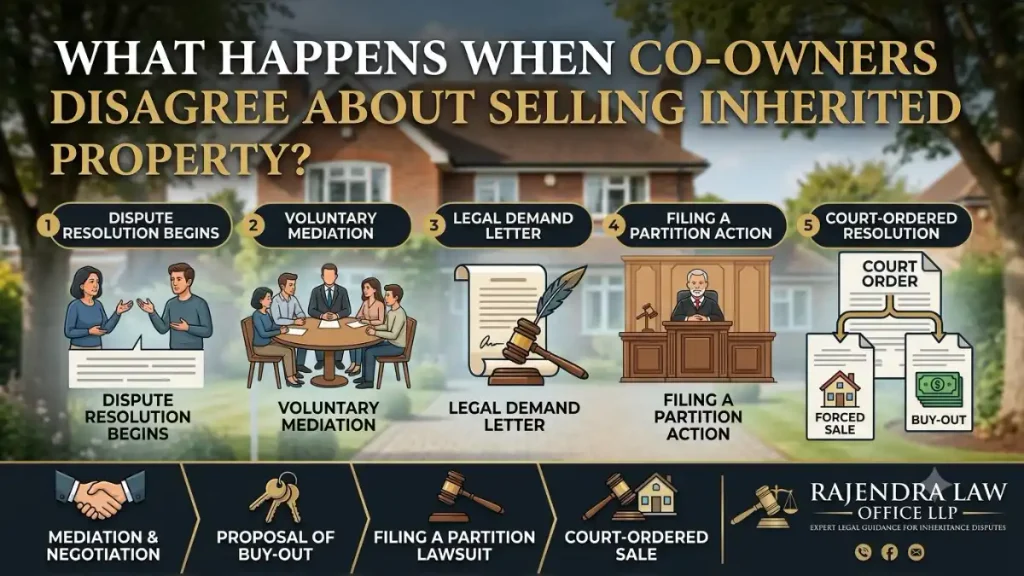
When Negotiation Fails
When direct discussions fail, co-owners should identify the exact legal relief required before filing proceedings. A partition suit may become relevant where parties seek separation of their respective interests. A declaration may become relevant where title or legal status requires judicial determination. An injunction may become relevant where a party seeks protection against a threatened transaction or other conduct. The Code of Civil Procedure provides procedural mechanisms for civil litigation, including temporary injunction applications under Order XXXIX. However, the appropriate pleading depends on the actual facts and documents. Therefore, do not copy a generic property dispute format without legal review. Identify the property description, parties, cause of action, jurisdictional facts, requested relief, and supporting records. Check whether any earlier proceeding affects the dispute. Also review limitation issues and court-fee requirements with counsel. The supplied post recommends clarifying the forum and comparing routes by purpose, evidence, timing, and consequence.
Partition Proceedings and Court-Ordered Sale
A partition dispute does not always end with an immediate sale of the entire property. The court first considers the legal interests claimed by the parties and the nature of the property. Physical division may work for certain parcels, while other properties may require another solution. Section 2 of the Partition Act allows a court to direct sale and distribution of proceeds in specified partition circumstances. :contentReference[oaicite:13]{index=13} The statutory provision considers situations where division cannot reasonably or conveniently occur and sale benefits the shareholders. Therefore, co-owners should not assume that one person’s refusal automatically forces a private sale. Conversely, one person’s refusal does not necessarily prevent every lawful method of resolving the ownership dispute. The court process can examine competing claims, documents, valuation evidence, and practical divisibility. Where appropriate, parties may also negotiate a buyout instead of continuing litigation. Legal counsel can help compare partition, sale, settlement, mediation, and other available remedies based on the actual property.
Temporary Injunction and Urgent Protection
Urgent protection may become relevant when a co-owner threatens an immediate transaction or alteration affecting disputed property. A party seeking interim relief must present a factual and evidentiary basis for the requested order. The Code of Civil Procedure contains provisions governing temporary injunction applications and court procedure. Therefore, applicants should preserve the threatened sale agreement, advertisements, messages, broker communications, registration details, and other supporting records. Next, prepare a concise chronology showing why urgent intervention may matter. Courts assess applications according to applicable legal principles and the circumstances presented. An injunction should not be treated as an automatic response to every family disagreement. Instead, the relief should match the actual risk and requested protection. Furthermore, parties should comply with existing court orders and avoid self-help measures. If an injunction application becomes necessary, legal counsel should prepare the pleadings and evidence carefully. This approach supports the supplied post’s emphasis on preserving records and checking deadlines before action.
Mediation and Court-Annexed Settlement
Mediation can help co-owners discuss practical solutions without immediately seeking a contested final judgment. The process may allow parties to explore sale, buyout, division, possession arrangements, expense sharing, and document completion. However, mediation cannot change legal ownership merely through informal discussion. Any final settlement should clearly record the agreed rights and obligations. Therefore, participants should obtain legal advice before signing settlement terms. A mediator can facilitate communication but does not replace independent legal representation where legal rights remain disputed. Furthermore, parties should disclose relevant title documents and material liabilities before finalizing financial terms. A structured settlement may also address timelines for vacating premises, paying consideration, registering documents, and handing over originals. If mediation fails, parties can consider the appropriate litigation route based on the remaining dispute. The supplied post recognizes negotiation and mediation among possible lawful routes before or alongside proceedings. This makes mediation a practical option to examine when communication remains possible and all parties seek an orderly resolution.
Criminal Complaints Require Separate Evidence
A family property disagreement does not automatically become a criminal case. Criminal allegations require facts that satisfy the relevant offence and supporting evidence. The Bharatiya Nyaya Sanhita, 2023 contains provisions concerning offences such as cheating. Section 318 defines cheating around deception and dishonest or fraudulent inducement.
Therefore, allegations involving forged documents, impersonation, cheating, criminal breach of trust, or dishonest conduct should receive separate legal assessment. The Bharatiya Nagarik Suraksha Sanhita governs criminal procedure and includes provisions concerning police information and investigation.
If a genuine cognizable offence appears, the concerned police station may become relevant. However, parties should not use criminal complaints merely as pressure in an essentially civil ownership dispute. Preserve original documents, communications, registration records, and transaction evidence before approaching authorities. Legal counsel can assess whether civil remedies, criminal remedies, or both have a lawful basis. This distinction protects the integrity of the dispute and avoids confusing title adjudication with criminal investigation.
Documents, Evidence, Forums, and Legal Remedies
Essential Property Documents
Strong property-dispute preparation starts with a complete evidence file rather than isolated documents. Collect the original title deed, parent documents, encumbrance certificate, tax receipts, patta or revenue records, survey details, approved plans, and possession evidence. Add the deceased owner’s death certificate, will, succession documents, legal-heir records, and earlier family arrangements. Also collect sale discussions, broker messages, proposed agreements, bank records, and written objections. The Bharatiya Sakshya Adhiniyam recognizes electronic or digital records subject to statutory conditions.
Therefore, preserve complete digital conversations instead of relying only on cropped screenshots. Keep files in chronological order and retain original versions where possible. The supplied post specifically recommends a dated chronology, preserved originals, and an evidence index.
Finally, note missing documents separately. This allows counsel to identify whether certified copies, government records, witness evidence, or additional searches may be necessary before proceedings begin.
Title Deeds
Death and Succession Records
Revenue and Registration Records
Digital Communications
Payment and Expense Records
Sale and Broker Documents
Chronology and Evidence Index
Choosing the Correct Forum and Legal Support
The correct forum depends on the relief sought, property location, parties, procedural law, and nature of the dispute. Civil courts generally address title, partition, possession, declaration, injunction, and related property remedies. Registration and revenue authorities may handle specific administrative records or registration functions, but they do not necessarily decide every title dispute. Police authorities may become relevant when facts disclose a cognizable criminal offence. Tribunals or specialized forums may apply where a separate statutory dispute falls within their jurisdiction. Therefore, identify the exact remedy before choosing the forum. Check territorial jurisdiction, pecuniary requirements, court fees, limitation, and applicable procedural rules. Also determine whether any earlier proceeding affects the proposed case. The supplied post recommends confirming which forum can provide the requested relief before action.
For Chennai property disputes, lawyers may examine the relevant civil court jurisdiction, registration authorities, revenue offices, mediation facilities, and police station jurisdiction.
Civil Court Remedies
Registration and Revenue Authorities
Police Station Jurisdiction
Mediation and Settlement Forums
Tribunals and Special Forums
Practical Legal Strategy for Co-Owners
A practical legal strategy begins with the desired outcome and then works backward through evidence, forum, and remedy. One co-owner may want a sale, while another may prefer continued ownership or a buyout. A third person may dispute the ownership shares themselves. Therefore, counsel should first separate the ownership question from the sale question. Next, prepare a complete chronology and evidence index. Then identify urgent risks, including proposed registration, encumbrance, possession changes, demolition, or disposal of documents. Consider negotiation or mediation where communication remains realistic. If settlement fails, evaluate partition, declaration, injunction, possession, accounting, cancellation, or other appropriate civil relief. Where credible criminal conduct exists, separately examine BNS and BNSS implications. Evidence should follow the requirements of the Bharatiya Sakshya Adhiniyam, including provisions governing electronic records. :contentReference[oaicite:22]{index=22} Finally, preserve proof of every notice, filing, payment, and response. This structured approach supports informed decision-making without assuming that one remedy fits every inherited property dispute.
Define the Desired Outcome
Prepare the Chronology
Compare Legal Remedies
Preserve Evidence
Review Before Filing
Obtain Property-Law Advice
Frequently Asked Questions
Can one co-owner sell inherited property without consent?
What if one heir refuses to sell?
Can a court order inherited property to be sold?
What evidence should disputed heirs preserve?
Can police intervene in an inherited property dispute?
When should an inherited property lawyer be consulted?
Rajendra Law Office can assist with inherited property disputes involving co-owner disagreements, partition claims, title verification, injunction strategy, settlement discussions, documentation, and civil litigation. Before taking action, preserve the records and establish the actual ownership position. Next, identify the outcome required and the forum capable of granting that relief. Relevant legal support may include property due diligence, succession analysis, legal notices, partition proceedings, injunction applications, mediation, settlement documentation, and representation before appropriate courts or authorities. The supplied post emphasizes defining the objective, preserving evidence, checking timelines, and reviewing the forum before submission.
These steps can help organize an inherited property dispute before formal action. Property disputes can involve substantial financial and family consequences, so document-specific legal advice remains important. This article provides general information and should not replace professional assessment of the particular title, succession documents, transactions, or proceedings involved.
Read more
- Best Legal Advice in Chennai | Fraudulent Sale Deed Cancellation, Patta Disputes & Business
- Expertise in Property Title and Ownership Disputes: Real Estate Advocates
- How to Verify Property Title Before Buying Land in Tamil Nadu?
- Exploring Mediation Services Excellence in Chennai 💼
- How to Choose the Best Property Lawyer in Chennai (2026 Guide)
Search Terms: inherited property dispute lawyer Chennai, co-owner property dispute India, inherited property sale disagreement, partition suit Chennai, co-owner rights in inherited property, ancestral property dispute lawyer, succession property lawyer Chennai, property injunction lawyer, title dispute advocate, family property settlement, partition lawyer Chennai, property litigation lawyer, inherited house sale dispute, legal heir property dispute, property documentation lawyer, civil court property dispute, property mediation Chennai, property legal notice, disputed property sale, Hindu succession property rights, Transfer of Property Act co-owner, Partition Act sale, BNS property offences, BNSS police complaint, BSA electronic evidence, revenue records, registration department, encumbrance certificate, Chennai property litigation, Tamil Nadu property lawyer.