
From Local to Global – Arbitration offers businesses an efficient alternative to traditional litigation. However, obtaining an award marks only one stage. Successful enforcement ultimately delivers practical value and financial recovery. Therefore, parties must understand enforcement procedures thoroughly. The Arbitration and Conciliation Act, 1996 governs domestic and foreign award enforcement. India also recognizes obligations under the New York Convention. Consequently, many international awards receive enforcement support through Indian courts. Rajendra Law Office LLP assists businesses, individuals, NGOs, and NRIs in enforcement proceedings. Effective legal strategies reduce delays and procedural challenges. Moreover, early asset identification improves recovery prospects significantly. Parties should preserve arbitration agreements, awards, pleadings, and supporting evidence carefully. Strong documentation facilitates smoother court proceedings. Professional representation ensures compliance with statutory requirements while maximizing enforcement opportunities across jurisdictions.
From Local to Global: Enforcing Arbitration Awards – Rajendra Law Office LLP
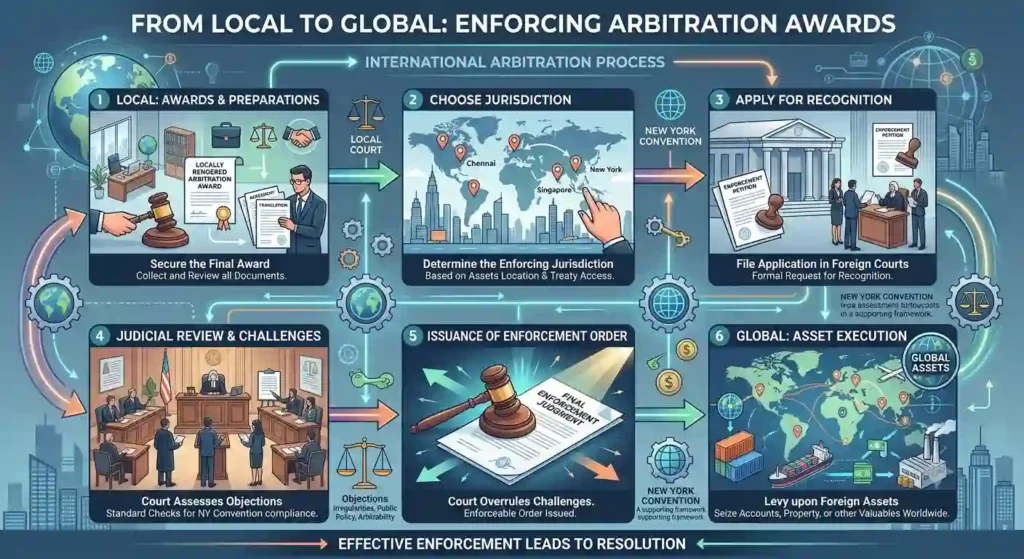
Why Arbitration Award Enforcement Matters
An unenforced award provides limited commercial benefit. Businesses require actual recovery to resolve disputes effectively. Therefore, enforcement remains a critical post-award process. Award debtors sometimes resist payment through procedural objections. Additionally, cross-border disputes introduce jurisdictional complexities. Effective enforcement achieves:
- Monetary recovery
- Asset attachment
- Compliance with award terms
- Business certainty
- Reduced litigation exposure
- Cross-border dispute resolution
Prompt action often prevents asset dissipation risks. Furthermore, enforcement strengthens confidence in arbitration mechanisms. Commercial parties increasingly prefer arbitration due to global enforceability advantages. Consequently, businesses gain practical remedies through efficient enforcement procedures. Strategic legal planning remains essential throughout recovery efforts.
Domestic Arbitration Award Enforcement Process
Domestic arbitration awards generally receive treatment similar to court decrees. Successful parties may seek execution through competent courts. Moreover, statutory procedures streamline enforcement actions. Key enforcement stages include:
- Obtaining the final award
- Reviewing challenge limitations
- Filing enforcement proceedings
- Identifying debtor assets
- Seeking execution measures
Courts may permit attachment and recovery actions against assets. Therefore, parties should gather relevant financial information promptly. Legal representation improves procedural compliance considerably. Proper execution strategies increase recovery efficiency and reduce enforcement delays. Effective planning remains crucial during domestic enforcement proceedings.
Enforcement of Foreign Arbitration Awards
Foreign awards often arise from international commercial relationships. India enforces qualifying awards under recognized international conventions. Courts generally examine limited statutory grounds during enforcement proceedings. Therefore, parties benefit from arbitration’s international framework. Important considerations include:
| Requirement | Purpose |
|---|---|
| Valid Award | Legal recognition |
| Arbitration Agreement | Jurisdiction basis |
| Convention Compliance | International enforcement |
| Proper Notice | Due process |
| Supporting Documents | Court verification |
Foreign award enforcement demands careful procedural preparation. Consequently, parties should obtain legal guidance before commencing proceedings. Compliance with documentation requirements reduces unnecessary objections and delays.
Common Challenges During Enforcement Proceedings
Award debtors frequently raise objections against enforcement efforts. Some challenges concern jurisdictional or procedural issues. Likewise, public policy objections occasionally arise in court proceedings. Common enforcement challenges include:
- Jurisdiction disputes
- Public policy objections
- Documentation deficiencies
- Asset concealment
- Limitation concerns
- Parallel proceedings
Strategic responses address these challenges effectively. Moreover, courts increasingly support arbitration-friendly enforcement principles. Professional advocacy improves success rates significantly. Therefore, parties should prepare comprehensive records and evidence before initiating enforcement proceedings.
Courts, Jurisdiction and Enforcement Forums
Enforcement proceedings involve several judicial authorities depending on circumstances. Commercial Courts frequently handle business-related enforcement disputes. High Courts also exercise jurisdiction in appropriate matters. Relevant forums include:
| Forum | Function |
|---|---|
| Commercial Courts | Commercial enforcement |
| District Courts | Execution proceedings |
| High Courts | Supervisory jurisdiction |
| Supreme Court | Appellate remedies |
| International Forums | Foreign enforcement support |
Jurisdiction depends upon assets, award nature, and statutory provisions. Therefore, legal assessment remains essential before filing proceedings. Proper forum selection reduces procedural complications and enforcement delays. Strategic jurisdiction planning improves recovery outcomes significantly.
Legal Remedies Available After an Arbitration Award
Successful parties possess several remedies during enforcement stages. Courts may authorize asset attachment and sale proceedings. Additionally, garnishee orders may assist debt recovery efforts. Available remedies include:
- Asset attachment
- Property sale orders
- Garnishee proceedings
- Bank account attachment
- Injunction relief
- Interest recovery
Timely applications preserve enforcement opportunities effectively. Therefore, parties should avoid unnecessary delays after receiving awards. Strategic execution measures often encourage voluntary compliance. Consequently, enforcement proceedings achieve faster and more efficient outcomes.
CPC, BNS, BNSS and BSA in Enforcement Matters
Enforcement proceedings occasionally intersect with civil and criminal issues. The Code of Civil Procedure, 1908 governs execution-related mechanisms. Fraudulent asset transfers may attract provisions under the Bharatiya Nyaya Sanhita, 2023. Investigation procedures follow the Bharatiya Nagarik Suraksha Sanhita, 2023. Electronic evidence receives recognition under the Bharatiya Sakshya Adhiniyam, 2023. Relevant concerns include:
- Fraudulent transfers
- Concealment of assets
- Digital evidence disputes
- Misrepresentation claims
- Recovery obstruction
Legal analysis determines suitable remedies under civil and criminal frameworks. Consequently, award holders obtain broader protection during enforcement proceedings.
Asset Tracing, Police Assistance and Recovery Measures
Certain enforcement matters involve asset concealment or fraudulent conduct. Parties may require asset tracing and investigative support. Moreover, criminal complaints may arise from fraudulent activities. Nearby police stations, Economic Offences Wings, and specialized units may investigate offenses. Common concerns include:
- Fraudulent asset disposal
- Forged records
- Financial concealment
- Misappropriation allegations
- Deceptive transactions
Lawyers coordinate recovery efforts and enforcement strategies effectively. Therefore, award holders gain stronger leverage during execution proceedings. Comprehensive evidence collection remains essential for successful recovery actions.
Global Enforcement Strategies for Arbitration Success
International commerce increasingly relies on arbitration for dispute resolution. However, successful recovery depends upon effective enforcement planning. Rajendra Law Office LLP provides comprehensive support for domestic and foreign award enforcement. Our services include jurisdiction assessment, asset tracing, execution proceedings, and cross-border recovery strategies. Furthermore, we assist individuals, companies, NGOs, and NRIs throughout enforcement stages. Legal teams evaluate risks and develop tailored recovery plans. Strategic representation strengthens enforcement prospects across multiple jurisdictions. Consequently, clients maximize recovery opportunities while minimizing procedural obstacles. Effective enforcement transforms favorable awards into practical results. Professional legal guidance remains essential for protecting commercial interests and securing timely compliance with arbitration awards worldwide.
Frequently Asked Questions
Q1. Can an arbitration award be enforced like a court decree?
Yes. Domestic awards generally receive enforcement through execution procedures similar to court decrees.
Q2. Are foreign arbitration awards enforceable in India?
Yes. India enforces qualifying foreign awards under applicable convention and statutory requirements.
Q3. What if the award debtor refuses payment?
Courts may permit attachment, garnishee proceedings, asset sales, and other recovery measures.
Q4. Can enforcement proceedings involve foreign assets?
Yes. Cross-border enforcement strategies may target assets located within other jurisdictions.
Q5. How long should I wait before enforcing an award?
Parties should act promptly to prevent asset dissipation and procedural complications.
Q6. Can fraud during enforcement trigger criminal action?
Yes. Fraudulent transfers, concealment, and deceptive conduct may attract criminal investigation and proceedings.
Read More
- Finding the Right Civil Lawyer: Tips and Considerations
- Find Top Lawyers in Chennai: Your Legal Solutions Await
- Insurance Law: Your Rights and Legal Protections
- Immigration Lawyers in Chennai for Visa Services
- Navigating Trademark Law and Registration: Essential Steps and Procedures
- Department of Legal Affairs, Ministry of Law & Justice