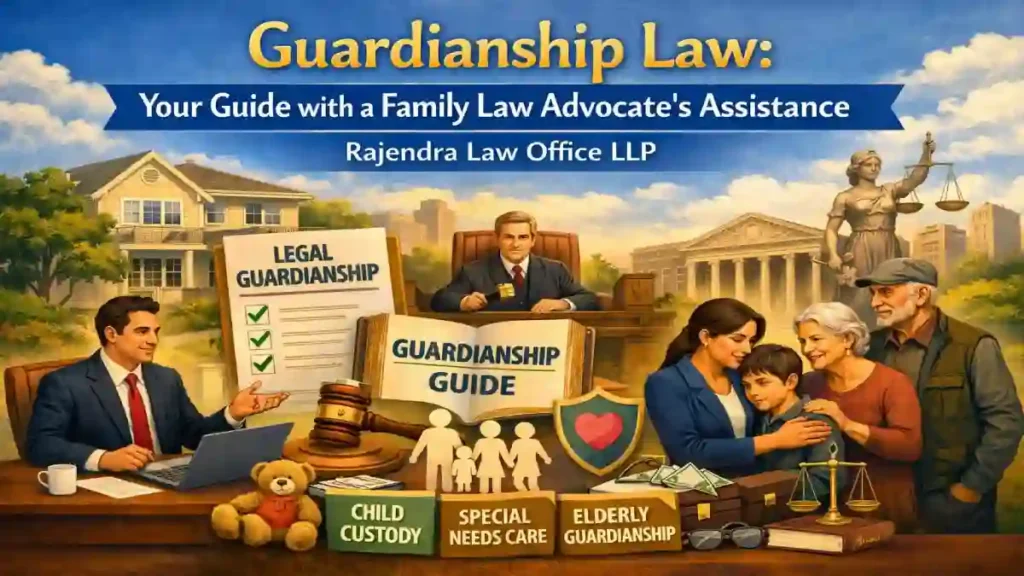
Guardianship law protects minors and legally incapable persons through court-appointed guardians who safeguard personal and financial interests. Therefore, families should understand their legal rights before seeking guardianship orders. Indian laws recognise guardianship based upon the child’s welfare, lawful custody, and best interests. Family Courts carefully examine every relevant circumstance before granting appropriate relief. Rajendra Law Office LLP assists parents, grandparents, relatives, guardians, NRIs, and families throughout guardianship proceedings across India. Early legal guidance prevents procedural delays while strengthening supporting documentation. Moreover, experienced family law advocates prepare petitions, represent clients before competent courts, and protect children’s welfare during every litigation stage. Proper legal advice also reduces avoidable disputes regarding custody, visitation, education, healthcare, property management, and financial decision-making.
Guardianship Law: Your Guide with a Family Law Advocate’s Assistance – Rajendra Law Office LLP
Importance of Legal Assistance in Guardianship Matters
Guardianship disputes often involve emotional issues, legal complexities, and detailed judicial scrutiny. Consequently, experienced legal representation remains essential throughout every proceeding. Family law advocates analyse family circumstances, statutory requirements, documentary evidence, and children’s welfare before preparing petitions. Courts consider parental capability, financial stability, educational needs, emotional wellbeing, and overall welfare before issuing guardianship orders. Legal professionals also assist with interim applications, visitation arrangements, settlement discussions, and appellate remedies wherever necessary. Common disputes include parental disagreements, NRI custody matters, property management, adoption-related issues, and guardianship after parental death. Therefore, early legal consultation protects family interests while ensuring compliance with applicable laws. Timely representation also improves procedural efficiency before Family Courts and appellate forums.
Persons Who May Seek Guardianship Orders
Several persons may approach competent courts seeking lawful guardianship according to statutory provisions. Therefore, applicants should understand eligibility before commencing legal proceedings. Eligible applicants commonly include:
- Biological parents.
- Surviving parent.
- Grandparents.
- Close relatives.
- Court-appointed guardians.
- Adoptive parents.
- Legal custodians.
- Interested family members.
- Persons managing minor property.
- NRIs with lawful claims.
- Welfare institutions where permitted.
- Other eligible applicants recognised by law.
Courts always prioritise the child’s welfare above competing personal interests. Consequently, every applicant should present complete evidence supporting suitability, stability, and genuine concern for the child’s wellbeing before judicial authorities.
Essential Documents Required for Guardianship Petitions
Accurate documentation strengthens guardianship proceedings and reduces procedural objections. Accordingly, applicants should organise all relevant records before filing petitions. Frequently required documents include:
| Document | Purpose |
|---|---|
| Birth certificate | Establishes age |
| Identity proof | Verifies applicant |
| Address proof | Confirms residence |
| Relationship proof | Establishes eligibility |
| School records | Shows educational status |
| Medical records | Supports welfare assessment |
| Property documents | Protects minor assets |
| Financial records | Demonstrates capability |
Additional documents may become necessary according to individual circumstances. Professional legal review ensures document accuracy before filing. Consequently, organised evidence improves judicial confidence and procedural efficiency.
Common Guardianship Disputes Before Family Courts
Family Courts regularly decide guardianship disputes involving personal welfare and property management. Therefore, legal preparation remains essential before initiating proceedings. Frequently reported disputes include:
- Child custody disagreements.
- Guardianship after parental death.
- NRI custody disputes.
- Minor property management.
- Educational decision conflicts.
- Healthcare decision disputes.
- Visitation disagreements.
- Guardian removal petitions.
Experienced advocates evaluate every dispute carefully before recommending suitable legal remedies. Consequently, families receive practical advice supporting children’s welfare while protecting lawful parental and guardian rights.
Legal Framework Governing Guardianship in India
Guardianship matters arise under several Indian statutes depending upon religion, personal law, and case circumstances. The Guardians and Wards Act, 1890 provides the principal statutory framework for many guardianship proceedings. Additionally, the Hindu Minority and Guardianship Act, 1956 governs applicable Hindu family matters. Civil proceedings generally follow the Code of Civil Procedure, 1908 (CPC) wherever applicable. Criminal conduct involving kidnapping, child abuse, forged documents, or fraudulent custody claims may attract provisions under the Bharatiya Nyaya Sanhita, 2023 (BNS). Investigation procedures generally follow the Bharatiya Nagarik Suraksha Sanhita, 2023 (BNSS), while evidentiary matters follow the Bharatiya Sakshya Adhiniyam, 2023 (BSA). Therefore, experienced legal guidance ensures statutory compliance and effective representation before competent judicial forums.
Legal Issues Frequently Raised in Guardianship Cases
Guardianship proceedings often involve several legal and factual issues requiring judicial determination. Therefore, comprehensive legal preparation strengthens every petition. Common legal issues include:
- Child custody.
- Permanent guardianship.
- Interim custody.
- Visitation rights.
- Minor property administration.
- Guardian removal.
- Educational decisions.
- Medical treatment consent.
- Cross-border custody.
- NRI guardianship.
- Child welfare concerns.
- Parental fitness assessments.
Appropriate proceedings generally commence before the Family Court or competent District Court depending upon statutory jurisdiction. Early legal intervention strengthens evidence, protects children’s welfare, and improves prospects for favourable judicial orders.
Guardianship Procedure Before Competent Family Courts
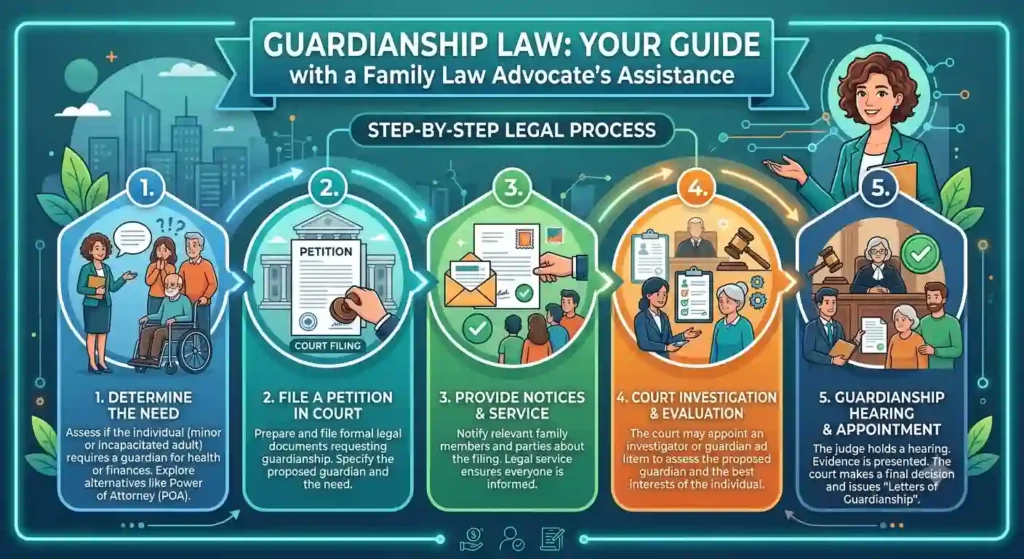
Guardianship proceedings begin with careful legal evaluation and proper petition drafting. Therefore, applicants should obtain professional legal advice before approaching the court. The petition should clearly explain the child’s welfare, relationship, financial capability, and reasons supporting guardianship. Supporting records must accompany every pleading because documentary evidence strengthens judicial confidence. Family Courts may issue notices to interested parties before conducting hearings. Judges also examine the child’s welfare, educational needs, emotional wellbeing, living environment, and future security. Where appropriate, the court may interact with the child before passing suitable orders. The usual procedure includes:
- Legal consultation.
- Document verification.
- Petition preparation.
- Court filing.
- Notice issuance.
- Evidence presentation.
- Final hearing.
- Guardianship order.
Proper legal preparation improves procedural efficiency and protects the child’s best interests.
Jurisdiction, Courts, and Government Authorities
Selecting the correct forum ensures timely adjudication and effective legal remedies. Consequently, families should determine jurisdiction before filing guardianship petitions. Most guardianship matters proceed before the Family Court or the competent District Court under applicable statutes. Appeals may lie before the High Court according to law. Government departments occasionally assist where child welfare concerns arise. Relevant authorities include:
- Department of Women and Child Development.
- Child Welfare Committee.
- District Child Protection Unit.
- State Commission for Protection of Child Rights.
- National Commission for Protection of Child Rights.
- Local Revenue Authorities where property issues arise.
Each authority performs specific statutory functions supporting child welfare and legal protection. Early legal advice ensures proper coordination with every competent authority whenever necessary.
Legal Remedies Available in Guardianship Matters
Family Courts possess wide powers to protect minors and legally incapable persons through suitable judicial orders. Therefore, lawyers carefully evaluate appropriate remedies before commencing proceedings. Available legal remedies include:
| Legal Remedy | Purpose |
|---|---|
| Permanent guardianship | Long-term protection |
| Interim guardianship | Immediate relief |
| Custody orders | Child care arrangements |
| Visitation orders | Parent-child access |
| Property management orders | Protect minor assets |
| Injunctions | Prevent unlawful interference |
| Modification petitions | Change existing orders |
| Appeals | Challenge adverse decisions |
Appropriate remedies depend upon statutory provisions, evidence, and the child’s welfare. Skilled advocacy improves the likelihood of obtaining meaningful judicial protection.
Evidence, Compliance, and Family Law Strategy
Strong evidence significantly influences guardianship decisions before Family Courts. Accordingly, applicants should preserve every relevant record supporting their claim. Important preparation steps include:
- Collect identity documents.
- Preserve financial records.
- Obtain school reports.
- Secure medical records.
- Gather witness statements.
- Prepare welfare plans.
- Organise property documents.
- Maintain communication records.
The Bharatiya Sakshya Adhiniyam, 2023 (BSA) governs evidentiary issues wherever applicable. Professional legal guidance ensures accurate documentation, procedural compliance, and persuasive presentation before competent judicial authorities. Consequently, organised preparation strengthens guardianship petitions while protecting the child’s long-term welfare and legal interests.
Police Assistance, Criminal Protection, and Emergency Legal Measures
Certain guardianship disputes involve criminal conduct requiring immediate legal intervention. Therefore, affected families should contact competent authorities without unnecessary delay. Kidnapping, child trafficking, wrongful confinement, forged documents, criminal intimidation, or custodial interference may attract the Bharatiya Nyaya Sanhita, 2023 (BNS). Investigation ordinarily follows the Bharatiya Nagarik Suraksha Sanhita, 2023 (BNSS), while evidentiary issues rely upon the Bharatiya Sakshya Adhiniyam, 2023 (BSA). Families may approach the nearby jurisdictional police station, All Women Police Station, Juvenile Police Unit, or specialised child protection authorities whenever immediate protection becomes necessary. Lawyers assist with complaints, anticipatory legal measures, documentation, and court proceedings. Prompt legal action safeguards children, preserves evidence, and supports effective judicial intervention through competent courts.
Family Law Advocate’s Role in Guardianship Proceedings
Experienced legal representation improves procedural compliance, evidence management, and effective advocacy throughout guardianship litigation. Accordingly, Rajendra Law Office LLP provides comprehensive family law services for parents, grandparents, guardians, relatives, NGOs, and NRIs. Lawyers prepare petitions, legal notices, affidavits, written submissions, settlement proposals, and appellate pleadings. Professional assistance also includes mediation, child custody negotiations, visitation arrangements, guardian appointments, property protection, and execution proceedings. Advocates represent clients before Family Courts, District Courts, High Courts, and the Supreme Court of India wherever appropriate. Regular legal guidance reduces procedural mistakes while strengthening every stage of litigation. Consequently, families receive dependable legal support focused upon children’s welfare, statutory compliance, and long-term legal protection across India.
Why Early Legal Advice Strengthens Guardianship Cases
Timely legal consultation preserves evidence, protects procedural rights, and improves judicial confidence throughout guardianship proceedings. Therefore, applicants should seek professional assistance before disputes escalate into prolonged litigation. Early legal review identifies jurisdiction, statutory remedies, documentation requirements, and suitable interim relief. Lawyers also evaluate settlement opportunities wherever family reconciliation remains possible. Strategic preparation reduces delays while ensuring compliance with the Code of Civil Procedure, 1908, applicable personal laws, and guardianship statutes. Careful documentation supports welfare assessments and strengthens factual presentations before Family Courts. Consequently, organised legal action enhances prospects for favourable guardianship orders while safeguarding children’s education, healthcare, emotional wellbeing, and financial security under judicial supervision.
Protecting Children’s Welfare Through Experienced Family Law Representation
Guardianship proceedings require careful legal planning, compassionate representation, and complete procedural compliance. Moreover, every decision should prioritise the child’s welfare above competing personal interests. Professional legal guidance assists families with guardianship petitions, custody disputes, visitation arrangements, property management, emergency protection, and appellate proceedings. Rajendra Law Office LLP represents clients before Family Courts, District Courts, High Courts, statutory authorities, and other competent judicial forums across India. Experienced advocates provide strategic legal solutions supported by accurate documentation and effective courtroom representation. Consequently, parents, relatives, guardians, NGOs, and NRIs receive reliable legal assistance protecting children’s rights, welfare, and future interests through lawful and practical guardianship solutions.
Frequently Asked Questions
1. Who can apply for guardianship in India?
Parents, grandparents, close relatives, legal custodians, eligible guardians, and certain institutions may seek guardianship through the competent Family Court or District Court.
2. Which law governs guardianship proceedings?
The Guardians and Wards Act, 1890, the Hindu Minority and Guardianship Act, 1956, and applicable personal laws primarily govern guardianship matters.
3. Which court decides guardianship disputes?
Family Courts or competent District Courts usually hear guardianship petitions, while appeals may proceed before the High Court under applicable law.
4. Can NRIs seek guardianship of a child in India?
Yes. NRIs may pursue guardianship subject to jurisdiction, statutory compliance, the child’s welfare, and judicial approval based upon supporting evidence.
5. What remedies are available in guardianship cases?
Courts may grant guardianship, custody, visitation, interim protection, property management orders, injunctions, modifications, and appellate relief where justified.
6. Why should families engage a family law advocate?
Experienced advocates prepare petitions, manage evidence, represent clients, protect procedural rights, and improve successful outcomes through effective legal strategies.
Read More
- Global Enforcement of Intellectual Property Rights: Legal Insights
- Future Forecasts: Trends and Innovations in Criminal Defense Law
- From Local to Global: Enforcing Arbitration Awards
- Finding the Right Civil Lawyer: Tips and Considerations
- Find Top Lawyers in Chennai: Your Legal Solutions Await
- National Legal Services Authority (NALSA)