Understanding legal procedures is crucial for effective litigation in Indian courts. Interlocutory applications and interim applications represent essential procedural tools in civil litigation. These applications enable parties to seek urgent relief during pending suits. Many litigants confuse these two types of applications despite their distinct purposes. The Civil Procedure Code, 1908 (CPC) governs both these remedial mechanisms comprehensively. Legal practitioners must grasp the nuances between interlocutory and interim applications. This knowledge ensures appropriate remedies are sought at the right time. Moreover, choosing the correct application type significantly impacts case outcomes. Courts in Chennai, including Madras High Court and subordinate courts, handle numerous such applications daily. Therefore, understanding these procedural distinctions becomes imperative for successful legal representation. This comprehensive guide clarifies the key differences, legal provisions, and practical applications. Consequently, litigants and lawyers can make informed decisions about seeking urgent court intervention.
What is an Interim Application Under CPC?
Definition and Legal Framework of Interim Applications
An interim application seeks temporary relief during the pendency of a suit. The term “interim” literally means “in the meantime” or “temporary.” These applications provide provisional remedies until the final disposal of the main case. Section 94 of the CPC empowers civil courts to grant interim orders. Additionally, Order 39 Rules 1 and 2 specifically deal with temporary injunctions. The primary objective is to preserve the subject matter of the suit. Furthermore, interim applications prevent irreparable loss to parties during litigation. Courts exercise discretionary powers while considering such applications based on merits. The Bharatiya Nagarik Suraksha Sanhita (BNSS) also incorporates similar provisional remedy provisions. Importantly, interim relief remains effective only until final judgment is pronounced. Civil courts across Chennai, including George Town courts, regularly entertain interim applications. Therefore, understanding the legal framework helps in drafting effective applications. Legal practitioners at Rajendra Law Office LLP specialize in handling urgent relief matters efficiently.
Types of Interim Relief Available in Civil Cases
Indian civil procedure recognizes various forms of interim relief for different situations. Temporary injunctions under Order 39 prevent parties from performing certain acts. Stay of execution applications halt the enforcement of decree or order. Attachment before judgment secures assets to satisfy potential future decrees. Appointment of receiver applications preserve property during litigation disputes. Moreover, interim maintenance applications in family courts provide financial support pending divorce. Ex-parte injunctions offer immediate relief without hearing the opposite party. Courts also grant interim custody orders in child custody disputes. Each type addresses specific urgent needs arising during civil litigation. Consequently, selecting the appropriate interim remedy requires thorough legal analysis. Family courts in Chennai frequently handle interim maintenance and custody applications. Similarly, commercial courts deal with urgent injunction applications in business disputes. Therefore, expert legal guidance ensures the right interim application is filed. Senior advocates provide strategic advice on choosing optimal interim remedies.
- Temporary injunction applications under Order 39 Rule 1 and 2
- Stay of execution proceedings pending appeal or revision
- Attachment before judgment to secure defendant’s property
- Appointment of receiver for disputed property management
- Interim maintenance and alimony in matrimonial disputes
- Interim custody orders in family court proceedings
- Ex-parte emergency injunctions for immediate protection
- Stay of suit proceedings in specific circumstances
Procedure for Filing Interim Application in Courts
Filing an interim application follows specific procedural requirements under the CPC. The application must be filed in the pending suit itself. It should clearly state the relief sought and grounds for urgency. Additionally, supporting affidavits must establish prima facie case and balance of convenience. The application format typically includes notice of motion and supporting documents. Court fees are payable as per the Court Fees Act applicable. Subsequently, the court issues notice to the opposite party for hearing. In urgent cases, ex-parte orders may be passed without prior notice. However, such orders require subsequent confirmation after hearing both parties. The time limit for disposal varies depending on the nature of relief. Courts generally expedite hearing of urgent interim applications to prevent injustice. Legal practitioners must ensure compliance with procedural requirements for success. Expert lawyers in Chennai draft comprehensive interim applications with strong legal foundations. Therefore, professional assistance significantly improves chances of obtaining favorable interim orders.
Essential Documents Required for Interim Applications
Proper documentation strengthens interim application prospects significantly in civil courts. The primary application draft must comprehensively state facts and legal grounds. Supporting affidavits verify the truthfulness of statements made in the application. Documentary evidence establishing urgency and irreparable injury must be annexed. Property documents become necessary in injunction and attachment applications particularly. Financial records support interim maintenance and alimony applications in family matters. Furthermore, photographs or inspection reports may substantiate property dispute claims. Previous correspondence between parties demonstrates attempts at amicable resolution before court intervention. Legal notices sent prior to filing strengthen the applicant’s position considerably. Courts appreciate well-documented applications that facilitate quick decision-making on merits. Lawyers at Rajendra Law Office LLP ensure comprehensive documentation for interim applications. Consequently, proper preparation increases the likelihood of obtaining favorable interim relief orders.
Understanding Interlocutory Applications in Legal Proceedings
Meaning and Scope of Interlocutory Applications
Interlocutory applications address procedural or incidental matters during pending litigation. The term “interlocutory” refers to orders passed during the course of proceedings. These applications do not finally determine the rights of parties involved. Instead, they facilitate the smooth progress of the main suit toward conclusion. Section 94 CPC provides general powers for passing interlocutory orders. Various other provisions under CPC enable specific interlocutory reliefs as well. Interlocutory orders may relate to discovery, production of documents, or interrogatories. They also cover amendments to pleadings, striking out defenses, or summoning witnesses. Unlike interim orders, interlocutory orders address procedural compliance primarily. However, both serve the common purpose of ensuring justice during litigation. Courts across Chennai handle numerous interlocutory applications in civil suits daily. Therefore, understanding their scope helps in effective case management and strategy. Senior advocates utilize interlocutory applications strategically to strengthen their client’s position systematically.
Common Examples of Interlocutory Orders in Civil Suits
Civil litigation involves various interlocutory applications for procedural and substantive purposes. Applications for amendment of pleadings allow parties to modify their claims. Discovery applications compel opponents to disclose relevant documents for case preparation. Production of documents applications ensure availability of evidence during trial proceedings. Interrogatories applications require parties to answer specific questions under oath truthfully. Moreover, applications for striking out pleadings remove irrelevant or scandalous matter. Commission applications appoint commissioners for local inspection or evidence recording. Applications for summoning witnesses ensure attendance of crucial persons for testimony. Each interlocutory application serves a specific purpose in advancing the litigation. Consequently, strategic use of these applications improves case preparation significantly. District courts in Chennai and Madras High Court regularly consider such applications. Therefore, experienced lawyers leverage interlocutory procedures to build stronger cases methodically. Professional legal services ensure timely filing of appropriate interlocutory applications.
Interlocutory Appeals and Revision Petitions
Not all interlocutory orders are appealable under the Code of Civil Procedure. Order 43 Rule 1 CPC specifically lists appealable interlocutory orders exhaustively. Orders refusing to grant temporary injunctions are appealable under this provision. Similarly, orders refusing to set aside ex-parte decrees can be challenged. Orders on applications under Order 39 Rules 1, 2, and 4 are appealable. Furthermore, orders rejecting applications for return of documents are also appealable. However, many interlocutory orders do not fall within the appealable category. In such cases, revision petitions under Section 115 CPC become the remedy. Revision petitions challenge orders on grounds of jurisdictional error or material irregularity. The Madras High Court entertains numerous revision petitions against interlocutory orders. Therefore, understanding appealability saves time and legal costs for litigants significantly. Expert lawyers analyze whether appeal or revision is the appropriate challenge mechanism. Consequently, proper legal advice ensures effective redressal of grievances against interlocutory orders.
Distinguishing Features of Interlocutory Proceedings
Procedural vs Substantive Nature of Applications
Interlocutory applications primarily address procedural aspects of ongoing civil litigation matters. These applications ensure compliance with procedural requirements during the suit’s progression. They facilitate orderly conduct of proceedings toward final disposal of the case. Conversely, interim applications often involve substantive rights requiring immediate protection temporarily. Temporary injunctions protect substantive property rights pending final adjudication of disputes. Similarly, interim maintenance applications enforce substantive right to financial support provisionally. The distinction lies in whether the application addresses process or substantive rights. However, this distinction sometimes blurs as procedural orders may impact substantive outcomes. Courts must carefully evaluate the nature of relief sought in each application. Judges exercise discretionary powers considering the specific circumstances of each case. Legal practitioners in Chennai draft applications highlighting the appropriate legal framework applicable. Therefore, understanding this distinction ensures proper legal strategy and argumentation in courts. Senior advocates at Rajendra Law Office LLP provide nuanced advice on application types.
Impact on Final Judgment and Case Outcome
Interlocutory orders generally do not prejudice the final rights of parties involved. They are meant to regulate proceedings without deciding the merits conclusively. However, certain interlocutory orders may significantly influence the trial’s eventual outcome. For instance, striking out a defense may leave the plaintiff’s case uncontested. Similarly, refusing amendment applications may prevent parties from raising crucial defenses properly. Therefore, courts exercise caution while passing interlocutory orders with potential substantive impact. Interim orders, by their nature, are temporary and provisional in character. They remain effective only until the final judgment determines parties’ rights definitively. Nevertheless, interim injunctions may practically determine commercial disputes in certain situations. The grant or refusal of interim relief often influences settlement negotiations significantly. Courts in Chennai consider these implications while deciding urgent relief applications carefully. Consequently, strategic litigation involves careful planning of both interlocutory and interim applications. Expert legal counsel ensures applications are drafted to maximize favorable impact systematically.
Time Limits and Urgency Considerations
Interlocutory applications generally follow the regular court timelines for hearing and disposal. Courts schedule them along with other pending matters in the cause list. Unless specifically urgent, they await their turn in the judicial queue systematically. Conversely, interim applications often involve urgency requiring immediate judicial attention and intervention. Applications for ex-parte temporary injunctions are heard on the same day. Stay of execution applications receive priority to prevent irreversible harm to parties. The CPC does not prescribe specific time limits for disposal of applications. However, courts endeavor to decide urgent matters expeditiously to prevent injustice. The Bharatiya Nagarik Suraksha Sanhita emphasizes speedy disposal of pending matters. Family courts in Chennai prioritize interim maintenance applications considering the urgent need. Commercial courts also fast-track urgent injunction applications in business disputes particularly. Therefore, highlighting urgency in the application text improves chances of early hearing. Legal practitioners must convincingly demonstrate why immediate relief is necessary and justified.
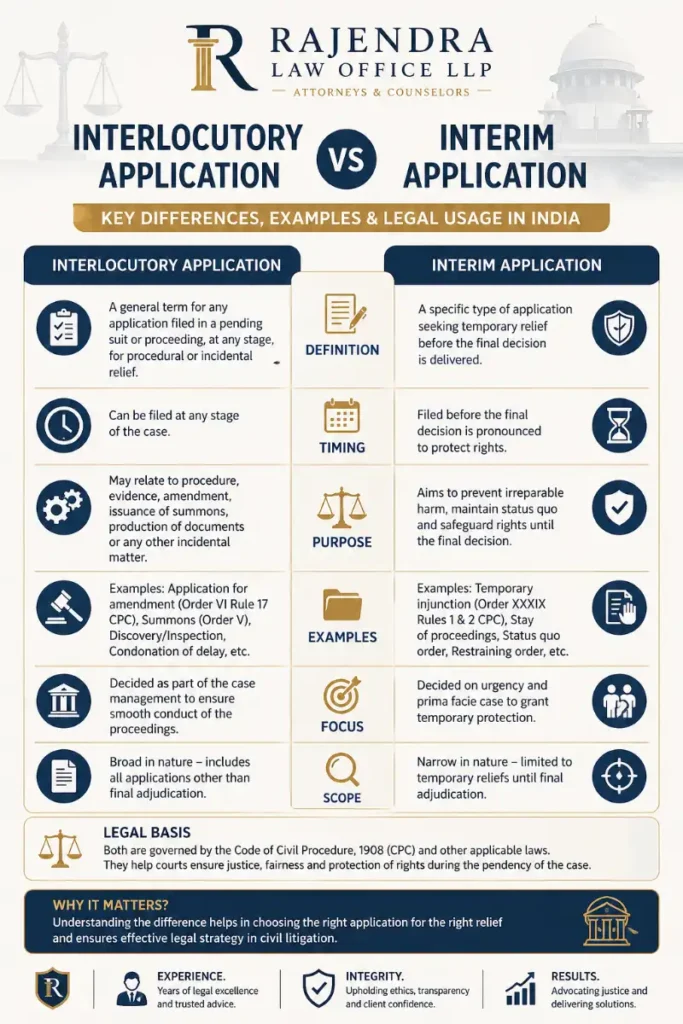
| Aspect | Interim Application | Interlocutory Application |
|---|---|---|
| Primary Purpose | Temporary substantive relief | Procedural compliance |
| Duration | Until final judgment | Specific to proceeding stage |
| Urgency | Usually urgent | Generally regular timeline |
| Examples | Injunctions, stay orders | Amendments, discovery |
| Legal Basis | Order 39, Section 94 CPC | Various CPC provisions |
| Appealability | Often appealable | Limited appealability |
Key Differences Between Interlocutory and Interim Applications
Nature and Objective of Relief Sought
The fundamental difference lies in the nature of relief sought through applications. Interim applications seek temporary protection of substantive rights during litigation pendency. They prevent irreparable injury to parties while the main suit progresses. Temporary injunctions preserve property status quo until final rights are determined. Conversely, interlocutory applications address procedural aspects and case management issues primarily. They ensure proper conduct of proceedings according to established legal procedures. Amendment applications allow correction of pleadings to reflect true facts accurately. Discovery applications enable parties to obtain evidence necessary for proving their case. Therefore, the objective determines which type of application should be filed. Courts evaluate applications based on their stated purpose and the relief sought. Legal practitioners must clearly articulate the objective in the application draft. Consequently, proper characterization ensures the court applies the appropriate legal standards. Expert lawyers at Rajendra Law Office LLP draft applications with precise legal framing.
Legal Provisions and Jurisdictional Aspects
Different CPC provisions govern interim and interlocutory applications in civil litigation matters. Order 39 Rules 1 and 2 specifically deal with temporary injunctions. Section 94 CPC provides general powers for passing interim orders. Order 39 Rule 4 empowers courts to grant injunctions in certain matrimonial cases. Meanwhile, Order 6 Rule 17 governs amendment of pleadings as interlocutory relief. Order 11 Rules 1 to 21 deal with discovery and inspection applications. Order 13 provides for production of documents during trial proceedings. Each provision specifies the conditions and limitations for granting the respective relief. Courts must exercise jurisdiction strictly within the statutory framework provided by CPC. The Bharatiya Nyaya Sanhita and Bharatiya Sakshya Adhiniyam also impact application procedures. District courts in Chennai follow these provisions rigorously while deciding applications. Therefore, citing correct legal provisions strengthens the application’s legal foundation significantly. Senior advocates ensure applications are grounded in proper statutory authority and precedents.
Standards of Proof and Decision Criteria
Courts apply different standards while deciding interim versus interlocutory applications in litigation. Interim injunction applications require establishing prima facie case on merits initially. The applicant must demonstrate balance of convenience favors granting temporary relief. Additionally, irreparable injury must be shown if interim relief is not granted. These three conditions form the trilogy test for granting temporary injunctions. Conversely, interlocutory applications focus on procedural compliance and fairness to parties. Amendment applications are liberally allowed unless they cause prejudice to opponents. Discovery applications are granted if documents are relevant and necessary for case. The emphasis is on ensuring fair trial and proper adjudication of disputes. Therefore, the evidentiary burden differs significantly between the two application types. Courts exercise discretionary powers guided by established legal principles and precedents. Legal practitioners must tailor their arguments to meet the specific standards applicable. Consequently, understanding these standards is crucial for drafting effective applications and arguments.
Remedies and Enforcement Mechanisms
Remedies available for violation of interim and interlocutory orders differ in nature. Violation of interim injunction orders may attract contempt of court proceedings immediately. Order 39 Rule 2A specifically provides for attachment and detention for disobedience. Courts can impose fines or imprisonment for willful breach of injunction orders. These stringent enforcement mechanisms ensure compliance with court directions on urgent matters. Conversely, violation of interlocutory orders may result in adverse inferences or costs. Courts may strike out pleadings if parties fail to comply with discovery orders. Non-compliance with production orders may lead to exclusion of evidence at trial. The enforcement is generally less severe compared to interim injunction breaches typically. However, persistent non-compliance may still attract contempt proceedings in certain cases. Legal practitioners advise clients on the serious consequences of violating court orders. Police stations in Chennai, including West Mogappair and George Town stations, assist in enforcement. Therefore, compliance with all court orders remains essential to avoid legal complications.
Cost Implications and Fee Structure
Court fees for interim and interlocutory applications vary based on relief sought. Temporary injunction applications attract ad valorem court fees in most cases significantly. The fee is calculated based on the market value of the subject property. Stay of execution applications require court fees based on the decree amount. Conversely, many interlocutory applications attract nominal fixed court fees only minimally. Amendment applications generally require only nominal fees for procedural changes sought. Discovery and production applications also attract minimal court fees in most situations. Additionally, lawyers’ professional fees depend on the complexity and urgency of applications. Urgent interim applications requiring immediate attention may cost more in legal fees. Courts may also award costs to successful parties in contested application proceedings. The cost implications should be considered while deciding litigation strategy and approach. Legal consultants at Rajendra Law Office LLP provide transparent fee structures upfront. Therefore, understanding cost factors helps in making informed decisions about filing applications.
Practical Examples from Indian Courts
Real-life examples illustrate the distinction between interim and interlocutory applications clearly. In property disputes, temporary injunctions prevent construction on disputed land pending suit. This represents a typical interim application protecting substantive rights provisionally during litigation. In matrimonial disputes, interim maintenance applications provide financial support to dependent spouses. These interim orders ensure basic sustenance rights are protected during lengthy divorce proceedings. Conversely, in a contractual dispute, an amendment application to add new grounds. This represents an interlocutory application addressing pleading deficiencies without affecting substantive rights. Similarly, discovery applications in intellectual property suits to obtain confidential documents represent interlocutory relief. Courts in Chennai, including Madras High Court and family courts, handle both types. The Madras High Court has delivered numerous precedents clarifying these procedural distinctions. Therefore, studying case law helps practitioners understand practical application of these concepts. Senior advocates leverage their experience to advise clients on the most appropriate remedy.
Strategic Considerations in Litigation Planning
Effective litigation strategy involves judicious use of both interim and interlocutory applications. Filing interim applications at the right time can preserve crucial evidence and assets. Early temporary injunctions may prevent irreversible damage to property or business interests. However, premature applications without adequate preparation may result in rejection and costs. Interlocutory applications should be filed strategically to strengthen the case systematically over time. Discovery applications filed at the right stage can reveal crucial evidence supporting claims. Amendment applications should be filed promptly upon discovering new facts or grounds. The timing and sequence of applications significantly impact the overall case trajectory. Courts appreciate well-planned litigation conducted efficiently without unnecessary delays or applications. Legal consultants help clients develop comprehensive litigation strategies incorporating appropriate applications optimally. Forums like Chennai City Civil Court and family courts value efficient case management. Therefore, expert guidance ensures litigation proceeds smoothly toward favorable outcomes without procedural pitfalls. Professional legal services at Rajendra Law Office LLP ensure strategic application filing.
Role of Legal Counsel in Application Proceedings
Experienced legal counsel plays a vital role in successfully obtaining interim relief. Senior advocates possess the expertise to draft compelling applications with strong legal foundations. They strategically present facts and law to convince courts of the urgency. Moreover, skilled lawyers effectively cross-examine opponents during contested application hearings to expose weaknesses. Legal consultants advise clients on the likelihood of success before filing applications. They also negotiate settlements during application proceedings to achieve quicker resolutions when beneficial. Professional lawyers ensure compliance with all procedural requirements to avoid technical rejections. They monitor application timelines and follow up with courts for early hearing dates. Additionally, experienced advocates maintain professional relationships with court staff facilitating smoother proceedings. Legal support extends beyond drafting to include effective oral advocacy during hearings. Rajendra Law Office LLP, located at West Mogappair and George Town Chennai, provides comprehensive support. Therefore, engaging competent legal counsel significantly improves application success rates and overall outcomes. Expert legal assistance ensures rights are protected through appropriate procedural mechanisms efficiently.
Recent Legal Developments and Amendments
Recent legal reforms have impacted the procedure for interim and interlocutory applications. The introduction of commercial courts has streamlined urgent relief procedures in commercial disputes. Commercial Courts Act, 2015 mandates time-bound disposal of commercial applications within stipulated periods. The Bharatiya Nagarik Suraksha Sanhita emphasizes digital filing and hearing of applications. E-filing facilities in Madras High Court enable online submission of urgent applications. Video conferencing allows remote hearing of applications reducing delays and travel requirements. The Bharatiya Nyaya Sanhita incorporates provisions aligning with modern procedural requirements and standards. Courts increasingly adopt technology-driven case management systems for efficient application tracking and disposal. These developments aim to reduce pendency and expedite justice delivery in civil matters. Legal practitioners must stay updated with procedural changes affecting application filing and hearing. Government departments and judicial academies regularly conduct training on new procedural requirements. Therefore, engaging lawyers familiar with latest developments ensures compliance with current procedures. Rajendra Law Office LLP stays abreast of all legal amendments and technological advancements.
Jurisdiction of Various Courts and Tribunals
Different courts and tribunals have jurisdiction over specific types of interim applications. District courts handle interim applications in regular civil suits filed before them. Family courts in Chennai exclusively deal with interim maintenance and custody applications. The Madras High Court exercises original and appellate jurisdiction over various applications. Commercial courts handle urgent injunctions in high-value commercial disputes exceeding specified thresholds. Debt Recovery Tribunals entertain interim applications in recovery proceedings against defaulting borrowers. National Company Law Tribunal (NCLT) deals with interim applications in corporate insolvency matters. Consumer forums handle interim relief applications in consumer disputes filed by aggrieved consumers. Each forum has specific territorial and pecuniary jurisdiction limits prescribed by law. Therefore, filing applications in the correct forum is essential for judicial consideration. Jurisdictional errors may lead to dismissal of applications causing delay and additional costs. Legal experts analyze jurisdictional aspects before advising on the appropriate forum for applications. Consequently, proper jurisdictional advice ensures applications are filed in competent courts only.
- Madras High Court – Original and appellate jurisdiction over civil matters
- Chennai City Civil Court – Civil suits within specified pecuniary limits
- Family Courts Chennai – Matrimonial disputes and custody applications
- Commercial Courts – High-value commercial disputes and injunctions
- Debt Recovery Tribunal – Recovery proceedings and interim applications
- Consumer Forums – Consumer disputes and interim relief applications
- NCLT Chennai – Corporate insolvency and company law applications
- District Courts – General civil jurisdiction over various applications
Common Mistakes to Avoid in Filing Applications
Several common mistakes can jeopardize the success of interim and interlocutory applications. Filing applications without adequate documentary evidence weakens the case before courts significantly. Failing to clearly state the urgency may result in delayed hearing schedules. Incorrect legal provisions cited in applications may lead to technical objections from opponents. Non-payment of proper court fees causes applications to be rejected at the threshold. Inadequate notice to opposite parties may render ex-parte orders vulnerable to being set aside. Vague or ambiguous prayer clauses create confusion about the relief actually sought. Filing multiple applications on the same issue without proper justification annoys courts and wastes time. Delayed filing of applications after the cause of action arises weakens urgency claims. Not following up with the court registry may result in applications getting lost administratively. Therefore, attention to detail and procedural compliance is essential for successful applications. Professional legal services ensure applications are drafted and filed meticulously avoiding common pitfalls. Consequently, expert assistance significantly reduces the risk of application failure due to technical defects.
Government Departments and Legal Support Services
Various government departments and agencies support legal proceedings and application filing processes. The Tamil Nadu State Legal Services Authority provides free legal aid to eligible applicants. District Legal Services Authorities in Chennai assist economically weaker sections in filing applications. The Registrar’s office at Madras High Court facilitates e-filing and procedural guidance. Court fee calculators help determine the correct court fees for various applications. Police stations including West Mogappair and George Town assist in enforcement of orders. The Registration Department provides certified copies of property documents for attachment applications. Government hospitals provide medical reports supporting interim maintenance and personal injury applications. Revenue Department officials assist in determining property values for ad valorem court fees. These support services make justice accessible to all sections of society equally. Legal aid lawyers help draft applications for those unable to afford private legal services. Therefore, awareness of available support services helps litigants navigate the legal system effectively. Professional law firms also coordinate with these departments for comprehensive client service delivery.
Read More
- Bail & Anticipatory Bail: Expert Legal Guide
- Civil Litigation Lawyers in Chennai: Trusted Expert Legal Services 👨⚖️
- Family Lawyers in Chennai: Compassionate Legal Support for Your Family
- Facing Arrest? Get the Right Bail – Anticipatory vs. Regular 👮♂️
- How to Choose the Best Property Lawyer in Chennai (2026 Guide) 🏛️
- Expert Chennai Lawyers: Your Partners in Legal Matters
- Unlocking Divorce Mediation Benefits: Insights from a Family Law Advocate
Successfully navigating interim and interlocutory applications requires comprehensive legal knowledge and strategic planning. Understanding the key differences ensures appropriate remedies are sought at the right time. Proper documentation and procedural compliance significantly improve application success rates in courts. The evolving legal landscape demands continuous learning and adaptation to new procedural requirements. Courts in Chennai handle diverse applications requiring nuanced understanding of applicable legal provisions. Expert legal counsel provides invaluable guidance in drafting, filing, and arguing applications effectively. Rajendra Law Office LLP offers specialized legal services in civil litigation and urgent relief matters. Located conveniently in West Mogappair and George Town, the firm serves clients across Chennai. Senior Advocate Saravvanan R brings extensive experience in handling complex interim and interlocutory applications. The firm’s comprehensive approach ensures clients receive strategic advice tailored to their specific situations. Therefore, engaging competent legal professionals is essential for protecting rights through appropriate procedural mechanisms. Ultimately, informed decision-making and professional legal support lead to favorable outcomes in civil litigation.
Frequently Asked Questions (FAQs)
Interim applications seek temporary relief protecting substantive rights during pending suits. Interlocutory applications address procedural matters without affecting final rights of parties involved.
Urgent ex-parte injunctions may be granted the same day of filing. Regular interim applications typically take two to four weeks depending on court workload and urgency demonstrated.
Only specific interlocutory orders listed in Order 43 Rule 1 CPC are appealable. Other orders can be challenged through revision petitions under Section 115 CPC in appropriate cases.
Court fees are calculated ad valorem based on property market value involved. Fixed fees apply for certain applications like stay of execution depending on decree amount and jurisdiction.
Contempt of court proceedings can be initiated for willful violation of interim orders. Courts may order attachment, detention, or impose fines for breach of temporary injunction orders granted.
Family courts in Chennai have exclusive jurisdiction over interim maintenance applications. Applications must be filed in the family court having territorial jurisdiction over matrimonial residence location.
Contact Rajendra Law Office LLP for expert legal assistance in filing interim and interlocutory applications across Chennai courts.
📍 West Mogappair Office: 8/13, 1st Floor, Bharathi Salai, Chennai – 600037
📍 George Town Office: 323/156, Andhra Insurance Building, 2nd Floor, Law Chamber 14, Chennai – 600001
📞 044-26533389 | 044-47660443
📱 +91-9994287060 | +91-9444014096
🌐 rajendralawoffice.com
📩 rajendralawoffice@gmail.com