
How to Post Bail – Bail protects personal liberty while ensuring the accused appears before investigating agencies and courts. Therefore, understanding bail procedures helps individuals respond quickly after an arrest. The Bharatiya Nagarik Suraksha Sanhita, 2023 (BNSS) governs bail procedures, replacing the earlier Code of Criminal Procedure. Courts examine the offence, available evidence, criminal history, flight risk, and investigation stage before granting relief. Moreover, the Bharatiya Nyaya Sanhita, 2023 (BNS) defines criminal offences affecting bail decisions. Documentary and electronic evidence receive evaluation under the Bharatiya Sakshya Adhiniyam, 2023 (BSA). Rajendra Law Office LLP assists clients before Police Stations, Magistrate Courts, Sessions Courts, High Courts, and the Supreme Court. Timely legal advice improves procedural compliance while protecting constitutional rights. Professional representation also minimizes avoidable delays during arrest, remand, investigation, and judicial proceedings.
How to Post Bail: Options and Considerations Unveiled – Rajendra Law Office LLP
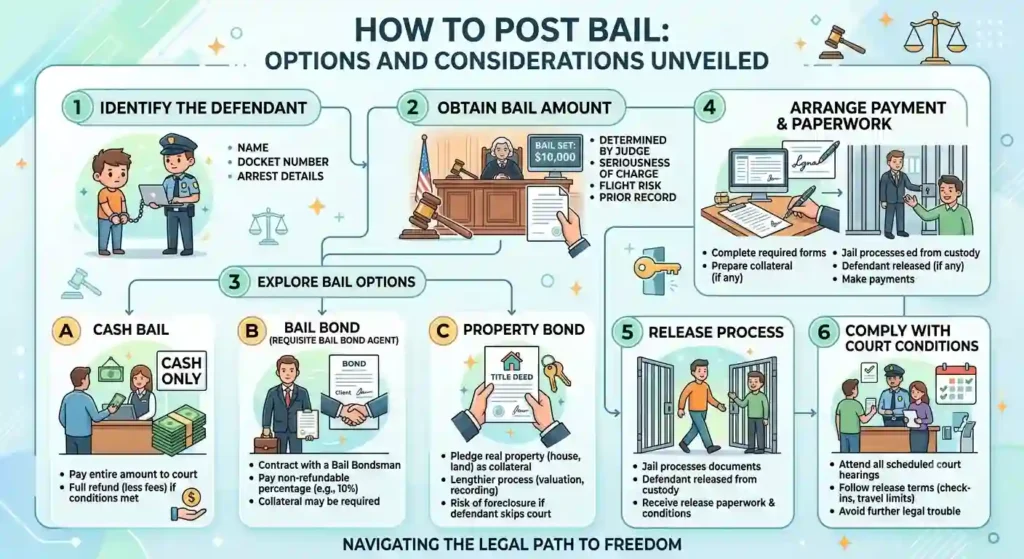
Types of Bail Available Under the BNSS
Indian criminal law recognizes different categories of bail depending upon the stage and nature of proceedings. Consequently, selecting the appropriate legal remedy becomes essential. Regular bail applies after arrest in many bailable and non-bailable offences, subject to statutory requirements. Anticipatory bail protects eligible persons expecting arrest for non-bailable offences. Interim bail offers temporary protection until final hearing. Default bail becomes available when investigation exceeds prescribed statutory timelines. Furthermore, courts impose reasonable conditions to balance individual liberty with fair investigation. Bail applications require careful drafting supported by relevant facts and judicial precedents. Lawyers also explain compliance obligations after release. Appropriate legal representation strengthens applications before Magistrates, Sessions Courts, and High Courts while reducing procedural objections raised during hearings.
Important Factors Courts Consider Before Granting Bail
Courts evaluate multiple legal considerations before deciding every bail application. Therefore, applicants should understand the factors influencing judicial discretion.
| Factor | Importance |
|---|---|
| Nature of offence | Determines seriousness |
| Criminal history | Indicates previous conduct |
| Investigation stage | Protects evidence |
| Flight risk | Ensures appearance |
| Witness influence | Prevents interference |
| Public interest | Maintains justice |
Courts also examine:
- Medical conditions
- Age
- Cooperation during investigation
- Documentary evidence
- Recovery status
- Victim protection
- Compliance history
- Local residence
Moreover, judges carefully balance personal liberty against societal interests while interpreting applicable provisions under the BNSS, BNS, constitutional principles, and relevant judicial precedents.
Procedure for Posting Bail Successfully
Posting bail requires prompt legal action supported by complete documentation. Consequently, applicants should contact an experienced criminal lawyer immediately after arrest or apprehension. Lawyers prepare bail applications explaining facts, legal grounds, personal circumstances, and willingness to cooperate. Supporting documents include identity proof, address proof, employment records, medical documents, and surety details whenever necessary. Furthermore, advocates appear before the appropriate court having territorial and subject matter jurisdiction. Prosecutors present objections while defence counsel addresses legal concerns through statutory provisions and precedents. Courts may require personal bonds, surety bonds, or additional conditions before granting release. Compliance with every condition remains essential after release. Failure to observe conditions may result in bail cancellation and renewed custody proceedings.
Regular Bail Protects Liberty After Arrest
Regular bail becomes relevant after police complete an arrest according to lawful procedures. Therefore, immediate legal consultation prevents unnecessary detention. Lawyers examine the First Information Report, arrest memo, remand papers, case diary, and applicable statutory provisions before filing applications. Magistrate Courts generally hear initial bail requests depending upon jurisdiction and offence classification. Sessions Courts consider applications involving more serious offences whenever appropriate. Additionally, High Courts exercise wider jurisdiction in suitable cases. Courts may direct personal bond execution, surety production, travel restrictions, periodic police appearance, or witness protection conditions. Compliance strengthens future defence strategy while demonstrating respect for judicial directions. Experienced legal representation improves procedural accuracy and protects constitutional safeguards throughout criminal proceedings.
Anticipatory Bail Offers Protection Before Arrest
Anticipatory bail safeguards eligible individuals expecting arrest for non-bailable offences. Consequently, timely legal consultation becomes extremely important after receiving credible information regarding possible arrest. Lawyers prepare detailed petitions explaining false implication, civil disputes, political rivalry, family disputes, business disagreements, or other relevant circumstances. Supporting documents strengthen factual credibility before judicial authorities. Sessions Courts and High Courts possess jurisdiction to entertain anticipatory bail applications under applicable provisions. Furthermore, courts may impose investigation cooperation, passport surrender, attendance requirements, or communication restrictions. Every applicant should comply strictly with judicial conditions after relief. Proper legal guidance minimizes procedural mistakes while preserving individual liberty during investigation. Early preparation frequently improves the likelihood of obtaining judicial protection.
Default Bail Ensures Statutory Protection Against Delay
Default bail protects accused persons when investigating agencies fail to complete investigations within statutory periods. Therefore, lawyers monitor investigation timelines carefully throughout custody. The BNSS prescribes investigation periods depending upon the alleged offence and punishment. Failure to submit the final report within applicable timelines creates valuable statutory rights. Defence lawyers promptly file applications asserting those legal rights before competent courts. Additionally, applicants must satisfy procedural requirements before relief becomes available. Courts examine custody records, filing dates, investigation progress, and statutory compliance before passing appropriate orders. Proper legal advice ensures timely assertion of rights without procedural lapses. Effective representation often determines whether statutory bail becomes available or stands forfeited through delay.
Surety, Personal Bond, and Bail Conditions Explained
Courts frequently impose conditions while granting bail to protect the investigation and judicial process. Consequently, applicants should understand every obligation before accepting release. A personal bond represents the accused’s promise to appear whenever directed. Sureties undertake financial responsibility if bail conditions face violation. Courts may require one or more solvent sureties depending upon case facts. Additional conditions sometimes restrict travel, witness contact, evidence tampering, or criminal activity. Moreover, applicants may require periodic attendance before investigating officers or jurisdictional police stations. Every condition deserves careful compliance because violations may invite cancellation proceedings. Legal advisors explain obligations clearly while helping clients avoid inadvertent breaches throughout the criminal case lifecycle.
Choosing the Correct Court for Bail Applications
Jurisdiction significantly influences the bail application process and available remedies. Therefore, experienced advocates determine the appropriate judicial forum before filing proceedings. Magistrate Courts generally hear ordinary bail matters within their jurisdiction. Sessions Courts consider serious offences, appeals, and anticipatory bail applications where authorized. High Courts exercise broader supervisory and appellate jurisdiction in suitable criminal matters. The Supreme Court grants exceptional relief in appropriate circumstances involving substantial legal questions. Furthermore, Special Courts may possess exclusive jurisdiction under specific statutes. Lawyers evaluate territorial jurisdiction, offence classification, investigation stage, and previous judicial orders before selecting the proper forum. Strategic filing reduces delays while improving procedural efficiency and protecting valuable legal rights.
Legal Remedies, Bail Conditions, and Professional Representation
Bail proceedings require strategic preparation supported by facts, documents, and applicable legal provisions. Therefore, experienced legal representation improves procedural compliance and protects individual rights. Lawyers analyze the First Information Report, arrest records, remand orders, witness statements, electronic evidence, and investigation status before preparing arguments. They also examine offences under the Bharatiya Nyaya Sanhita, 2023, procedural safeguards under the Bharatiya Nagarik Suraksha Sanhita, 2023, and evidentiary standards under the Bharatiya Sakshya Adhiniyam, 2023. Constitutional protections further strengthen lawful bail applications. Civil remedies under the CPC generally remain separate from criminal proceedings but may become relevant in connected disputes. Professional advocacy before Magistrate Courts, Sessions Courts, High Courts, Special Courts, and the Supreme Court improves the possibility of obtaining timely judicial relief while ensuring compliance with every statutory requirement imposed after release.
Common Bail Issues and Available Legal Remedies
Applicants often face procedural and legal challenges throughout bail proceedings. Consequently, immediate legal advice prevents unnecessary delays and strengthens the defence strategy.
| Legal Issue | Authority | Legal Remedy |
|---|---|---|
| Bail Rejection | Sessions Court/High Court | Fresh or appellate bail application |
| Bail Cancellation | Competent Court | Opposition and compliance proof |
| Illegal Arrest | High Court | Writ Petition |
| False Criminal Case | Criminal Court | Discharge or Quashing |
| Delay in Investigation | Criminal Court | Default Bail |
| Rights Violation | Constitutional Court | Appropriate Constitutional Remedy |
Additional legal support includes:
- Bail application drafting.
- Surety verification.
- Police representation.
- Court appearances.
- Bail modification.
- Bail extension.
- Legal opinions.
- Criminal defence planning.
Moreover, timely consultation frequently prevents procedural mistakes that may adversely affect future criminal proceedings.
Documents Required for Posting Bail
Proper documentation significantly improves the efficiency of bail proceedings. Therefore, applicants should maintain complete and accurate records before approaching the court. Common documents include identity proof, address proof, arrest memo, FIR copy, remand order, medical records, employment documents, educational certificates, surety identity documents, property documents supporting surety solvency, and previous court orders whenever applicable. Lawyers verify every document before filing the application. Furthermore, organized documentation enables courts to examine facts without unnecessary procedural objections. Documentary evidence also assists advocates during oral submissions. Police records, electronic communications, and witness materials receive evaluation according to the Bharatiya Sakshya Adhiniyam, 2023. Comprehensive documentation strengthens credibility while supporting lawful judicial discretion during bail hearings before competent criminal courts.
Role of Police, Prosecutors, and Courts During Bail Proceedings
Every authority performs a distinct legal function throughout bail proceedings. Consequently, understanding institutional responsibilities promotes better procedural compliance. Police investigate alleged offences, collect evidence, arrest accused persons where legally justified, and produce them before jurisdictional courts within prescribed timelines. Public Prosecutors present the prosecution’s objections against bail wherever necessary. Defence advocates explain legal grounds supporting release while addressing judicial concerns. Magistrates, Sessions Judges, and High Court Judges independently evaluate statutory requirements, constitutional principles, investigation progress, and available evidence before passing orders. Additionally, courts balance personal liberty with public interest and victim protection. Fair judicial consideration ensures lawful decision-making without prejudging the merits of the criminal case. Professional legal representation helps applicants navigate every procedural stage confidently.
Bail Conditions Every Applicant Must Follow
Grant of bail creates legal responsibilities that continue until completion of criminal proceedings. Therefore, every applicant should understand judicial conditions carefully before accepting release. Courts frequently direct attendance during investigation, appearance before trial courts, cooperation with investigating officers, and avoidance of witness intimidation. Travel restrictions, passport surrender, reporting requirements, and communication limitations may also apply depending upon case circumstances. Applicants should never violate imposed conditions intentionally or negligently. Moreover, courts possess authority to cancel bail upon proven violations. Lawyers explain every obligation and assist clients throughout compliance. Responsible conduct after release strengthens credibility before courts while reducing future procedural complications. Continuous legal guidance helps accused persons protect their liberty during investigation and trial.
Bail Cancellation and Preventive Legal Strategies
Courts may cancel previously granted bail if applicants violate judicial conditions or obstruct justice. Consequently, preventive legal strategies remain equally important after obtaining release. Common grounds include witness intimidation, evidence tampering, repeated criminal conduct, absconding, or deliberate non-appearance before courts. Defence lawyers proactively advise clients regarding lawful conduct and procedural obligations. They also respond promptly whenever cancellation proceedings commence. Supporting documents, attendance records, and compliance evidence frequently strengthen the defence. Furthermore, advocates seek appropriate modification of restrictive conditions whenever genuine hardship exists. Careful legal planning minimizes avoidable risks while preserving valuable judicial protection throughout criminal litigation. Continued cooperation with investigating agencies demonstrates respect for the legal process.
Choosing Rajendra Law Office LLP for Bail Assistance
Effective criminal defence begins with prompt legal consultation after arrest or anticipated arrest. Therefore, Rajendra Law Office LLP provides comprehensive bail assistance before Police Stations, Magistrate Courts, Sessions Courts, High Courts, Special Courts, and the Supreme Court. Our legal team prepares well-researched bail applications supported by statutory provisions, judicial precedents, and complete documentation. We advise individuals, professionals, companies, NRIs, students, and older citizens facing criminal investigations across India. Additionally, we assist with anticipatory bail, regular bail, interim bail, default bail, bail cancellation proceedings, surety documentation, compliance advice, criminal defence, and appellate remedies. Our practical approach emphasizes timely action, legal accuracy, and effective courtroom advocacy. Professional legal representation protects constitutional rights while pursuing lawful and timely release through appropriate judicial forums.
Frequently Asked Questions
1. What is the difference between regular bail and anticipatory bail?
Regular bail follows arrest, while anticipatory bail protects eligible persons before arrest in non-bailable offences under the BNSS.
2. Which court should hear my bail application?
Jurisdiction depends upon the offence, investigation stage, and applicable law. Magistrate, Sessions, High Court, or Special Court may hear the matter.
3. Can bail be cancelled after release?
Yes. Courts may cancel bail for violating conditions, influencing witnesses, committing new offences, absconding, or obstructing investigations.
4. What documents are usually required for posting bail?
Applicants generally require identity proof, FIR details, arrest documents, address proof, surety papers, and supporting records relevant to the case.
5. Can I obtain bail if the police oppose my application?
Yes. Courts independently evaluate legal merits, evidence, statutory provisions, constitutional rights, and judicial precedents before deciding bail.
6. How can Rajendra Law Office LLP assist in bail matters?
Our lawyers provide strategic legal advice, prepare bail applications, arrange documentation, represent clients before courts, and ensure compliance after release.
Read More
- Guardianship Law: Your Guide with a Family Law Advocate’s Assistance
- Global Enforcement of Intellectual Property Rights: Legal Insights
- Future Forecasts: Trends and Innovations in Criminal Defense Law
- From Local to Global: Enforcing Arbitration Awards
- Finding the Right Civil Lawyer: Tips and Considerations
- Ministry of Home Affairs – Judicial Division