Quick Answer: Property title verification should precede substantial payment or registration. A registered sale deed does not by itself guarantee marketable ownership. A buyer should examine the ownership chain, encumbrances, revenue records, survey details, possession, litigation, planning restrictions, and relevant approvals. The Supreme Court has recently reaffirmed the distinction between registration of a document and conclusive proof of title. Therefore, buyers should treat title due diligence as a structured legal investigation rather than a routine document check.
Why Property Title Verification Matters Before Buying Land in Tamil Nadu
Buying land is a major financial decision, so title verification should precede every substantial payment. A registered sale deed alone does not guarantee that the seller owns marketable title. Registration creates a public record, but it does not conclusively establish ownership. Therefore, a buyer should examine the entire chain of title before signing the final transaction. In Tamil Nadu, the exercise commonly involves registered deeds, revenue records, encumbrance records, survey details, approvals, possession evidence, and applicable planning records. Moreover, the buyer should identify mortgages, family claims, pending litigation, acquisition proposals, and restrictions affecting the land. A proper property title search should connect the seller’s present claim with earlier transfers. It should also test whether every transfer was legally capable of conveying the claimed interest. Consequently, title due diligence is not merely document collection. It is a structured legal investigation designed to reduce ownership and litigation risks.
Start With the Seller’s Current Title Document
The first document to examine is the instrument through which the proposed seller claims ownership. This may be a sale deed, settlement deed, gift deed, partition deed, release deed, court decree, grant, or another legally relevant instrument. The document should identify the property accurately through survey number, subdivision, extent, boundaries, village, taluk, district, and registration particulars. Next, verify the executants, consideration, execution date, registration details, and earlier title references. The buyer should compare the document with the property physically offered for sale. Any mismatch requires investigation before money changes hands. Furthermore, the seller’s identity should correspond with the title documents and available supporting records.
If the seller acts through a power of attorney, the authority document needs separate scrutiny. A title review should also determine whether the seller owns the entire property or only a share. Importantly, a person in possession may not always have complete legal title. Therefore, possession evidence should support, rather than replace, documentary title.
Build the Chain of Title Backward
A reliable title investigation follows the ownership chain backward from the proposed seller. The reviewer should identify each material transfer and confirm how one owner obtained rights from the preceding owner. The chain may include several registered instruments across many years. Each link should connect the property description, parties, extent, and nature of rights. Missing links can create uncertainty even when the latest deed appears regular. Therefore, the investigation should not stop with the immediate seller’s document. The Supreme Court has described title due diligence as significant within India’s presumptive registration framework. In practice, the appropriate period depends on the property, transaction history, applicable records, and identified risks. Older documents can become especially important when inheritance, partition, settlement, acquisition, or family arrangements appear in the chain. A title opinion should explain missing links instead of simply assuming that earlier transactions were valid.
Check Sale Deeds and Earlier Conveyances
Examine every material conveyance for consistency and legal effect. A sale deed must identify the transferor’s authority and the interest they are transferring. You must also check the consideration and execution details against surrounding documents. Earlier deeds may reveal co-owners, reservations, easements, mortgages, or boundaries that the latest document does not emphasise. Furthermore, the buyer should compare the schedule across successive documents. Changes in survey numbers or subdivisions require particular attention. Sometimes administrative changes explain a difference, but records must support the explanation. You also cannot evaluate a deed in isolation when a prior partition, settlement, release, or court order affected ownership. Therefore, place each conveyance within its chronological chain. The review should record document number, year, registering office, parties, property description, and legal significance. This creates a transaction map that helps identify gaps quickly. It also gives the buyer a defensible record of the due diligence undertaken before purchase.
Investigate Partition, Settlement and Release Documents
Family arrangements frequently affect land ownership in Tamil Nadu, particularly when they involve ancestral or jointly held property. A buyer should therefore identify partition deeds, family settlements, release deeds, settlement deeds, and related instruments. These documents may explain why one family member presently claims exclusive ownership. The legal effect depends on the instrument, execution, registration requirements, parties, property description, and surrounding facts. Moreover, the buyer should check whether every person with a relevant interest participated where participation was legally necessary.
A later sale cannot automatically cure an earlier defect in title. If a co-owner releases an interest, the auditor must examine the release for the property and share covered. Similarly, the auditor must test any partition against the current survey description and physical possession. Disputes sometimes arise when family records and registered documents diverge. Therefore, the title review should identify potential claims by heirs, co-owners, or persons omitted from earlier transactions. Where uncertainty remains, obtain a specific legal opinion before proceeding with the purchase.
Examine Inheritance and Succession Issues
Inheritance can create hidden title risks when property has passed through generations. The buyer should determine how each deceased owner’s interest devolved and whether the relevant succession documents support the present seller’s claim. Depending on the facts, the review may involve a will, legal-heir documentation, succession proceedings, probate issues, partition arrangements, or other evidence. The governing personal law can also affect succession. Therefore, the reviewer should not assume that one standard inheritance document resolves every case. If several heirs existed, the investigation should identify their respective interests and any later transfers.
A sale by one heir does not necessarily transfer interests belonging to other heirs. Furthermore, minors, persons under legal disability, or disputed succession can create additional concerns. The buyer should also check whether a family settlement or release changed the inheritance position. Consequently, inheritance-related title should be reviewed as a separate legal question. A written title opinion should identify the succession route, the documents supporting it, and any unresolved risk before completion.
Verify Encumbrances and Registered Liabilities
An encumbrance search is an important part of property due diligence, but it should not be treated as the entire title investigation. The buyer should obtain and examine the available encumbrance record for the relevant property and period. Registered mortgages, charges, sales, releases, attachments, and other registrable transactions may appear in the record. However, an absence of an entry does not automatically prove that no legal issue exists. Unregistered interests, pending proceedings, possession claims, and other circumstances can require separate investigation. Therefore, the encumbrance record should be compared with the title chain and information supplied by the seller.
If a mortgage appears, the buyer should verify its discharge and supporting documents before completion. Similarly, any attachment or court-related entry requires careful legal assessment. The registration system is valuable because it provides transaction records, yet the Supreme Court has emphasised that registration is not a conclusive title guarantee. Accordingly, buyers should use the encumbrance search as one component of broader legal due diligence.
Cross-Check Revenue and Land Records
Revenue records can provide important information about land identity, classification, possession, and administrative entries. In Tamil Nadu, buyers may encounter records such as patta and other revenue-related documents. These records should be compared with the registered title documents rather than treated as independent proof of ownership. The Supreme Court has reiterated that revenue entries do not create or extinguish ownership rights. Therefore, a patta entry cannot by itself cure a defective title chain. Nevertheless, discrepancies between revenue records and registered documents can reveal issues requiring investigation.
The buyer should compare survey numbers, subdivisions, extent, classification, names, and relevant changes. Where records have changed, the legal basis for the change should be identified. Survey and subdivision records can also matter when the transaction concerns only part of a larger parcel. Consequently, revenue verification supports title analysis but does not replace it. Any material mismatch should be resolved before registration, preferably through documentary clarification and professional legal review.
Compare Survey Numbers, Extent and Boundaries
Property descriptions must match across the title documents and physical land. A small numerical difference can sometimes reflect lawful subdivision or resurvey, but it can also signal a serious problem. The buyer should compare survey numbers, subdivision numbers, extent, boundaries, village, taluk, district, and other identifying particulars. Next, the buyer should inspect the site and compare the physical boundaries with the documents. Where necessary, professional survey assistance can clarify location and measurements. Furthermore, access roads, common pathways, water channels, easements, and neighbouring boundaries deserve attention.
A deed may transfer an identified parcel while the buyer assumes a larger area on the ground. That assumption can create future disputes. Therefore, physical verification should accompany documentary verification. If the property forms part of a layout, apartment project, or larger development, the buyer should also examine the relevant approved plan and subdivision history. A title opinion should clearly identify any discrepancy and recommend the document or authority required to resolve it.
Check Classification, Conversion and Land-Use Issues
The legal and practical use of land should correspond with the proposed transaction. Buyers should investigate the land classification and applicable planning restrictions before purchasing for construction or commercial use. Revenue classification alone may not answer every planning question. Depending on the location and intended development, planning permissions, layout approvals, zoning restrictions, access requirements, and other statutory controls may apply. Therefore, a buyer should identify the competent local planning or development authority for the property.
The investigation should also consider whether the proposed use conflicts with any restriction affecting the parcel. Agricultural land, approved layouts, road alignments, water bodies, and other regulated categories may require specific scrutiny. Moreover, a property may have a clear ownership chain but still face development restrictions. That distinction is commercially important. A buyer seeking construction rights should therefore conduct both title due diligence and development due diligence. The written report should separate ownership risks from land-use risks so that the buyer can make an informed transaction decision.
Review Acquisition, Reservation and Public Authority Risks
Land can face public-law constraints even when private title documents appear orderly. Buyers should investigate whether the property is affected by acquisition proceedings, road proposals, planning reservations, water-body restrictions, government claims, or other statutory measures. The appropriate inquiry depends on the property location and intended use. Local planning records, revenue information, official notifications, and other competent authority records may become relevant. Importantly, the absence of an obvious warning from the seller should not end the investigation.
Public-law restrictions can materially affect value, possession, construction, or future transfer. Therefore, the buyer should identify the authorities with jurisdiction over the land and obtain appropriate records where necessary. If the transaction concerns a larger development, approvals and reservations should be reviewed at project level. Similarly, access through public or private land should be confirmed. A professional title report should identify known public-law risks separately from private ownership claims. This allows the buyer to assess whether the transaction requires further investigation, negotiation, restructuring, or withdrawal.
Documents and Searches for a Tamil Nadu Property Title Check
A strong title investigation uses several categories of evidence rather than one certificate. The exact document set varies with the property history, location, transaction structure, and identified risks. At minimum, the buyer should collect the current title deed and the earlier material deeds forming the chain. The buyer should also obtain available encumbrance records, relevant revenue records, survey information, tax or possession-related documents, and applicable approvals. Where inheritance or family ownership is involved, succession and family documents become important. Similarly, a property subject to development should be examined against planning and project approvals.
The investigation should create a document index so that missing records become visible. Moreover, each document should be assessed for its legal role. Some records establish transactions, while others identify land or support possession. A careful lawyer connects these categories instead of treating every document as equivalent. The result should be a coherent title narrative that explains how ownership moved from earlier holders to the present seller.
Use the Encumbrance Certificate Correctly
The encumbrance certificate is useful for identifying registered transactions affecting the property during the searched period. It can help reveal registered sales, mortgages, releases, attachments, and other entries depending on the record and period covered. However, the certificate should not be described as a standalone title certificate. Its evidentiary value depends on the completeness of the underlying registration records and the scope of the search. Therefore, buyers should verify that the property identifiers and search period are appropriate.
A narrow or incorrect search can produce a misleadingly clean result. Furthermore, the buyer should compare entries with the title chain and information disclosed by the seller. If the certificate contains an unexpected transaction, the underlying registered document should be obtained and examined. A discharge document should also be checked when a prior mortgage appears. Consequently, the correct approach is layered verification. Use the encumbrance record to identify registered transactions, then use the underlying documents and other searches to determine their legal effect.
Create a Property Document Index
A property transaction becomes easier to evaluate when every document has a clear reference number. Create a chronological index showing the document date, document number, year, registering office, parties, property description, and purpose. Add a column showing whether the document has been received, verified, or requires further clarification. This simple method can expose missing links in the title chain.
It also prevents important documents from being overlooked during negotiations. For example, a sale deed may refer to an earlier partition deed that was never supplied. The index would immediately identify that missing document. Similarly, an encumbrance entry can be matched against its underlying instrument. The buyer can then ask focused questions instead of relying on general assurances. A lawyer can also use the index to prepare a title-flow chart and risk assessment. Therefore, documentation discipline improves both legal analysis and transaction management. Before registration, the final index should be updated to include documents obtained after the initial title review.
Verify Seller Identity and Authority
The person signing a sale deed must have legal authority to transfer the interest being sold. Begin by matching the seller’s identity with the current title document and supporting identification. Where ownership belongs to multiple persons, identify all relevant owners and determine how their interests will be conveyed. If an authorised representative acts under a power of attorney, examine the instrument carefully.
The authority should cover the transaction and property in question. The buyer should also consider whether the power remains operative and whether its execution and registration requirements are satisfied. Corporate or institutional sellers require additional verification of constitutional documents, board authority, and signing powers. Similarly, a trustee, executor, guardian, or representative may require authority arising from a specific legal framework. Therefore, identity verification and authority verification are separate tasks. A seller can be correctly identified yet lack authority to transfer the property. The legal review should document both questions and obtain corrective documents before the buyer commits to completion.
Investigate Litigation and Dispute Risk
A property can face litigation even when the registered documents appear consistent. The buyer should therefore ask the seller about pending cases, notices, claims, attachments, family disputes, acquisition proceedings, and possession conflicts. Searches should be tailored to the property, parties, location, and known disputes. Court records may reveal suits concerning title, possession, partition, injunctions, cancellation, specific performance, or other relief.
The relevant forum depends on the nature of the dispute and applicable jurisdiction. Therefore, the buyer should not rely solely on a seller’s declaration. Where a known dispute exists, obtain the pleadings, orders, and current status before deciding whether to proceed. A pending suit can affect transaction strategy and pricing. Moreover, a court order may impose restrictions that are not obvious from the title deed. A lawyer should distinguish between a historical case with no continuing effect and a live dispute carrying material risk. This assessment should appear clearly in the final legal due diligence report.
Check Tax, Utility and Possession Records
Tax receipts, utility records, and possession evidence can support the factual assessment of a property, although they do not independently establish ownership. The buyer should compare available property tax information with the property identification and seller details. Electricity or water records can sometimes help establish occupation or use, but they should not substitute for title documents. Possession is particularly important in disputes because physical occupation may differ from legal ownership. Therefore, the buyer should inspect the property and identify the person actually occupying it.
Tenants, licensees, caretakers, co-owners, or unauthorised occupants may create practical complications. Any existing lease or occupation arrangement should be investigated before completion. Furthermore, access and possession should be consistent with the transaction documents. A property can have a technically acceptable title chain while still carrying a possession dispute. Consequently, possession verification should form part of the transaction risk review, especially where the seller is not physically occupying the property.
Review Approvals for Layouts and Developments
Buyers purchasing plots within layouts or development projects should review the approvals relevant to that development. The exact approval framework depends on the location, project type, development period, and competent planning authority. The buyer should verify whether the relevant layout, subdivision, access, and infrastructure permissions exist. The approved plan should correspond with the plot being sold. Road widths, reserved areas, common spaces, and public-purpose allocations can affect the practical value of a plot. Moreover, the seller’s deed should describe the plot consistently with the approved plan and parent documents. Where a developer is involved, the buyer should examine the developer’s title and authority to market individual plots.
RERA may become relevant to qualifying projects, depending on the transaction and statutory framework. Therefore, development approval review should sit alongside title verification. A property lawyer should clearly distinguish ownership, planning, development, and project-compliance questions. This prevents a buyer from treating an approved-looking brochure as proof of legal title or development entitlement.
Identify Red Flags Before Paying an Advance
Certain warning signs justify additional scrutiny before an advance payment. These include missing parent documents, unexplained survey changes, inconsistent boundaries, sudden family transfers, unresolved mortgages, disputed possession, unusual powers of attorney, unexplained revenue changes, and pressure to complete quickly. Another warning sign is a seller who refuses to provide documents for professional review. Buyers should also question unusually low prices where the explanation is unclear. A clean-looking encumbrance record cannot eliminate every risk. Therefore, a transaction should pause when material inconsistencies remain unresolved.
The buyer can request additional documents, seek a written title opinion, negotiate protective clauses, or reconsider the transaction. Moreover, payment structures should reflect the identified risk. Avoid irreversible payments before essential due diligence is completed. A lawyer can also recommend representations, warranties, indemnities, escrow arrangements, or document conditions where commercially appropriate. The central principle is simple: resolve material uncertainty before commitment. Speed should never replace evidence when acquiring immovable property.
Use a Written Title Opinion for High-Value Transactions
A written legal opinion creates a structured record of the title analysis and identified risks. It should not merely state that the property is clear. Instead, it should explain the documents reviewed, the chain of title, ownership position, encumbrances, relevant searches, identified disputes, and limitations. The opinion should also distinguish confirmed facts from assumptions and missing information. Where a risk remains, the lawyer should explain its legal significance and possible mitigation.
High-value transactions justify deeper scrutiny because the financial consequences of a defect can be substantial. NRI purchasers, investors, developers, and buyers of inherited property may require additional review. Similarly, properties involving family arrangements, old documents, subdivisions, or litigation deserve focused analysis. A written report can help the buyer negotiate conditions before signing the sale deed. It can also provide a reference for future counsel if a dispute arises. Therefore, the objective is not a simplistic certificate. It is a reasoned legal assessment supporting a significant property decision.
Practical Property Title Due Diligence Checklist for Buyers
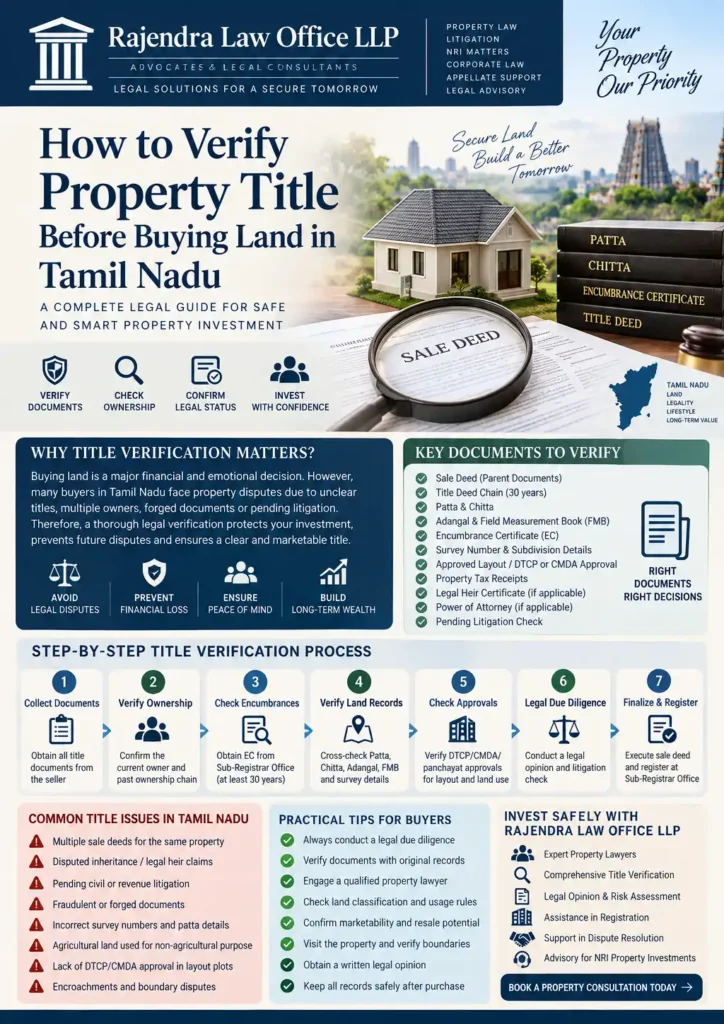
Before purchasing land in Tamil Nadu, the buyer should follow a documented sequence rather than relying on informal assurances. First, identify the property precisely and collect the seller’s current title document. Next, reconstruct the relevant chain of title and obtain the material prior instruments. Then verify encumbrances, revenue records, survey particulars, possession, planning restrictions, and litigation indicators. After that, investigate inheritance, family rights, mortgages, attachments, and development approvals where relevant. Finally, obtain a written legal assessment before committing to completion.
The following checklist should guide the process: verify the seller’s identity; verify ownership share; examine parent documents; obtain appropriate encumbrance records; compare survey and boundaries; check revenue entries; inspect physical possession; investigate litigation; review land-use restrictions; verify approvals; confirm mortgage discharge; and ensure the final deed accurately describes the property. This sequence reduces avoidable surprises. It also creates an audit trail showing how the buyer assessed title before purchasing the land.
- Verify the complete title chain.
- Check encumbrances and registered liabilities.
- Compare survey details with physical boundaries.
- Review revenue and planning records.
- Investigate litigation and possession.
- Obtain a written legal opinion before completion.
| Check | Purpose |
|---|---|
| Title deeds | Trace ownership and transfer history. |
| Encumbrance records | Identify registered transactions and liabilities. |
| Revenue records | Cross-check land identity and administrative entries. |
| Survey records | Confirm extent, subdivision and boundaries. |
| Court records | Identify relevant litigation and orders. |
| Planning approvals | Assess development and land-use risks. |
When to Stop the Transaction and Seek Legal Advice
A buyer should pause a transaction whenever a material title issue cannot be explained through reliable documents. Missing parent deeds, disputed ownership, inconsistent survey details, unresolved mortgages, adverse possession claims, family disputes, or active litigation can justify a temporary halt. The same applies when the seller refuses reasonable due diligence. Another concern arises when the transaction depends on an informal promise to correct title after registration. Such promises can create unnecessary litigation exposure. Therefore, the buyer should obtain a specific legal assessment before proceeding. The lawyer should identify whether the issue is curable, manageable through contractual protection, or fundamentally inconsistent with the proposed purchase. In some cases, additional records may resolve the concern.
Buyer should not treat a legal opinion as a formality
In others, the parties may need a release deed, rectification instrument, discharge document, partition arrangement, or other corrective step. Importantly, the buyer should not treat a legal opinion as a formality. It should guide the commercial decision. If the material risk cannot be reasonably controlled, withdrawing may be safer than litigating later.
Legal Remedies When Title Is Defective
The appropriate remedy depends on the defect and the buyer’s legal position. A person discovering a defect before completion may refuse to proceed, renegotiate, seek correction, or require additional contractual protection. After a transaction, remedies can include declaration, cancellation, injunction, possession, specific performance, damages, or other relief depending on the facts.
The forum also depends on the dispute, valuation, jurisdictional rules, and statutory framework. Civil proceedings generally require careful pleading, documentary evidence, and attention to limitation. Where fraud or forgery is alleged, criminal remedies may also become relevant, subject to the facts and applicable current criminal law. However, criminal proceedings do not automatically resolve every civil title question. Therefore, the strategy should identify the legal right, appropriate forum, available evidence, and immediate relief required. Buyers should obtain case-specific advice before filing proceedings.
A generic remedy cannot replace jurisdictional analysis. Early legal assessment can also prevent a buyer from choosing a procedurally unsuitable remedy.
Final Verification Before Registration
The final verification should occur shortly before execution and registration. Property transactions can change between the initial title search and completion. Therefore, buyers should confirm that the seller remains entitled to transfer the property and that no new material encumbrance or dispute has emerged. The final deed should reproduce the correct survey details, extent, boundaries, consideration, parties, and representations. Supporting documents should be checked again for consistency. If a mortgage was discharged, obtain the relevant evidence before completion. If a correction deed or release was required, ensure it has been properly completed.
Verify the identity and signing authority of every executing party
The buyer should also verify the identity and signing authority of every executing party. Furthermore, possession arrangements should be documented where necessary. The final review should confirm that agreed risk-mitigation conditions have been satisfied. Only then should the buyer proceed with registration and payment according to the transaction structure. A careful closing process protects the buyer from last-minute inconsistencies and creates a stronger documentary record for future ownership.
A Practical Buyer Checklist
A buyer can use the following sequence before committing to a land purchase. First, obtain the current sale deed and all material parent documents. Second, create a chronological title chain. Third, verify the seller’s identity, ownership share, and authority. Fourth, obtain and review the appropriate encumbrance records. Fifth, cross-check survey numbers, subdivisions, extent, and boundaries. Sixth, review revenue and land records. Seventh, inspect physical possession and access. Eighth, investigate mortgages, attachments, litigation, acquisition risks, and family claims. Ninth, verify planning and layout approvals where relevant. Tenth, obtain a written legal opinion addressing the identified risks. Finally, conduct a closing-stage verification before registration.
checklist should remain flexible
This process is especially useful for high-value purchases and transactions involving old title documents. It also helps buyers communicate efficiently with advocates, surveyors, sellers, and authorities. The checklist should remain flexible because every property has a different history. Its purpose is to prevent important questions from being overlooked. Good due diligence is systematic, evidence-based, and completed before irreversible commitment.
Questions to Ask Your Property Lawyer
A buyer should ask focused questions rather than requesting a generic statement that the property is safe. Firstly, Ask whether the seller has marketable title and whether the chain contains any material gap. Secondly, Ask which documents were reviewed and which documents remain unavailable. Thirdly, Ask whether any encumbrance, mortgage, litigation, family claim, acquisition issue, or possession concern was identified. Fourthly, Ask whether revenue records match the registered title and whether the survey description is consistent. Finally, Ask whether planning or development restrictions affect the intended use.
Also ask whether the proposed sale deed accurately reflects the property and the seller’s interest. Where a risk exists, ask whether it can be cured and what document or action is required. Finally, ask what assumptions and limitations apply to the legal opinion. These questions help the buyer understand the analysis instead of treating legal due diligence as a checkbox. A good consultation should leave the buyer with a clear list of verified facts, unresolved risks, required documents, and recommended next steps.
How Rajendra Law Office LLP Can Assist
Rajendra Law Office LLP can assist buyers who need structured legal review before acquiring land in Tamil Nadu. The legal assessment can focus on title documents, chain of ownership, registered transactions, property descriptions, revenue records, possession issues, and transaction risks. Depending on the property, the review may also consider family claims, inheritance, mortgages, development permissions, RERA issues, litigation, and other relevant legal concerns. The objective should remain practical: identify what is established, what is uncertain, and what should happen before completion. Buyers can organise the available documents before consultation to make the review more efficient.
A property title review can also be coordinated with survey and other professional checks when the circumstances require them. Importantly, legal advice must remain specific to the actual documents and facts. This article provides general information and does not replace a case-specific title opinion. For a high-value or complex purchase, obtaining professional advice before payment and registration can materially improve transaction planning and risk management.
Key Takeaways for Buyers in Tamil Nadu
The safest approach to land purchase begins before the sale deed is signed. Registration records a transaction, but buyers should not confuse registration with conclusive proof of title. A proper title search therefore examines the ownership chain, supporting instruments, encumbrances, revenue records, survey particulars, possession, litigation, public restrictions, and development approvals where relevant. Moreover, each document should be connected to the legal story of ownership. A clean-looking document cannot cure a missing link elsewhere in the chain. Buyers should also distinguish title risk from planning risk and possession risk. Each category requires separate analysis. Where a material defect appears, the transaction should pause until the issue is resolved or professionally assessed.
A written legal opinion is particularly valuable for high-value, inherited, disputed, old, or development-related property. Finally, buyers should preserve the complete due diligence file. That record can support future transactions, financing, or dispute management. Careful verification may take time, but it is usually far less costly than discovering a title problem after registration.
Read More
- Best Legal Advice in Chennai | Fraudulent Sale Deed Cancellation, Patta Dispute
- Adverse Possession Claims: Supreme Court Decisions and Implications ⚖️
- How to Choose the Best Property Lawyer in Chennai (2026 Guide) 🏛️
- Legal Support for Real Estate Transactions: Expert Advocacy 🛋️
- Understanding Property Law: Essential Knowledge for Property Owners
Frequently Asked Questions
Registration records a transaction, but it does not by itself conclusively prove marketable ownership. Buyers should verify the complete title chain and related records.
No. It helps identify registered transactions, but buyers should also review title deeds, revenue records, litigation, possession and other relevant risks.
Patta is an important revenue record, but it does not independently create or extinguish ownership rights. It should be cross-checked with title documents.
The period depends on the property and its history. A lawyer should determine the appropriate chain after reviewing available documents and identified risks.
Pause the transaction and obtain specific legal advice. The defect may require correction, additional documentation, contractual protection, or withdrawal.
A written opinion is particularly useful for high-value or complex purchases. It records the documents reviewed, risks identified, assumptions and recommended safeguards.
Legal information notice: This article provides general information and does not replace legal advice based on the documents and facts of a specific property transaction.
Rajendra Law Office LLP: For property title due diligence, property disputes, NRI property matters and related legal assistance, obtain advice based on the actual title documents and transaction facts.