Understanding Property Law – Property ownership creates valuable rights, but those rights operate within several Indian laws. Owners should understand title, possession, transfer, inheritance, registration, taxation, and land-use restrictions. The Transfer of Property Act, 1882 governs many property transfers and related rights. The Registration Act, 1908 regulates registration of specified documents affecting immovable property. Additionally, state revenue laws influence patta, subdivision, survey, and land records. Therefore, owners should preserve sale deeds, parent documents, tax receipts, approvals, and succession records. Clear documentation reduces disputes involving boundaries, ownership, mortgages, partition, and possession. Moreover, property owners should conduct periodic title verification before selling or developing land. Chennai property owners may require assistance from registration offices and revenue authorities. A property lawyer can identify defects before they become expensive disputes. Consequently, preventive legal advice often provides stronger protection than litigation after a dispute arises.
Understanding Property Law: Essential Knowledge for Property Owners – Rajendra Law Office LLP
Title, Possession and Registration
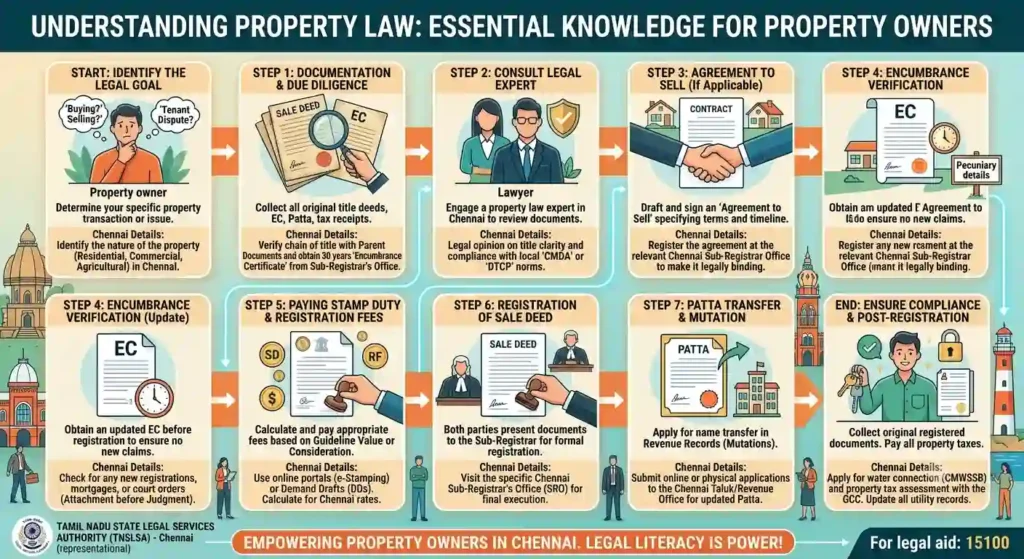
A valid property transaction requires careful distinction between ownership title and physical possession. Title concerns the lawful basis supporting ownership, while possession concerns physical control or occupation. Registration provides important documentary evidence for transactions requiring statutory registration. However, registration alone does not guarantee an undisputed title. Therefore, purchasers should examine the complete chain of title before completing transactions. Relevant records may include parent deeds, sale deeds, settlement deeds, partition deeds, release deeds, and court orders. Encumbrance certificates can reveal registered transactions affecting the property during the searched period. Revenue records can provide additional information about land identification and possession. However, patta alone should not replace title investigation. Buyers should also examine mortgages, pending litigation, acquisition notices, and third-party claims. Accordingly, a professional property title search can expose risks before money changes hands. Rajendra Law Office LLP assists property owners with title verification and transaction-related legal support.
Property Registration and Documentation
Property owners should understand the importance of accurate registration documents. A sale deed should correctly identify parties, consideration, boundaries, extent, survey details, and property description. Errors can create later disputes involving identity, extent, ownership, or registration records. Therefore, parties should verify documents before execution and registration. The Registration Act, 1908 identifies instruments requiring compulsory registration. Certified copies can help when original registered documents are unavailable. Additionally, owners should maintain original documents securely after completing transactions. Banks may retain originals when properties secure housing or commercial loans. After repayment, owners should obtain appropriate release documentation and verify relevant records. Furthermore, legal heirs should preserve succession documents after inheritance. Wills, probate documents, legal-heir records, partition instruments, and settlement deeds can become important evidence. Property owners should therefore maintain a comprehensive property document file. Proper documentation supports resale, financing, inheritance planning, and effective litigation when disputes arise.
Parent Documents and Chain of Title
Parent documents establish the historical chain connecting present ownership with earlier ownership. They may include previous sale deeds, partition deeds, settlements, gifts, releases, or inheritance records. Therefore, owners should preserve these documents even after obtaining a later sale deed. Missing parent documents can complicate future sales, loans, and title verification. Certified copies from registration authorities can sometimes reconstruct missing registered instruments. However, certified copies do not automatically cure defects in the ownership chain. Buyers should investigate unexplained gaps, conflicting deeds, family claims, and mortgage interests. Additionally, lawyers should compare names, dates, boundaries, survey numbers, and property extent across documents. Any inconsistency requires clarification before completing a transaction. Owners should also investigate whether earlier transactions involved minors, trusts, companies, or powers of attorney. Consequently, title documentation should reflect every legally significant transfer. A property lawyer can prepare a title report identifying missing documents and potential risks. Early correction can prevent costly disputes and transaction failures.
Encumbrances, Mortgages and Liabilities
Property owners should identify financial and legal burdens affecting their property. Mortgages, attachments, leases, easements, court orders, and acquisition proceedings can restrict transactions. An encumbrance certificate can reveal several registered dealings involving the property. However, owners should not treat an encumbrance certificate as a complete litigation search. Court cases, unregistered claims, family disputes, and statutory restrictions may require separate investigation. Therefore, owners should obtain legal searches before selling or mortgaging valuable property. Banks may also require extensive title documents before approving loans. If a mortgage exists, the borrower should obtain proper discharge evidence after repayment. Additionally, owners should verify whether registration records reflect the release appropriately. Property tax arrears and statutory dues should also receive attention. Consequently, financial clearance should accompany title verification. A lawyer can coordinate registration searches, revenue checks, court searches, and lender documentation. This approach helps owners establish cleaner and more marketable title.
Patta, Survey and Revenue Records
Tamil Nadu property owners frequently deal with patta, chitta, adangal, subdivision, and survey records. These records help identify land and support revenue administration. However, revenue entries generally should not replace documents establishing legal title. Therefore, owners should compare revenue records with registered title documents. Differences in survey numbers, boundaries, extent, or ownership names can create serious complications. The concerned revenue authorities may handle appropriate corrections under applicable procedures. Additionally, owners should verify whether subdivision records correctly reflect the purchased portion. Encroachment, pathway, watercourse, and access issues may require separate investigation. Physical inspection can reveal problems that documents do not clearly disclose. Consequently, owners should combine documentary verification with site inspection. Chennai and Tamil Nadu property transactions can involve multiple administrative records. Legal assistance can help coordinate registration and revenue procedures. A property lawyer can also advise on patta disputes, boundary conflicts, possession issues, and appropriate remedies before litigation becomes necessary.
Easements, Boundaries and Access Rights
Property rights may include easements involving access, drainage, light, water, or other lawful uses. Boundary disputes often arise when neighbouring owners rely on inconsistent surveys or old descriptions. Therefore, owners should preserve approved plans, survey sketches, measurement records, and earlier conveyances. Physical possession should match the documentary description whenever possible. If boundaries remain uncertain, a qualified survey can provide useful factual evidence. Additionally, neighbouring rights should be investigated before constructing walls, buildings, or access routes. Courts may grant injunctions when unlawful interference threatens established property rights. Depending on circumstances, declaratory relief may also become appropriate. Owners should avoid unilateral acts that escalate neighbour disputes. Instead, legal notices, surveys, negotiations, mediation, or civil proceedings may provide proportionate remedies. Consequently, early advice can prevent prolonged boundary litigation. Rajendra Law Office LLP can assess easement, encroachment, access, and boundary disputes. Proper documentation strengthens both negotiation and court proceedings.
Inheritance and Succession Planning
Inheritance frequently creates property disputes when families lack clear succession arrangements. Owners should consider wills, nominations, family settlements, and appropriate estate-planning documents. A valid will can clarify intended distribution, subject to applicable succession law. However, succession rules differ according to personal law and individual circumstances. Therefore, owners should obtain advice before preparing or altering estate documents. Joint ownership also requires careful planning because different ownership structures create different legal consequences. After a death, heirs should collect death certificates and relevant succession documents. They should also identify outstanding loans, claims, taxes, and existing litigation. Partition disputes can arise when several heirs assert competing shares. Mediation may offer an efficient alternative where family members remain willing to negotiate. Otherwise, a competent civil court may determine disputed rights. Consequently, timely succession planning can reduce family conflict and preserve property value. Legal advice can help owners structure wills, settlements, partitions, and succession documentation effectively.
Joint Ownership and Partition Rights
Joint owners should clearly understand their respective shares and transaction rights. One co-owner generally cannot convey another co-owner’s independent share without lawful authority. Therefore, buyers should verify every owner’s interest before purchasing jointly held property. Partition may occur through agreement, registered instruments, or appropriate judicial proceedings. Disputes may involve unequal contributions, inherited shares, possession, improvements, or family arrangements. Additionally, a co-owner may seek injunctions when another person threatens unlawful alienation. A partition suit may become necessary when negotiations fail. Courts can determine shares and order appropriate relief according to the evidence. Owners should preserve title deeds, family records, payment evidence, and prior agreements. Furthermore, mediation can sometimes resolve disputes without prolonged court proceedings. The appropriate remedy depends on ownership structure and factual circumstances. Rajendra Law Office LLP can advise on partition, co-ownership, settlement, release, and injunction proceedings. Early legal assessment can identify practical solutions before relationships deteriorate further.
Sale, Gift, Lease and Mortgage
Property owners may transfer interests through sale, gift, lease, mortgage, settlement, or other lawful arrangements. Each transaction carries distinct legal requirements and financial consequences. Therefore, owners should choose the correct instrument after reviewing the transaction purpose. Sale transactions require careful title verification and accurate registration. Gifts of immovable property generally require compliance with applicable registration requirements. Leases require attention to duration, rent, possession, renewal, termination, and registration issues. Mortgages create security interests and require careful repayment and release documentation. Additionally, powers of attorney require precise drafting and appropriate authority. Owners should avoid signing blank documents or incomplete instruments. They should also verify stamp duty and registration requirements before execution. Consequently, professional document review can prevent costly contractual and title disputes. Lawyers can draft agreements, deeds, notices, indemnities, and transaction safeguards. Proper legal support protects owners while facilitating legitimate property transactions.
Construction, Planning and Land-Use Compliance
Property ownership does not automatically permit unrestricted construction or development. Owners must comply with planning rules, building regulations, zoning requirements, and applicable approvals. Depending on location, different authorities may regulate planning and building activity. Therefore, owners should verify sanctioned plans and required permissions before commencing construction. Unauthorized development can trigger notices, penalties, demolition risks, or litigation. Additionally, environmental, fire-safety, heritage, road-access, and land-use restrictions may apply. Developers should conduct due diligence before purchasing or developing larger parcels. Apartment owners may also need to understand association, common-area, and maintenance rights. RERA can become relevant to qualifying real-estate projects and promoter obligations. Consequently, legal review should occur before construction commitments become irreversible. Owners should retain approvals, sanctioned plans, completion records, and correspondence. Rajendra Law Office LLP can assist with property development documentation, regulatory disputes, and legal notices.
Property Tax and Government Dues
Property owners should regularly verify municipal taxes and other applicable government dues. Outstanding dues can create financial complications during sale or transfer. Therefore, owners should preserve tax receipts and relevant assessment records. Municipal authorities may regulate property assessment, collection, and certain local permissions. Landowners should also check revenue dues and applicable development charges. Disputes can arise from incorrect assessments, classification, extent, or ownership entries. Owners should challenge incorrect demands through the appropriate administrative procedure. Additionally, buyers should request evidence showing payment status before completing transactions. Clear tax records can support smoother conveyancing and reduce later disputes. However, payment of taxes alone does not establish ownership title. Consequently, tax compliance should complement, rather than replace, title verification. Legal advice can help owners contest improper demands or understand statutory obligations. Proper records also assist accountants, purchasers, lenders, and courts when financial history becomes relevant.
Property Disputes and Civil Court Remedies
Property disputes may involve title, possession, partition, injunction, boundaries, contracts, inheritance, or cancellation. Civil courts generally decide many such disputes according to jurisdiction and relief sought. The Code of Civil Procedure remains an important procedural framework for civil litigation. Owners may seek declaration, injunction, possession, partition, specific performance, cancellation, or damages. Therefore, the remedy should match the underlying legal injury. Interim injunctions can protect property from threatened alienation or unlawful interference. Additionally, courts may grant final relief after considering pleadings and evidence. Limitation periods can restrict claims, making timely legal advice important. Parties should preserve deeds, photographs, correspondence, notices, payment records, and electronic communications. Mediation can also provide a practical settlement route before prolonged litigation. Consequently, owners should obtain a legal assessment before filing proceedings. Rajendra Law Office LLP can evaluate jurisdiction, limitation, evidence, pleadings, and appropriate civil remedies.
Fraud, Forgery and Criminal Property Issues
Property fraud can involve cheating, forged documents, impersonation, dishonest transfers, or fraudulent representations. Such conduct may create both civil and criminal consequences. The Bharatiya Nyaya Sanhita, 2023 replaced the Indian Penal Code framework from July 2024. Bharatiya Nagarik Suraksha Sanhita, 2023 governs criminal procedure under the new framework. The Bharatiya Sakshya Adhiniyam, 2023 governs evidence under the current system. Therefore, suspected property fraud requires prompt preservation of documentary and electronic evidence. A victim may approach the appropriate police station where facts disclose a cognizable offence. Further remedies may arise through competent criminal courts and civil courts. However, criminal proceedings do not automatically determine civil title rights. Consequently, lawyers should assess both tracks separately. Police complaints should clearly identify transactions, documents, deception, payments, and supporting evidence. Early legal support can prevent further transfers and strengthen recovery strategies.
Police, Revenue and Registration Authorities
Property owners may need assistance from several government departments during disputes. The Registration Department handles registration-related records and procedures. Revenue authorities address matters involving patta, subdivision, survey, and related land administration. Municipal bodies may address property tax, building permissions, and local regulatory issues. Police authorities may investigate suspected cheating, forgery, trespass, or other criminal conduct. Therefore, owners should identify the correct authority before submitting a complaint or application. A poorly directed complaint may delay practical relief. Additionally, courts may require documentary proof of earlier administrative steps. Owners should retain acknowledgements, notices, applications, orders, and correspondence. If an administrative decision causes legal prejudice, appropriate appellate or writ remedies may arise. Consequently, legal counsel can coordinate administrative and judicial strategies. Rajendra Law Office LLP assists property owners with notices, representations, complaints, appeals, and court proceedings. The correct forum depends upon the precise legal issue and requested remedy.
Tribunals, Forums and Alternative Dispute Resolution
Not every property-related dispute belongs before an ordinary civil court. Certain disputes may fall within specialised statutory authorities, tribunals, consumer forums, commercial courts, or regulatory bodies. Therefore, forum selection requires careful examination of the transaction and governing statute. RERA authorities may handle qualifying real-estate project disputes. Consumer commissions may address qualifying deficiencies involving consumer relationships. Commercial courts can hear eligible commercial disputes satisfying statutory requirements. Mediation can provide another route where parties seek negotiated settlement. Arbitration may apply when a valid arbitration agreement covers the dispute. However, parties should not assume that every property dispute permits arbitration. Jurisdiction, limitation, statutory bars, and relief availability require legal analysis. Consequently, early forum assessment can prevent unnecessary procedural complications. Rajendra Law Office LLP can evaluate civil, commercial, regulatory, consumer, mediation, and arbitration options. Choosing the correct forum can significantly influence cost, duration, and practical outcomes.
Evidence, Electronic Records and Legal Strategy
Property litigation increasingly involves digital payments, emails, messages, scanned deeds, photographs, and electronic communications. Owners should preserve such material in its original form whenever possible. The Bharatiya Sakshya Adhiniyam, 2023 now governs evidence under India’s current evidence framework. Therefore, parties should preserve relevant electronic records without unnecessary alteration. Bank statements can establish consideration payments and transaction timelines. Registration records can support documentary proof of registered dealings. Photographs and survey materials may assist boundary and possession disputes. Witness testimony can also become important where factual controversies remain. Consequently, lawyers should develop an evidence strategy before filing proceedings. The strongest case usually combines documentary, electronic, expert, and oral evidence. Owners should avoid deleting messages or modifying files relevant to anticipated litigation. Rajendra Law Office LLP can review available evidence and develop appropriate litigation strategies. Timely evidence preservation can substantially strengthen legal remedies.
Practical Legal Checklist for Property Owners
Property owners can reduce risks through regular legal and documentary checks. First, preserve original title documents and secure certified copies when necessary. Second, periodically review encumbrances, taxes, mortgages, and relevant revenue records. Third, verify boundaries and possession against documentary descriptions. Fourth, update succession planning after major family or ownership changes. Fifth, obtain legal review before selling, gifting, leasing, mortgaging, or developing property. Sixth, investigate notices, claims, attachments, and court proceedings immediately. Seventh, preserve electronic evidence whenever a dispute emerges. Finally, choose the correct authority, forum, or court before seeking relief. These measures can prevent avoidable title defects and procedural mistakes. Moreover, early legal advice often costs less than defending a mature property dispute. Owners should treat property documentation as a continuing legal responsibility. Rajendra Law Office LLP provides title review, conveyancing, dispute resolution, litigation, notices, and property-law consultation. Professional guidance can protect ownership and long-term property value.
Property Law Remedies and Legal Support
Choosing the Right Property-Law Remedy
Property owners should select remedies according to the specific legal injury. A title dispute may require declaration or cancellation proceedings. Possession disputes may require recovery or injunction relief. Partition disputes may require partition proceedings or negotiated settlement. Contract breaches may support specific performance, damages, or refund claims. Fraud allegations may require criminal complaints alongside civil proceedings. Administrative disputes may require representations, appeals, revisions, or writ remedies. Therefore, owners should avoid using one remedy for every property problem. Limitation periods, jurisdiction, court fees, evidence, and statutory procedures influence litigation strategy. Additionally, interim relief may become essential where property faces immediate alienation or damage. Mediation can offer settlement opportunities when parties remain willing to negotiate. Consequently, a property lawyer should evaluate facts before recommending proceedings. Rajendra Law Office LLP can assess legal rights, available remedies, jurisdiction, and procedural options. Prompt advice helps owners protect property before disputes become harder to resolve.
Why Professional Property Legal Support Matters
Property transactions involve substantial financial value and complex legal documentation. Even apparently simple transactions can conceal title defects, family claims, mortgages, or regulatory restrictions. Therefore, professional legal review should precede major property decisions. A lawyer can conduct title verification, review deeds, examine encumbrances, and identify litigation risks. Additionally, lawyers can draft sale agreements, conveyances, leases, settlements, releases, and powers of attorney. During disputes, counsel can issue legal notices and initiate suitable proceedings. Where criminal allegations arise, counsel can coordinate civil and criminal strategies. Owners may also require representation before registration offices, revenue authorities, courts, tribunals, or statutory forums. Consequently, legal support should address both preventive and remedial needs. Rajendra Law Office LLP offers property-law assistance focused on practical risk reduction and enforceable remedies. The firm can assist owners, buyers, sellers, joint owners, heirs, landlords, developers, and NRIs. Early consultation can protect ownership, possession, investment, and future transferability.
Property Law Guidance for Chennai Owners
Chennai property owners face issues involving title verification, patta, boundaries, registration, inheritance, construction, tenancy, and litigation. Local property transactions may involve multiple government departments and administrative records. Therefore, owners should obtain Chennai-focused legal advice when transactions involve complex land histories. The relevant Sub-Registrar Office depends upon the property’s registration jurisdiction. Revenue issues may involve the appropriate taluk and district administration. Civil disputes generally require filing before the competent court according to territorial and subject jurisdiction. Criminal allegations may require approaching the appropriate local police station. Additionally, specialised disputes may involve RERA authorities, consumer commissions, commercial courts, or other statutory forums. Owners should keep records of every application, notice, order, and payment. Consequently, organised documentation helps lawyers respond quickly when disputes arise. Rajendra Law Office LLP can provide property title opinions, documentation, notices, negotiations, and litigation support. Chennai owners can therefore address property risks before they become prolonged legal battles.
FAQs
Can a property owner sell without legal verification?
Yes, but legal verification remains strongly advisable. A title search can identify ownership gaps, encumbrances, litigation, mortgages, and documentation defects before sale completion.
Does patta prove property ownership?
Patta supports revenue administration but does not automatically establish conclusive ownership. Registered title documents and the complete ownership chain require independent examination.
Which court handles property disputes?
The competent court depends on the property’s location, dispute type, valuation, and applicable statute. A lawyer should determine territorial and subject-matter jurisdiction before filing.
Can property fraud result in criminal proceedings?
Yes. Cheating, forgery, impersonation, and fraudulent transactions may attract criminal provisions. Civil proceedings may also remain necessary for title, possession, cancellation, or recovery.
What should owners do after receiving a property dispute notice?
Do not ignore the notice. Preserve documents, avoid unnecessary admissions, and obtain legal advice promptly. Counsel can assess limitation, evidence, jurisdiction, and appropriate remedies.
Can NRIs obtain property-law assistance in India?
Yes. NRIs can appoint suitable representatives where legally permitted and obtain remote title verification, document review, transaction assistance, notices, and litigation support through Indian counsel.
Read More
- Intellectual Property Due Diligence in Mergers and Acquisitions: Legal Considerations
- Insurance Lawyers in India for Claims and Disputes
- Maximizing Your Defense: Advantages of Hiring a Criminal Defense Lawyer
- Mastering Mergers and Acquisitions: Legal Insights and Strategies
- Insurance Claim Lawyers in Chennai: Maximizing Your Policy Benefits
- Ministry of Home Affairs – New Criminal Laws