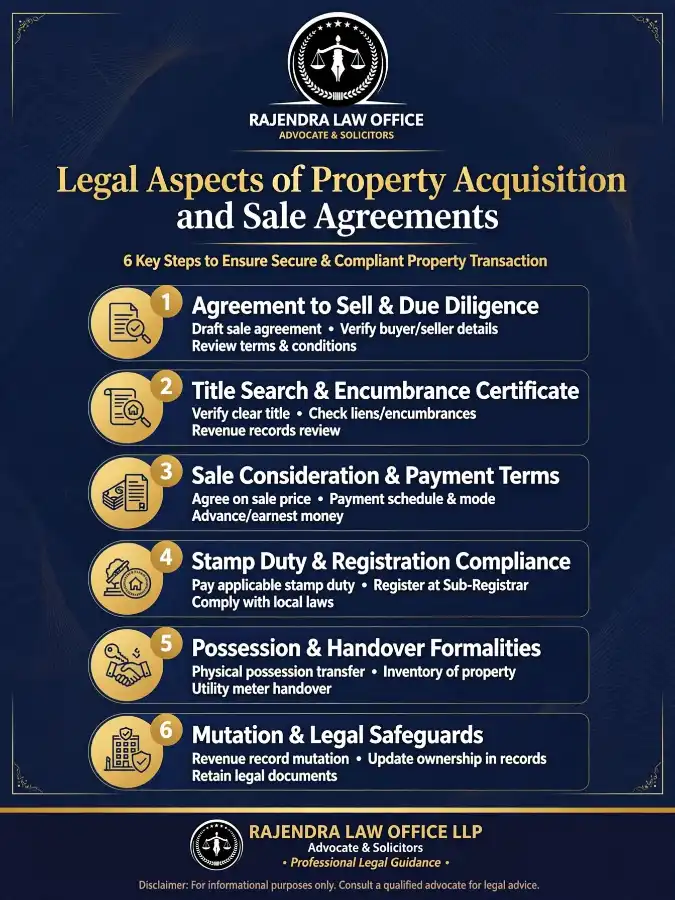
Property acquisition involves legal, financial, planning, and registration questions that should be resolved before the buyer commits substantial funds. An agreement to sell records the parties’ obligations, but it does not itself transfer ownership in the manner of a completed conveyance. Buyers should verify title, authority, encumbrances, approvals, possession, payment terms, and completion conditions. Sellers should confirm their ability to convey, disclose relevant risks, and understand the consequences of default. Tamil Nadu transactions require current checks on stamp duty, registration fees, and local registration procedure. This guide outlines the main legal issues and practical steps. The appropriate advice depends on the property, transaction structure, documents, and current law.
Legal Essentials of Property Purchase and Sale Contracts

What You Need to Know Before Signing a Property Sale Agreement?
1. Conduct legal and factual due diligence before committing
A buyer should identify the property precisely and verify the seller’s title before paying a substantial advance. Review the root document, subsequent conveyances, partitions, releases, settlements, inheritance records, court orders, and other relevant instruments. Confirm the seller’s identity, capacity, and authority to transfer. Search for registered encumbrances and compare the results with the title documents and available court records. Inspect physical possession, access, boundaries, tenants, and structures. For land or buildings, verify planning and land-use status where relevant. Due diligence should identify missing documents, inconsistent survey details, mortgages, and competing claims. Make material cures conditions to completion rather than relying on informal assurances.
2. Draft an agreement that allocates risk clearly
The agreement should identify the parties, property schedule, consideration, payment dates, title obligations, approvals, possession, taxes, default, termination, and completion process. State which documents the seller must provide and when. Explain how existing mortgages, leases, or other encumbrances will be discharged. Include a mechanism for dealing with title defects and failure to obtain required approvals. Payment milestones should match verified progress and legal conditions. Avoid blank schedules, vague completion dates, and inconsistent descriptions. A well-drafted agreement can create contractual remedies, but it cannot automatically cure defective ownership or override mandatory law. Have the instrument checked for stamp and registration requirements before execution.
3. Complete the conveyance and post-registration steps properly
The sale deed should accurately record the transaction, property, consideration, parties, and rights being conveyed. Confirm the correct stamp duty and registration fees under current Tamil Nadu law, and identify the competent Sub-Registrar. Check execution, identity, witness, appointment, and document requirements before attendance. Registration is important, but it does not independently guarantee that the seller had valid title. After registration, retain the original deed, receipts, payment evidence, and supporting records. Complete relevant revenue or mutation procedures where applicable and verify the resulting entries. The buyer should also preserve possession evidence and comply with tax or utility transfer requirements relevant to the property.
4. Understand the legal difference between agreement and sale deed
Section 54 of the Transfer of Property Act, 1882 distinguishes a sale from a contract for sale. A contract for sale does not, by itself, create an interest or charge in the property. The sale deed and registration requirements must be analysed under the governing law and facts. The agreement may create enforceable contractual obligations, including obligations to complete the sale, but the available remedy depends on its terms and legal conditions. A buyer should not treat possession, advance payment, or a signed agreement as a substitute for valid conveyance. Counsel should check the instrument, payment, title, and statutory requirements before advising whether a transaction has completed.
5. Allocate payment, possession, and default risk
The agreement should state the total consideration, advance, instalments, payment mode, and balance payable at completion. It should define when possession will be delivered and what condition the property must meet. If vacant possession is required, identify how tenants or occupants will be dealt with. Set out consequences of buyer default and seller default, including notice, cure periods, refund, interest, damages, or specific performance where legally available. Avoid assuming that every advance is automatically forfeitable or refundable in all circumstances. The outcome depends on the contract, facts, and applicable law. Record payments and acknowledgements accurately and use traceable payment methods.
6. Check approvals, restrictions, and property use
A transaction may require checks beyond title deeds. Depending on the property, verify layout approval, land-use classification, building permissions, access, easements, environmental restrictions, acquisition notices, and other statutory limitations. For apartments, review relevant association documents, undivided share, common areas, completion status, and applicable project disclosures. For agricultural or specially regulated land, check restrictions on transfer and use. A property’s marketing description does not establish lawful development or permissible use. If an approval is missing, determine whether the law permits a cure before agreeing to proceed. Do not treat regularisation as guaranteed.
7. Plan remedies for delay, breach, or defective title
If a party fails to complete, first identify the contractual obligation, notice requirements, deadlines, and evidence of breach. Potential remedies may include negotiated completion, refund, damages, specific performance, declaration, cancellation, or injunction, depending on the facts and law. The Specific Relief Act, 1963 and limitation rules may be relevant, but availability is fact-specific. A legal notice does not automatically preserve every claim or suspend limitation. Preserve payment records, communications, approvals, and title documents. Before filing, identify the competent court, necessary parties, valuation, court fee, limitation, and any special statutory route.
8. Write a complete property schedule
Include the correct survey and subdivision numbers, extent, boundaries, village, taluk, district, door number where relevant, and appurtenant rights. Compare the schedule against prior deeds and current official records. Resolve differences in measurements or names before execution. Where needed, obtain a qualified survey and legal review. Do not copy an old schedule without checking the current property identity.
9. Make title representations specific
Representations should identify ownership, authority, encumbrances, litigation, possession, approvals, and disclosed exceptions. Define the documents the seller must deliver and the consequences of a material inaccuracy. A representation can support contractual remedies, but it does not automatically defeat a third party’s superior title. Consider whether an indemnity is commercially meaningful and enforceable.
10. Control advances and instalments
State the payment amount, due date, method, receipt, and condition for each instalment. Link material payments to verified milestones, such as title clearance or discharge of a mortgage. Explain what happens if a condition fails. Avoid unclear labels such as token, deposit, or advance without defining their legal and contractual effect.
11. Deal with mortgages and lender requirements
If the property is mortgaged, confirm the outstanding amount, discharge mechanism, lender consent where required, and release documentation. Consider a direct payment arrangement only after legal and banking review. Obtain evidence that the mortgage has been discharged and check the relevant records. A no-dues letter alone may not resolve every title or registration issue.
12. Verify stamp duty and registration costs
Confirm the applicable instrument, market value, consideration, concessions if any, and current Tamil Nadu notifications. Use official sources and recheck the rate close to execution. Confirm the registration office, appointment process, identity requirements, witnesses, and document presentation rules. Do not rely on an old calculator without verifying its assumptions.
13. Specify completion conditions and deadlines
List each document, approval, payment, discharge, and possession obligation needed before completion. Set realistic dates and define how extensions are agreed. State what happens if a condition remains unsatisfied. A clear completion checklist reduces disputes over whether one party was ready and willing to perform.
14. Preserve evidence of readiness and performance
Keep notices, payment proofs, approvals, inspection records, and communications showing attempts to complete. If a dispute arises, these records may matter to breach, readiness and willingness, limitation, and relief. Do not alter records or rely on undocumented conversations for important terms. Confirm material variations in writing.
15. Verify the seller’s legal capacity
Confirm identity and capacity, including company authority, partnership authority, co-owner rights, or representative authority where relevant. Review powers of attorney and resolutions. A person may possess the property without having authority to transfer full legal title. Resolve authority issues before paying the balance.
16. Confirm all necessary parties
Identify co-owners, heirs, spouses where legally relevant, mortgagees, tenants, and persons whose rights affect the transaction. Determine which signatures or consents the law requires. Do not assume one family member can transfer everyone else’s interest. The correct parties depend on title and applicable law.
17. Review tenancy and vacant possession
Identify any tenant, licensee, occupant, or third party claiming possession. Review leases, deposits, notices, and statutory protections. State whether the buyer accepts an occupied property or requires vacant possession. Verify compliance at completion rather than relying solely on a promise.
18. Check access and easements
Confirm legal access from a public road and any shared pathway, drainage, utility, or easement rights. Informal use may not establish an enforceable right. Compare physical access with deeds and relevant records. Resolve access uncertainty before completion.
19. Review taxes and transaction reporting
Identify applicable tax withholding, reporting, and payment obligations based on the transaction value, parties, and current law. Obtain tax advice where the facts require it. Retain payment receipts and filings. Do not assume the deed alone proves compliance with every tax obligation.
20. Consider delay and extension clauses
Specify whether extensions require written consent, how long they may last, and what happens to payments during delay. Address delays caused by approvals, lender discharge, or document defects. Avoid indefinite completion periods that leave the parties uncertain about their rights.
21. Address misrepresentation and title defects
Define disclosure obligations and consequences of material inaccuracies. If a defect appears, identify the missing link and determine whether it can lawfully be cured. An indemnity may not protect against every third-party claim. Obtain advice before proceeding with unresolved title risk.
22. Keep the final deed consistent with the agreement
Check parties, consideration, payment history, property schedule, rights, and possession against the agreement and actual facts. Document any agreed change. Inconsistencies can create future disputes and complicate proof. Review the final deed before execution, not only after registration.
23. Preserve registration and payment records
Retain the registered deed, receipts, appointment records, payment proofs, title documents, approvals, and possession evidence. Keep secure digital copies as well as originals. Record where originals are stored and who has access. These records may be needed for resale, finance, or litigation.
24. Understand specific performance and limitation
A claim for specific performance depends on the contract, statutory requirements, conduct, and limitation. Do not assume that a signed agreement gives an unlimited right to compel conveyance. Calculate the applicable period and seek advice promptly after breach or refusal.
25. Obtain a transaction-specific legal review
A useful review should identify documents examined, defects, assumptions, conditions to completion, and unresolved questions. Ask the lawyer to distinguish a curable issue from a serious title risk. Avoid proceeding based on a generic checklist where the transaction is substantial or unusual.
26. Conclusion and practical next steps
A secure property acquisition requires verified title, a precise agreement, clear payment and possession terms, lawful approvals, and correct registration. Section 54 of the Transfer of Property Act distinguishes a sale from a contract for sale, so an agreement should not be mistaken for completed ownership transfer. Obtain a written due-diligence report, verify current Tamil Nadu charges and procedure, and resolve material defects before completion. Keep the signed agreement, sale deed, receipts, approvals, and possession evidence. Rajendra Law Office LLP’s property-law page is a starting point for its stated services; advice must be tailored to the actual property.
Transaction checks before signing or paying
Before paying a substantial advance, verify the identity and legal capacity of every seller and confirm who is entitled to execute the transaction. Compare the description in the draft agreement with the title deed, survey details, boundaries, extent, subdivision records, and relevant revenue or municipal records. Review the chain of title for the period relevant to the transaction and obtain an appropriate encumbrance search. An encumbrance certificate is useful but should not be treated as conclusive proof that no competing claim or defect exists.
Check whether the property is subject to a mortgage, court order, acquisition notice, tenancy, easement, planning restriction, unapproved layout, access dispute, or pending litigation. Where a company, trust, power-of-attorney holder, legal heir, or multiple co-owners are involved, verify the authority and consent required for execution. For apartments or projects, review the sanctioned plan, completion or occupancy documents where applicable, association records, undivided share, common areas, and any relevant RERA disclosures. The checks should match the property type and its location.
The agreement should state the property description, price, payment milestones, deadline for completion, documents to be delivered, responsibility for taxes and charges, consequences of default, conditions for refund, vacant-possession obligations, and the process for resolving disputes. Ensure that material promises are written into the signed instrument rather than left in informal messages. Registration, stamp duty, and execution requirements depend on the instrument and current Tamil Nadu law. Obtain a property-specific review before signing; a template cannot resolve a title defect or replace searches of the actual records.
Completion and handover controls
Before completion, reconcile the final payment statement with the agreement and confirm that any agreed conditions have been satisfied. Obtain the executed and registered instrument where registration is required, together with the documents promised by the seller. Record possession, keys, meter readings, fixtures, and any agreed repairs in a handover note. Keep proof of payments and the registration receipt. If a lender is involved, coordinate the release of the existing charge and the new financing requirements before fixing the completion date.
Frequently Asked Questions
No. Section 54 of the Transfer of Property Act says a contract for sale does not by itself create an interest or charge in the property.
It should identify parties and property, consideration, payment dates, title obligations, approvals, possession, default, termination, and completion conditions.
Not in every case. The result depends on the agreement, facts, applicable law, and the nature and circumstances of the payment.
Yes. Review the chain of title, encumbrances, authority, possession, approvals, and property schedule before committing substantial funds.
Check current official Tamil Nadu registration and stamp-duty sources for the instrument and transaction. Rates and procedures may depend on the facts.
Potential remedies include negotiated completion, refund, damages, specific performance, or other relief, subject to the contract, limitation, and applicable law.