Insurance Lawyers in India – Insurance disputes can affect families, businesses, vehicle owners, hospitals, exporters, and NRIs. Policyholders often face claim rejection, delayed settlement, underpayment, exclusions, or allegations of non-disclosure. Therefore, timely legal advice can protect contractual rights and improve dispute strategy. Insurance lawyers examine policy wording, endorsements, claim correspondence, survey reports, medical records, and supporting evidence. They also identify the correct grievance forum, limitation period, jurisdiction, and available remedies. In India, policyholders can approach insurers, IRDAI grievance mechanisms, Insurance Ombudsman forums, consumer commissions, and competent courts. IRDAI’s Bima Bharosa system allows policyholders to register and track grievances electronically. Legal assistance may include claim review, legal notices, negotiations, complaints, mediation, litigation, and enforcement. Consequently, professional guidance becomes valuable when insurers dispute liability or quantum. Rajendra Law Office LLP provides strategic insurance legal support for individuals, companies, and NRIs.
Insurance Lawyers in India for Claims and Disputes – Rajendra Law Office LLP
Understanding Insurance Claims and Disputes
Common Insurance Claim Problems
Claim Rejection and Repudiation
Insurance claim rejection can create serious financial pressure when insurers refuse liability. Common grounds include policy exclusions, alleged misrepresentation, non-disclosure, delayed intimation, breach of conditions, and insufficient documentation. However, insurers must assess claims according to applicable policy terms and regulatory requirements. Policyholders should obtain the insurer’s written repudiation letter and identify every stated reason. Furthermore, they should compare those reasons against the policy schedule, wording, endorsements, and proposal form. Legal counsel can examine whether the rejection reflects a genuine exclusion or an unreasonable interpretation. Therefore, claimants should avoid accepting repudiation without reviewing their contractual and statutory remedies. A lawyer can prepare a representation, legal notice, grievance complaint, or appropriate proceeding. Evidence should include claim forms, photographs, reports, invoices, correspondence, and payment records. Consequently, prompt legal review can identify weaknesses before limitation periods create additional difficulties.
Delayed Settlement and Underpayment
Claim delays can cause significant hardship, especially after accidents, medical emergencies, property damage, or business losses. Policyholders should document every communication with the insurer and surveyor. Moreover, they should request written reasons for unexplained delays or reduced settlement offers. Underpayment disputes may involve depreciation, exclusions, deductibles, valuation methods, policy limits, or assessment disagreements. Therefore, lawyers should compare the insurer’s calculation against policy coverage and supporting financial evidence. Bima Bharosa provides a mechanism for registering complaints and tracking insurer responses. If an insurer fails to resolve a grievance satisfactorily, escalation options may become available. Legal counsel can formulate representations and assess whether further proceedings remain appropriate. Businesses should preserve accounting records and loss calculations for commercial claims. Consequently, a properly documented claim can strengthen negotiations and formal proceedings. Professional advice becomes particularly important when the disputed amount is substantial.
Health and Life Insurance Disputes
Health and life insurance claims often involve medical records, exclusions, waiting periods, disclosures, and policy conditions. Insurers may dispute hospitalisation, pre-existing conditions, treatment necessity, or disclosure history. Life claims may involve nominee rights, policy status, premium payments, exclusions, or alleged material misrepresentation. Therefore, claimants should preserve policy documents, medical records, hospital bills, prescriptions, diagnostic reports, and correspondence. Family members should also retain nomination documents and death certificates where relevant. Furthermore, insurers should provide clear reasons when they decline claims. Legal counsel can examine whether the policy wording supports the insurer’s position. A lawyer may also assist with grievance escalation, Ombudsman proceedings, consumer complaints, or court proceedings. Consequently, early document review can prevent avoidable procedural mistakes. Rajendra Law Office LLP helps clients understand policy coverage and develop evidence-based claim strategies. Every case requires assessment according to its specific facts and contractual terms.
Property, Motor and Business Insurance
Motor Insurance Claims
Motor insurance disputes frequently involve accident liability, repair costs, total loss assessments, depreciation, and policy exclusions. Claimants should immediately preserve photographs, repair estimates, police records, survey reports, and insurer correspondence. Additionally, accident-related records can establish circumstances surrounding the loss. Delayed reporting may create disputes, although its legal effect depends upon the policy and circumstances. Therefore, claimants should provide accurate information without admitting unnecessary liability. Lawyers can examine comprehensive coverage, third-party liability, own-damage claims, and applicable policy conditions. Where accidents involve suspected offences, police records may become relevant to the broader dispute. The Bharatiya Nyaya Sanhita, 2023 now governs offences under India’s current criminal framework. Legal counsel can distinguish ordinary insurance disputes from separate criminal allegations. Consequently, claimants should pursue the appropriate forum rather than treating every rejection as criminal conduct. A detailed claim file improves negotiation and subsequent proceedings.
Property and Fire Insurance
Property and fire insurance disputes can involve complex questions concerning causation, valuation, exclusions, and loss assessment. Commercial establishments may face substantial losses after fire, flooding, machinery failure, theft, or natural events. Therefore, businesses should preserve stock records, purchase invoices, photographs, accounting statements, and incident reports. Surveyor assessments can significantly influence settlement discussions and require careful review. Furthermore, policyholders should identify coverage limits, deductibles, warranties, exclusions, and reinstatement conditions. A dispute may arise when insurers attribute damage to an excluded cause. Lawyers can analyse policy language and supporting technical evidence. Businesses should also maintain fire brigade reports, police records, CCTV footage, and inventory documents when relevant. Consequently, evidence preservation should begin immediately after the insured event. Legal assistance can cover surveyor disputes, claim representations, negotiations, Ombudsman complaints, consumer proceedings, and court litigation. Prompt action can protect evidence and reduce uncertainty during loss assessment.
Business Interruption and Commercial Loss
Business interruption insurance claims require careful calculation of financial losses and policy coverage. Disputes may concern indemnity periods, turnover calculations, saved expenses, trends, exclusions, or causation. Therefore, companies should preserve audited accounts, tax records, sales data, payroll records, invoices, and operational documents. Accountants and technical experts may assist lawyers in preparing reliable loss calculations. Furthermore, insurers may appoint surveyors or loss assessors to evaluate business losses. Policyholders should review assessment reports before accepting settlement amounts. Legal counsel can identify contractual inconsistencies and challenge unsupported deductions. Commercial insurance disputes may also involve banking, property, marine, cyber, or liability policies. Consequently, forum selection requires attention to the parties, contract, jurisdiction, and available statutory remedies. Businesses should maintain complete communication records throughout claim processing. Rajendra Law Office LLP can coordinate legal, financial, and evidentiary aspects of complex commercial insurance disputes.
Marine, Travel and Liability Insurance
Marine Insurance Disputes
Marine insurance disputes can involve cargo damage, vessel losses, transit risks, seaworthiness, warranties, and policy exclusions. Exporters and importers should preserve bills of lading, invoices, packing lists, survey reports, photographs, and transport records. Additionally, port documents and customs records can help establish the movement and condition of goods. Policy interpretation often requires detailed analysis of coverage clauses and exclusions. Therefore, legal counsel should review the insurance contract alongside commercial shipping documents. International transactions may introduce jurisdiction, arbitration, governing-law, and evidence issues. Businesses should promptly notify insurers and preserve damaged goods where practical. Furthermore, survey findings should receive careful legal and technical review. Lawyers can assist with claim notices, negotiations, arbitration strategy, court proceedings, and settlement. Consequently, early action protects evidence and clarifies contractual responsibilities. Marine insurance litigation may require coordination with shipping, customs, commercial, and contractual specialists.
Travel and Personal Accident Claims
Travel and personal accident insurance disputes often involve exclusions, medical documentation, cancellation losses, disability, or accidental death. Claimants should retain tickets, policy documents, hospital records, police reports, invoices, and correspondence. Furthermore, travel disruptions require proof of cancellation, delay, expenses, and insurer communications. Personal accident claims may require medical evidence establishing injury and resulting disability. Therefore, claimants should obtain complete medical and documentary records before challenging rejection. Insurers may rely on exclusions or policy definitions that require careful interpretation. Legal counsel can examine whether those clauses apply to the actual circumstances. Bima Bharosa offers an official grievance channel for policyholders facing unresolved insurer complaints. If necessary, lawyers can evaluate Ombudsman or judicial remedies. Consequently, accurate documentation remains essential for successful claim resolution. Individuals and NRIs can obtain case-specific advice before accepting disputed settlements.
Legal Remedies and Insurance Dispute Resolution
Forums, Evidence and Legal Strategy
Insurer Grievance Redressal
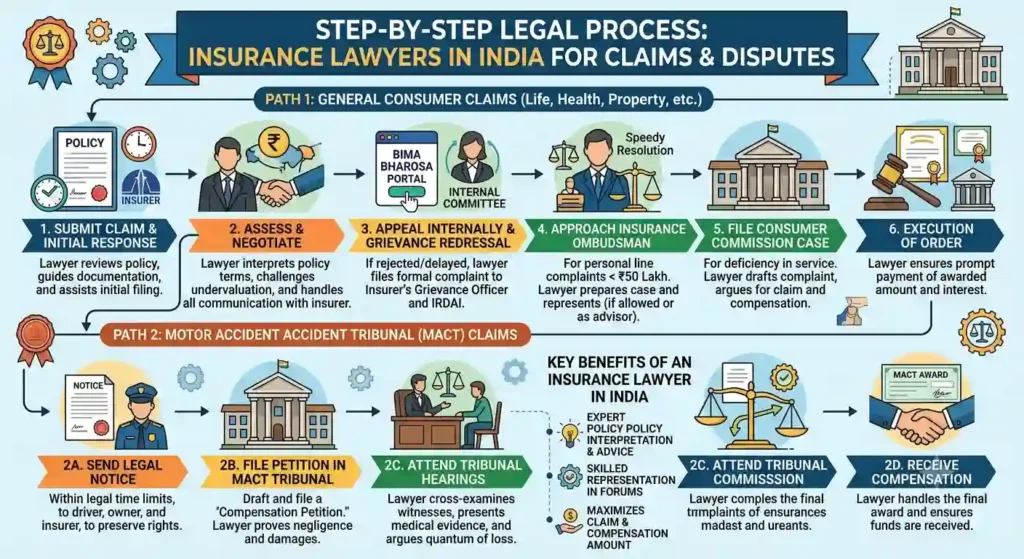
Policyholders should normally begin by using the insurer’s internal grievance mechanism. IRDAI’s Bima Bharosa guidance states that complaints should first reach the insurer’s grievance process. Insurers are expected to address complaints within the prescribed timeline. If the response remains unsatisfactory, policyholders can escalate grievances through Bima Bharosa. The portal generates a token number for tracking registered complaints. Therefore, complainants should retain the complaint number, acknowledgement, and complete correspondence. Legal counsel can prepare a concise representation explaining policy coverage and disputed grounds. Additionally, lawyers can identify regulatory violations or procedural shortcomings. Businesses should attach organised supporting documents rather than sending unclear material. Consequently, effective grievance presentation can improve the insurer’s understanding of the dispute. Rajendra Law Office LLP can assist policyholders before escalation becomes necessary.
IRDAI and Bima Bharosa
IRDAI regulates India’s insurance sector and provides policyholder grievance mechanisms. Bima Bharosa allows policyholders to register complaints involving insurers and track complaint status. IRDAI also provides insurer grievance officer information through its official resources. Policyholders can use Bima Bharosa after pursuing the insurer’s grievance process. The official portal provides complaint registration and document-upload facilities. (Bima Bharosa) Therefore, complainants should provide accurate policy, claim, insurer, and grievance information. Legal counsel can assist with drafting and evidence organisation. However, regulatory grievance mechanisms do not automatically replace judicial remedies. Each dispute requires assessment of contractual rights, limitation, forum, and relief. Furthermore, businesses should consider the commercial impact before choosing prolonged litigation. Consequently, legal strategy should integrate regulatory escalation with other available remedies. Professional advice can prevent duplication and procedural errors.
Insurance Ombudsman Proceedings
The Insurance Ombudsman provides a specialised grievance redressal route for eligible policyholder disputes. IRDAI identifies the Ombudsman as a quasi-judicial mechanism under the Insurance Ombudsman Rules, 2017. The Ombudsman route can provide a cost-effective alternative for qualifying complaints. Policyholders should first understand whether their dispute falls within applicable jurisdiction and eligibility requirements. Therefore, lawyers should review the policy, insurer response, complaint history, and requested relief. The Council for Insurance Ombudsman provides information about Ombudsman centres and procedures. Legal assistance can include preparing submissions, organising evidence, and presenting the claim clearly. Furthermore, parties should understand the effect of any settlement or award before proceeding. Complex disputes may require a different judicial or contractual remedy. Consequently, forum selection should follow legal analysis rather than convenience alone. Rajendra Law Office LLP assists clients in evaluating appropriate insurance dispute resolution options.
Consumer Commissions and Courts
Consumer Commissions can provide remedies in eligible consumer disputes involving insurance services. Depending on the facts, remedies may include compensation, refund, interest, or other appropriate relief. Courts can also hear insurance disputes where jurisdiction and maintainability requirements permit. The Commercial Courts framework may apply to qualifying commercial disputes involving insurance contracts. Therefore, lawyers should assess the nature of the parties, transaction, valuation, jurisdiction, and relief sought. Civil proceedings may involve the Code of Civil Procedure, 1908 where applicable. Furthermore, contractual arbitration clauses can affect the appropriate dispute-resolution route. Parties should not assume that every insurance claim belongs before one particular forum. Legal counsel can compare regulatory, Ombudsman, consumer, arbitration, and court remedies. Consequently, strategic forum selection can reduce delay and unnecessary expense. The strongest remedy depends upon the policy, facts, evidence, and applicable law.
Electronic Evidence Under BSA
Insurance claims increasingly depend on emails, online policy records, payment receipts, portal communications, and digital documents. The Bharatiya Sakshya Adhiniyam, 2023 governs evidence principles and recognises electronic and digital records. (India Code) Section 63 addresses admissibility requirements for specified electronic records. (India Code) Therefore, policyholders should preserve original emails, downloaded documents, portal records, and relevant metadata. Screenshots alone may not always provide sufficient evidentiary context. Furthermore, claimants should preserve communications showing dates, acknowledgements, responses, and decisions. Lawyers can assess how electronic records should support pleadings or submissions. Businesses should maintain secure backups of important claim documentation. Consequently, disciplined evidence management strengthens insurance litigation strategy. Digital records can become particularly important when insurers dispute communication, notice, or submission dates. Proper preparation helps lawyers present electronic evidence more effectively.
Criminal Issues and Professional Legal Support
BNS, BNSS and Police Complaints
Some insurance disputes may contain allegations involving fraud, forgery, cheating, or other criminal conduct. Such allegations require separate assessment under the Bharatiya Nyaya Sanhita, 2023. Criminal procedure now operates under the Bharatiya Nagarik Suraksha Sanhita, 2023. However, ordinary claim rejection does not automatically constitute a criminal offence. Therefore, clients should distinguish contractual disagreement from genuine criminal conduct. A nearby police station may become relevant where facts disclose an appropriate criminal allegation. Police complaints should include authentic documents and a clear chronology. Furthermore, false or exaggerated allegations can create unnecessary legal exposure. Lawyers can advise whether police action, civil proceedings, consumer remedies, or regulatory escalation remains appropriate. Electronic evidence may also require consideration under the BSA. Consequently, criminal strategy should complement rather than replace insurance claim analysis. Professional legal advice helps clients choose proportionate and legally sustainable remedies.
Legal Notice and Settlement Strategy
A legal notice can clarify an insurance dispute before formal proceedings begin. The notice should identify the policy, insured event, claim number, disputed decision, contractual basis, and requested relief. Additionally, it should attach or reference critical supporting documents. Counsel can challenge unsupported repudiation grounds and request reconsideration where appropriate. Settlement discussions can sometimes resolve disputes without prolonged litigation. However, policyholders should avoid signing settlement documents without understanding their legal consequences. Full-and-final settlement language can affect subsequent remedies depending on the circumstances. Therefore, lawyers should review proposed settlement terms carefully. Businesses may also negotiate partial payments while preserving genuinely disputed rights where legally possible. Consequently, a well-prepared legal notice can improve negotiation leverage. Rajendra Law Office LLP provides claim assessment, notice drafting, settlement negotiation, and litigation preparation. Early legal intervention often improves clarity and preserves strategic options.
Remedies Available to Policyholders
Insurance law provides several potential remedies depending on the policy and dispute forum. Available relief may include claim payment, interest, compensation, costs, reconsideration, settlement, or appropriate judicial orders. Injunctive relief may arise in suitable proceedings where legal requirements are satisfied. Additionally, contractual arbitration may provide relief when a valid arbitration agreement governs the dispute. Consumer proceedings may offer remedies where statutory requirements apply. Ombudsman proceedings may provide another route for eligible policyholder grievances. Therefore, lawyers should identify remedies before selecting a forum. Evidence, limitation, policy terms, and jurisdiction influence the appropriate strategy. Furthermore, businesses may require expert valuation or accounting evidence for large claims. NRIs may require powers of attorney and coordinated representation in India. Consequently, tailored legal assistance can reduce procedural risks and improve claim presentation.
Legal Support for NRIs and Companies
NRIs and companies often require specialised assistance because insurance disputes may involve distance, documentation, representatives, and complex transactions. NRIs can authorise Indian lawyers to manage appropriate proceedings through valid documentation. Companies should preserve board approvals, policy records, claim files, accounting documents, and authorised representative details. Furthermore, corporate insurance disputes may involve multiple policies covering interconnected risks. Legal counsel can coordinate communications with insurers, surveyors, brokers, TPAs, and authorities. International businesses may also require advice concerning Indian jurisdiction and contractual dispute-resolution clauses. Therefore, cross-border insurance claims require careful procedural planning. Rajendra Law Office LLP assists with claim assessment, legal notices, grievance escalation, negotiations, Ombudsman proceedings, and litigation strategy. Evidence can be organised remotely through secure document sharing. Consequently, clients need not manage complex insurance disputes without professional guidance. Early consultation helps identify the correct forum, remedy, evidence, and legal pathway.
Preventive Insurance Legal Advice
Prevention remains valuable because many insurance disputes begin with unclear coverage or inadequate documentation. Businesses should review policies before renewal and after major operational changes. Individuals should understand exclusions, deductibles, waiting periods, limits, endorsements, and disclosure requirements. Furthermore, companies should maintain claim protocols for accidents, cyber incidents, fires, thefts, and business interruptions. Prompt notification can protect contractual rights where policies impose reporting requirements. Legal professionals can review policy wording and identify potentially problematic clauses. They can also advise on risk allocation, insurance contracts, indemnities, and dispute-resolution provisions. Therefore, preventive insurance legal consultation can reduce future claim uncertainty. Organisations should train relevant employees to preserve evidence after insured events. Additionally, policy schedules should remain accessible to authorised personnel. Consequently, preparation can improve both claim administration and legal outcomes. Rajendra Law Office LLP offers insurance legal support focused on practical risk management and dispute prevention.
Frequently Asked Questions
Can an insurance lawyer challenge claim rejection?
Yes. A lawyer can review policy terms, repudiation reasons, evidence, and applicable remedies. The lawyer can then pursue grievance, Ombudsman, consumer, arbitration, or court remedies.
How can I complain against an insurer?
First approach the insurer’s grievance officer. If unresolved, Bima Bharosa provides an official escalation mechanism and complaint tracking facility.
Can NRIs pursue insurance claims in India?
Yes. NRIs can pursue eligible Indian insurance claims using appropriate authorisations. Lawyers can assist with documentation, representation, negotiations, and applicable proceedings.
Can police handle insurance fraud?
Police involvement may apply where facts disclose an independent criminal offence. Lawyers should distinguish genuine fraud allegations from ordinary contractual claim disputes.
What evidence helps an insurance dispute?
Useful evidence includes policies, claim forms, repudiation letters, invoices, photographs, medical records, survey reports, emails, payment records, and digital communications.
What remedies can insurance lawyers pursue?
Depending on the case, lawyers may pursue claim payment, compensation, interest, costs, settlement, Ombudsman relief, consumer remedies, arbitration, or court proceedings.
Read More
- Maximizing Your Defense: Advantages of Hiring a Criminal Defense Lawyer
- Mastering Mergers and Acquisitions: Legal Insights and Strategies
- Insurance Claim Lawyers in Chennai: Maximizing Your Policy Benefits
- Inside the Tribunal: Understanding Arbitral Roles
- Immigration Lawyers in India for Visa Applications
- Insurance Regulatory and Development Authority of India (IRDAI)