
Intellectual Property Due Diligence – Intellectual property often represents a major component of an Indian company’s commercial value. Therefore, M&A transactions require detailed examination of every relevant intellectual property asset. The review should cover trademarks, patents, copyrights, designs, trade secrets, domain names, software, and licences. Lawyers should compare registered assets with actual business operations and revenue streams. They should also identify pending applications, renewals, oppositions, assignments, licences, and encumbrances. IP India maintains official records covering patents, trademarks, designs, and copyright matters. Consequently, registry searches should form an important part of acquisition due diligence. Buyers should also examine unregistered intellectual property with commercial importance. A complete IP schedule can reveal ownership gaps and hidden liabilities. Rajendra Law Office LLP helps businesses assess these risks before transaction completion. Early legal review can protect valuation, ownership, exclusivity, and post-acquisition commercial use.
Intellectual Property Due Diligence in Mergers and Acquisitions: Legal Considerations – Rajendra Law Office LLP
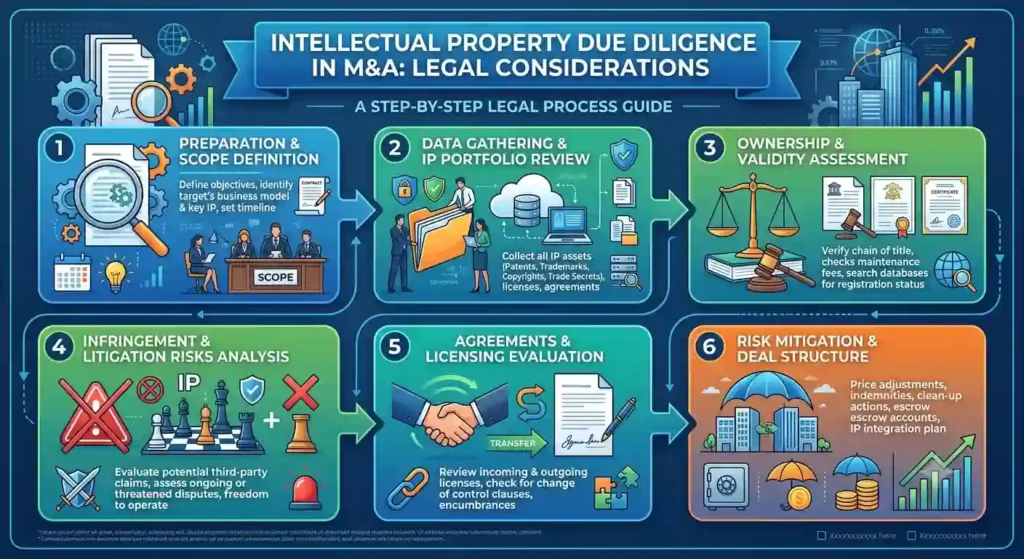
Assessing Ownership and Chain of Title
Ownership verification remains one of the most important elements of intellectual property due diligence. A buyer should confirm that the target actually owns every asset included within the transaction. Employment agreements, consultancy contracts, assignments, licences, joint-development agreements, and acquisition documents require careful review. Furthermore, historic assignments should match official registry records wherever registration applies. Patent assignments require registration of title with the Controller under Section 69. Similarly, trademark assignments require registration with the Trade Marks Registry under Section 45. Design assignments also require prescribed documentation and registration requirements. Copyright ownership requires separate contractual analysis because statutory ownership rules can vary by circumstances. Therefore, missing documents can create serious post-closing disputes. Buyers should obtain corrective assignments before completion whenever practical. Proper chain-of-title verification also supports warranties, indemnities, valuation, and integration planning.
Reviewing Registered and Unregistered Rights
Trademarks, Patents and Designs
Registered IP rights require examination of registration numbers, classes, territories, owners, validity, renewals, and pending proceedings. Trademark due diligence should examine similarity conflicts, oppositions, licensing arrangements, and restrictions on assignment. The Trade Marks Act permits assignments subject to statutory restrictions and registration requirements. Patent diligence should examine granted patents, applications, prosecution history, licences, ownership, renewals, and infringement exposure. Section 69 requires registration of assignments and other interests affecting patent title. Design diligence should verify registration status, ownership, validity, assignments, and cancellation risks. Unregistered rights require separate review of contractual ownership and evidence of use. Additionally, buyers should investigate whether third parties claim competing rights. Registry searches should therefore accompany contractual document reviews. A transaction can lose substantial value when key IP rights remain uncertain. Legal counsel should classify every asset as owned, licensed, shared, disputed, pending, expired, or commercially restricted.
Copyright and Software Rights
Copyright diligence becomes essential when the target depends upon software, databases, websites, marketing content, manuals, graphics, films, or other creative works. Lawyers should determine authorship, contractual ownership, employee creation, commissioned work, and third-party licensing. IP India’s copyright guidance confirms that copyright can generally be assigned wholly or partially. Software acquisition requires additional attention to source code, repositories, developer agreements, open-source components, and third-party libraries. Buyers should verify whether developers assigned relevant rights to the target company. They should also examine restrictions affecting modification, distribution, sublicensing, and commercial deployment. Furthermore, open-source licences may create disclosure or distribution obligations. Source-code escrow arrangements can also affect transaction value and continuity. Therefore, software IP diligence should combine legal, technical, and contractual analysis. Copyright registration records can provide useful evidence, although ownership analysis should not depend solely upon registration. Rajendra Law Office LLP can coordinate contractual and legal reviews for technology-driven acquisitions.
Contractual and Commercial IP Risks
Reviewing Licences and Third-Party Rights
Inbound and Outbound IP Licences
Licence agreements can significantly affect the value and usability of acquired intellectual property. Due diligence should identify licensors, licensees, territories, fields of use, duration, exclusivity, royalties, sublicensing, and termination rights. Buyers should examine change-of-control provisions because an acquisition may trigger consent requirements. Some agreements may restrict assignment without prior written approval. Others may terminate automatically after ownership changes. Therefore, transaction counsel should review every material IP licence before signing definitive documents. Patent and trademark licences should also match registry information where relevant. Buyers should identify minimum payments, royalty obligations, audit rights, and performance conditions. Additionally, exclusivity provisions can create valuable competitive advantages or significant restrictions. Unfavourable licences may require renegotiation before closing. Consequently, IP diligence should evaluate both legal ownership and practical commercial usability. A buyer should understand whether the acquired business can continue operating after completion without third-party consent.
Co-Ownership and Joint Development Issues
Co-owned intellectual property can create significant complications during an acquisition. Joint-development agreements may divide ownership, licensing rights, enforcement powers, costs, and commercialisation rights. Patent co-ownership can restrict unilateral licensing or assignment depending upon statutory provisions and contractual arrangements. Buyers should therefore inspect agreements with universities, research institutions, vendors, customers, and strategic partners. They should determine who owns improvements, derivative works, inventions, and technical developments. Furthermore, joint-development contracts may contain confidentiality and termination provisions affecting post-closing operations. A buyer should identify every obligation attached to jointly developed technology. Where possible, transaction documents should allocate responsibility for obtaining required consents. Indemnities can address unresolved ownership risks, although they should not replace due diligence. Consequently, co-owned IP requires special attention during valuation and transaction structuring. Legal counsel can negotiate amendments, waivers, consents, or risk allocation before completion.
Legal Framework, Risks and Transaction Remedies
Indian Laws and Regulatory Considerations
Key Intellectual Property Legislation
Trade Marks, Patents and Copyright Laws
Indian M&A transactions involving intellectual property require compliance with several specialised statutes. The Trade Marks Act, 1999 governs trademark registration, assignment, transmission, infringement, and related rights. The Patents Act, 1970 governs patents, assignments, licences, ownership, and enforcement. Section 69 specifically addresses registration of patent assignments and interests. The Copyright Act, 1957 governs copyright ownership, assignment, licensing, infringement, and related protections. The Designs Act, 2000 regulates registered industrial designs and ownership transfers. Therefore, buyers should conduct statute-specific diligence rather than applying one generic checklist. Additionally, contractual rights may supplement statutory protections. Lawyers should assess registrations, agreements, renewals, disputes, encumbrances, and compliance obligations together. This approach provides a clearer picture of the target’s intellectual property position.
Companies Act and NCLT Proceedings
Mergers and amalgamations involving Indian companies commonly require consideration of the Companies Act, 2013. Sections 230 and 232 provide statutory mechanisms concerning compromises, arrangements, mergers, and amalgamations. The National Company Law Tribunal can supervise and sanction applicable schemes under the statutory framework. Therefore, IP assets transferred through a merger require careful identification within transaction documentation. The scheme should address intellectual property ownership, licences, contracts, liabilities, and pending disputes. Additionally, Section 233 provides a simplified framework for specified classes of mergers. Cross-border mergers may involve additional regulatory and Reserve Bank of India requirements. Buyers should therefore coordinate corporate, IP, tax, competition, and foreign exchange advice. NCLT proceedings can also require clear disclosure of material IP liabilities. Consequently, transaction counsel should integrate IP diligence into the broader merger process. Rajendra Law Office LLP can assist with corporate and intellectual property legal coordination.
Competition Commission and Combination Review
M&A transactions can require scrutiny under India’s competition law framework. The Competition Commission of India regulates combinations involving qualifying acquisitions, mergers, and amalgamations. Section 5 thresholds determine whether a transaction constitutes a reportable combination. Section 6 establishes the notification framework before consummation, subject to applicable exemptions. Intellectual property can influence market definition, competitive strength, entry barriers, and innovation incentives. Therefore, IP-heavy transactions require careful competition assessment. Exclusive licences or acquisitions of strategic technology may receive particular attention. The CCI may modify or prohibit combinations causing an appreciable adverse effect on competition. Buyers should therefore coordinate IP and competition analysis before signing. Pre-filing consultation may assist parties where competition concerns require clarification. Legal counsel can assess filing obligations, exemptions, remedies, and transaction conditions.
IP Disputes and Litigation Exposure
Identifying Existing and Potential Claims
Infringement, Opposition and Revocation Risks
A target’s IP portfolio may contain existing disputes that materially affect transaction value. Due diligence should identify infringement suits, trademark oppositions, patent revocation proceedings, copyright claims, and design cancellation petitions. Buyers should examine pleadings, interim orders, settlement agreements, correspondence, and litigation strategies. Trademark disputes can affect brand continuity and market expansion. Patent disputes can threaten important technology and revenue streams. Design registrations may also face cancellation proceedings under statutory grounds. Additionally, third parties may threaten claims without commencing formal proceedings. Therefore, legal searches should cover court records, registry records, and internal correspondence. Delhi High Court and other competent commercial courts frequently hear significant IP disputes. Depending upon jurisdiction and subject matter, appeals may reach appropriate appellate courts. Consequently, unresolved IP litigation should influence valuation, warranties, indemnities, escrow arrangements, and closing conditions.
Trade Secrets and Confidential Information
Trade secrets can represent valuable assets even without formal registration. M&A diligence should examine confidentiality agreements, employee obligations, access controls, technical safeguards, and third-party disclosures. Buyers should determine how the target protects commercially sensitive formulas, algorithms, customer lists, processes, and business strategies. Former employees may create risks where confidentiality obligations remain unclear. Similarly, vendor contracts may permit disclosure or limited use of confidential information. Therefore, counsel should review confidentiality clauses across employment and commercial agreements. Cybersecurity incidents can also compromise valuable confidential information before closing. Buyers should investigate known breaches, unauthorised disclosures, and remediation measures. Additionally, transaction teams should use controlled virtual data rooms for sensitive materials. Unnecessary disclosure during diligence can itself create commercial risks. Strong confidentiality provisions should apply throughout negotiations and integration. Legal advice can help establish protective measures and allocate responsibility for historic confidentiality breaches.
Employee and Founder Intellectual Property
Employee-created IP frequently requires detailed contractual examination during M&A diligence. Companies should maintain clear agreements covering inventions, software, designs, copyright works, confidentiality, and post-employment obligations. Founders may personally own domains, trademarks, patents, source code, or social-media assets despite company use. Consultants and contractors can create similar ownership concerns. Therefore, buyers should compare business-critical assets against employment and consultancy documentation. Missing assignments can create gaps between commercial expectations and legal ownership. Courts may examine contractual terms, statutory provisions, and factual circumstances when ownership becomes disputed. Consequently, buyers should identify high-risk assets before signing definitive agreements. Corrective assignments can sometimes resolve ownership deficiencies before closing. Transaction documents can also require specific indemnities for historic employee or founder claims. Rajendra Law Office LLP can review employment-linked IP ownership and recommend corrective measures.
Transaction Structuring and Legal Remedies
Protecting the Acquirer
Representations, Warranties and Indemnities
IP representations and warranties should accurately reflect the target’s ownership and compliance position. Typical protections address ownership, validity, registrations, licences, infringement claims, employee assignments, and third-party rights. Buyers should avoid relying on generic corporate warranties for material IP risks. Instead, schedules should identify important patents, trademarks, copyrights, designs, licences, and disputes. Specific indemnities can address known infringement claims or defective ownership. Escrow arrangements may provide additional financial security for identified risks. Furthermore, closing conditions can require assignments, renewals, consents, or registry filings. Material adverse change provisions may also address unexpected IP developments. Therefore, transaction documents should reflect the actual findings from diligence. Strong contractual protection can preserve bargaining power when risks cannot disappear before completion. Lawyers should align indemnity scope, duration, caps, baskets, exclusions, and claims procedures with identified IP exposure.
Post-Closing IP Protection
IP diligence should continue into post-closing integration and compliance. The buyer should promptly update ownership records, licence arrangements, domain registrations, and internal IP databases. Trademark assignments should receive appropriate registration attention under applicable statutory requirements. Patent title changes should follow Section 69 requirements and applicable procedural rules. Design transfers should satisfy statutory documentation and filing requirements. Employees should receive updated confidentiality and IP policies where necessary. Moreover, technology systems should protect acquired source code and confidential information. Buyers should also review renewal calendars to prevent accidental expiration. Integration teams should monitor third-party licences and change-of-control obligations. Therefore, post-closing legal support remains essential for preserving acquired IP value. Rajendra Law Office LLP can assist with recordal, contractual updates, enforcement planning, and ongoing IP compliance.
Remedies for IP Due Diligence Problems
####### Legal Remedies and Corrective Measures
IP due diligence can uncover ownership defects, infringement exposure, invalid registrations, contractual restrictions, or undisclosed disputes. Buyers can respond through several legal and commercial remedies. They may demand corrective assignments, obtain third-party consents, renegotiate licences, or adjust transaction consideration. Additionally, representations, warranties, indemnities, escrow arrangements, and closing conditions can allocate identified risks. In serious cases, parties may postpone or terminate the transaction. Courts can provide appropriate relief in IP infringement disputes, including injunctions and damages where legally available. Commercial courts may hear qualifying intellectual property disputes under applicable procedural law. The Code of Civil Procedure, 1908 can remain relevant to civil litigation and procedural matters. Criminal provisions may also become relevant where facts disclose forgery, fraud, or other offences. The Bharatiya Nyaya Sanhita and Bharatiya Nagarik Suraksha Sanhita now govern India’s general criminal law and procedure. Therefore, counsel should match each remedy with the specific legal issue and forum.
Why Specialist IP Counsel Matters
####### End-to-End M&A Legal Support
Intellectual property due diligence requires coordination between corporate lawyers, IP specialists, commercial teams, and technical experts. A transaction may involve patents, trademarks, copyrights, designs, software, confidential information, licences, and regulatory approvals. Each category carries different ownership and enforcement rules. Therefore, generic contract review may fail to identify important IP risks. Specialist counsel can conduct registry searches, review agreements, assess litigation, verify ownership, and prepare risk matrices. They can also negotiate transaction protections and advise on closing requirements. Furthermore, counsel can coordinate with NCLT proceedings, CCI requirements, commercial courts, and government IP offices. Appropriate legal support can cover due diligence, transaction drafting, negotiation, filings, enforcement, and post-closing integration. Rajendra Law Office LLP provides strategic legal assistance for M&A and intellectual property matters. Early involvement helps buyers understand risk before valuation and transaction terms become fixed. Ultimately, effective IP diligence protects ownership, market position, technology, goodwill, and investment value.
Intellectual Property Due Diligence in Mergers and Acquisitions: Legal Considerations
Understanding Intellectual Property Due Diligence in M&A
Why IP Due Diligence Matters
Identifying Valuable Intellectual Property Assets
Mapping the Target Company’s IP Portfolio
Intellectual property often represents a major component of an Indian company’s commercial value. Therefore, M&A transactions require detailed examination of every relevant intellectual property asset. The review should cover trademarks, patents, copyrights, designs, trade secrets, domain names, software, and licences. Lawyers should compare registered assets with actual business operations and revenue streams. They should also identify pending applications, renewals, oppositions, assignments, licences, and encumbrances. IP India maintains official records covering patents, trademarks, designs, and copyright matters. (IP India) Consequently, registry searches should form an important part of acquisition due diligence. Buyers should also examine unregistered intellectual property with commercial importance. A complete IP schedule can reveal ownership gaps and hidden liabilities. Rajendra Law Office LLP helps businesses assess these risks before transaction completion. Early legal review can protect valuation, ownership, exclusivity, and post-acquisition commercial use.
Assessing Ownership and Chain of Title
Ownership verification remains one of the most important elements of intellectual property due diligence. A buyer should confirm that the target actually owns every asset included within the transaction. Employment agreements, consultancy contracts, assignments, licences, joint-development agreements, and acquisition documents require careful review. Furthermore, historic assignments should match official registry records wherever registration applies. Patent assignments require registration of title with the Controller under Section 69. (IP India) Similarly, trademark assignments require registration with the Trade Marks Registry under Section 45. (IP India) Design assignments also require prescribed documentation and registration requirements. (IP India) Copyright ownership requires separate contractual analysis because statutory ownership rules can vary by circumstances. Therefore, missing documents can create serious post-closing disputes. Buyers should obtain corrective assignments before completion whenever practical. Proper chain-of-title verification also supports warranties, indemnities, valuation, and integration planning.
Reviewing Registered and Unregistered Rights
Trademarks, Patents and Designs
Registered IP rights require examination of registration numbers, classes, territories, owners, validity, renewals, and pending proceedings. Trademark due diligence should examine similarity conflicts, oppositions, licensing arrangements, and restrictions on assignment. The Trade Marks Act permits assignments subject to statutory restrictions and registration requirements. (IP India) Patent diligence should examine granted patents, applications, prosecution history, licences, ownership, renewals, and infringement exposure. Section 69 requires registration of assignments and other interests affecting patent title. (IP India) Design diligence should verify registration status, ownership, validity, assignments, and cancellation risks. Unregistered rights require separate review of contractual ownership and evidence of use. Additionally, buyers should investigate whether third parties claim competing rights. Registry searches should therefore accompany contractual document reviews. A transaction can lose substantial value when key IP rights remain uncertain. Legal counsel should classify every asset as owned, licensed, shared, disputed, pending, expired, or commercially restricted.
Copyright and Software Rights
Copyright diligence becomes essential when the target depends upon software, databases, websites, marketing content, manuals, graphics, films, or other creative works. Lawyers should determine authorship, contractual ownership, employee creation, commissioned work, and third-party licensing. IP India’s copyright guidance confirms that copyright can generally be assigned wholly or partially. (IP India) Software acquisition requires additional attention to source code, repositories, developer agreements, open-source components, and third-party libraries. Buyers should verify whether developers assigned relevant rights to the target company. They should also examine restrictions affecting modification, distribution, sublicensing, and commercial deployment. Furthermore, open-source licences may create disclosure or distribution obligations. Source-code escrow arrangements can also affect transaction value and continuity. Therefore, software IP diligence should combine legal, technical, and contractual analysis. Copyright registration records can provide useful evidence, although ownership analysis should not depend solely upon registration. Rajendra Law Office LLP can coordinate contractual and legal reviews for technology-driven acquisitions.
Contractual and Commercial IP Risks
Reviewing Licences and Third-Party Rights
Inbound and Outbound IP Licences
Licence agreements can significantly affect the value and usability of acquired intellectual property. Due diligence should identify licensors, licensees, territories, fields of use, duration, exclusivity, royalties, sublicensing, and termination rights. Buyers should examine change-of-control provisions because an acquisition may trigger consent requirements. Some agreements may restrict assignment without prior written approval. Others may terminate automatically after ownership changes. Therefore, transaction counsel should review every material IP licence before signing definitive documents. Patent and trademark licences should also match registry information where relevant. Buyers should identify minimum payments, royalty obligations, audit rights, and performance conditions. Additionally, exclusivity provisions can create valuable competitive advantages or significant restrictions. Unfavourable licences may require renegotiation before closing. Consequently, IP diligence should evaluate both legal ownership and practical commercial usability. A buyer should understand whether the acquired business can continue operating after completion without third-party consent.
Co-Ownership and Joint Development Issues
Co-owned intellectual property can create significant complications during an acquisition. Joint-development agreements may divide ownership, licensing rights, enforcement powers, costs, and commercialisation rights. Patent co-ownership can restrict unilateral licensing or assignment depending upon statutory provisions and contractual arrangements. (IP India) Buyers should therefore inspect agreements with universities, research institutions, vendors, customers, and strategic partners. They should determine who owns improvements, derivative works, inventions, and technical developments. Furthermore, joint-development contracts may contain confidentiality and termination provisions affecting post-closing operations. A buyer should identify every obligation attached to jointly developed technology. Where possible, transaction documents should allocate responsibility for obtaining required consents. Indemnities can address unresolved ownership risks, although they should not replace due diligence. Consequently, co-owned IP requires special attention during valuation and transaction structuring. Legal counsel can negotiate amendments, waivers, consents, or risk allocation before completion.
Legal Framework, Risks and Transaction Remedies
Indian Laws and Regulatory Considerations
Key Intellectual Property Legislation
Trade Marks, Patents and Copyright Laws
Indian M&A transactions involving intellectual property require compliance with several specialised statutes. The Trade Marks Act, 1999 governs trademark registration, assignment, transmission, infringement, and related rights. (IP India) The Patents Act, 1970 governs patents, assignments, licences, ownership, and enforcement. Section 69 specifically addresses registration of patent assignments and interests. (IP India) The Copyright Act, 1957 governs copyright ownership, assignment, licensing, infringement, and related protections. (IP India) The Designs Act, 2000 regulates registered industrial designs and ownership transfers. (IP India) Therefore, buyers should conduct statute-specific diligence rather than applying one generic checklist. Additionally, contractual rights may supplement statutory protections. Lawyers should assess registrations, agreements, renewals, disputes, encumbrances, and compliance obligations together. This approach provides a clearer picture of the target’s intellectual property position.
Companies Act and NCLT Proceedings
Mergers and amalgamations involving Indian companies commonly require consideration of the Companies Act, 2013. Sections 230 and 232 provide statutory mechanisms concerning compromises, arrangements, mergers, and amalgamations. (Ministry of Corporate Affairs) The National Company Law Tribunal can supervise and sanction applicable schemes under the statutory framework. Therefore, IP assets transferred through a merger require careful identification within transaction documentation. The scheme should address intellectual property ownership, licences, contracts, liabilities, and pending disputes. Additionally, Section 233 provides a simplified framework for specified classes of mergers. (Ministry of Corporate Affairs) Cross-border mergers may involve additional regulatory and Reserve Bank of India requirements. Buyers should therefore coordinate corporate, IP, tax, competition, and foreign exchange advice. NCLT proceedings can also require clear disclosure of material IP liabilities. Consequently, transaction counsel should integrate IP diligence into the broader merger process. Rajendra Law Office LLP can assist with corporate and intellectual property legal coordination.
Competition Commission and Combination Review
M&A transactions can require scrutiny under India’s competition law framework. The Competition Commission of India regulates combinations involving qualifying acquisitions, mergers, and amalgamations. (CCI) Section 5 thresholds determine whether a transaction constitutes a reportable combination. Section 6 establishes the notification framework before consummation, subject to applicable exemptions. (CCI) Intellectual property can influence market definition, competitive strength, entry barriers, and innovation incentives. Therefore, IP-heavy transactions require careful competition assessment. Exclusive licences or acquisitions of strategic technology may receive particular attention. The CCI may modify or prohibit combinations causing an appreciable adverse effect on competition. (CCI) Buyers should therefore coordinate IP and competition analysis before signing. Pre-filing consultation may assist parties where competition concerns require clarification. Legal counsel can assess filing obligations, exemptions, remedies, and transaction conditions.
IP Disputes and Litigation Exposure
Identifying Existing and Potential Claims
Infringement, Opposition and Revocation Risks
A target’s IP portfolio may contain existing disputes that materially affect transaction value. Due diligence should identify infringement suits, trademark oppositions, patent revocation proceedings, copyright claims, and design cancellation petitions. Buyers should examine pleadings, interim orders, settlement agreements, correspondence, and litigation strategies. Trademark disputes can affect brand continuity and market expansion. Patent disputes can threaten important technology and revenue streams. Design registrations may also face cancellation proceedings under statutory grounds. (IP India) Additionally, third parties may threaten claims without commencing formal proceedings. Therefore, legal searches should cover court records, registry records, and internal correspondence. Delhi High Court and other competent commercial courts frequently hear significant IP disputes. Depending upon jurisdiction and subject matter, appeals may reach appropriate appellate courts. Consequently, unresolved IP litigation should influence valuation, warranties, indemnities, escrow arrangements, and closing conditions.
Trade Secrets and Confidential Information
Trade secrets can represent valuable assets even without formal registration. M&A diligence should examine confidentiality agreements, employee obligations, access controls, technical safeguards, and third-party disclosures. Buyers should determine how the target protects commercially sensitive formulas, algorithms, customer lists, processes, and business strategies. Former employees may create risks where confidentiality obligations remain unclear. Similarly, vendor contracts may permit disclosure or limited use of confidential information. Therefore, counsel should review confidentiality clauses across employment and commercial agreements. Cybersecurity incidents can also compromise valuable confidential information before closing. Buyers should investigate known breaches, unauthorised disclosures, and remediation measures. Additionally, transaction teams should use controlled virtual data rooms for sensitive materials. Unnecessary disclosure during diligence can itself create commercial risks. Strong confidentiality provisions should apply throughout negotiations and integration. Legal advice can help establish protective measures and allocate responsibility for historic confidentiality breaches.
Employee and Founder Intellectual Property
Employee-created IP frequently requires detailed contractual examination during M&A diligence. Companies should maintain clear agreements covering inventions, software, designs, copyright works, confidentiality, and post-employment obligations. Founders may personally own domains, trademarks, patents, source code, or social-media assets despite company use. Consultants and contractors can create similar ownership concerns. Therefore, buyers should compare business-critical assets against employment and consultancy documentation. Missing assignments can create gaps between commercial expectations and legal ownership. Courts may examine contractual terms, statutory provisions, and factual circumstances when ownership becomes disputed. Consequently, buyers should identify high-risk assets before signing definitive agreements. Corrective assignments can sometimes resolve ownership deficiencies before closing. Transaction documents can also require specific indemnities for historic employee or founder claims. Rajendra Law Office LLP can review employment-linked IP ownership and recommend corrective measures.
Transaction Structuring and Legal Remedies
Protecting the Acquirer
Representations, Warranties and Indemnities
IP representations and warranties should accurately reflect the target’s ownership and compliance position. Typical protections address ownership, validity, registrations, licences, infringement claims, employee assignments, and third-party rights. Buyers should avoid relying on generic corporate warranties for material IP risks. Instead, schedules should identify important patents, trademarks, copyrights, designs, licences, and disputes. Specific indemnities can address known infringement claims or defective ownership. Escrow arrangements may provide additional financial security for identified risks. Furthermore, closing conditions can require assignments, renewals, consents, or registry filings. Material adverse change provisions may also address unexpected IP developments. Therefore, transaction documents should reflect the actual findings from diligence. Strong contractual protection can preserve bargaining power when risks cannot disappear before completion. Lawyers should align indemnity scope, duration, caps, baskets, exclusions, and claims procedures with identified IP exposure.
Post-Closing IP Protection
IP diligence should continue into post-closing integration and compliance. The buyer should promptly update ownership records, licence arrangements, domain registrations, and internal IP databases. Trademark assignments should receive appropriate registration attention under applicable statutory requirements. (IP India) Patent title changes should follow Section 69 requirements and applicable procedural rules. (IP India) Design transfers should satisfy statutory documentation and filing requirements. (IP India) Employees should receive updated confidentiality and IP policies where necessary. Moreover, technology systems should protect acquired source code and confidential information. Buyers should also review renewal calendars to prevent accidental expiration. Integration teams should monitor third-party licences and change-of-control obligations. Therefore, post-closing legal support remains essential for preserving acquired IP value. Rajendra Law Office LLP can assist with recordal, contractual updates, enforcement planning, and ongoing IP compliance.
Remedies for IP Due Diligence Problems
####### Legal Remedies and Corrective Measures
IP due diligence can uncover ownership defects, infringement exposure, invalid registrations, contractual restrictions, or undisclosed disputes. Buyers can respond through several legal and commercial remedies. They may demand corrective assignments, obtain third-party consents, renegotiate licences, or adjust transaction consideration. Additionally, representations, warranties, indemnities, escrow arrangements, and closing conditions can allocate identified risks. In serious cases, parties may postpone or terminate the transaction. Courts can provide appropriate relief in IP infringement disputes, including injunctions and damages where legally available. Commercial courts may hear qualifying intellectual property disputes under applicable procedural law. The Code of Civil Procedure, 1908 can remain relevant to civil litigation and procedural matters. Criminal provisions may also become relevant where facts disclose forgery, fraud, or other offences. The Bharatiya Nyaya Sanhita and Bharatiya Nagarik Suraksha Sanhita now govern India’s general criminal law and procedure. Therefore, counsel should match each remedy with the specific legal issue and forum.
Why Specialist IP Counsel Matters
####### End-to-End M&A Legal Support
Intellectual property due diligence requires coordination between corporate lawyers, IP specialists, commercial teams, and technical experts. A transaction may involve patents, trademarks, copyrights, designs, software, confidential information, licences, and regulatory approvals. Each category carries different ownership and enforcement rules. Therefore, generic contract review may fail to identify important IP risks. Specialist counsel can conduct registry searches, review agreements, assess litigation, verify ownership, and prepare risk matrices. They can also negotiate transaction protections and advise on closing requirements. Furthermore, counsel can coordinate with NCLT proceedings, CCI requirements, commercial courts, and government IP offices. Appropriate legal support can cover due diligence, transaction drafting, negotiation, filings, enforcement, and post-closing integration. Rajendra Law Office LLP provides strategic legal assistance for M&A and intellectual property matters. Early involvement helps buyers understand risk before valuation and transaction terms become fixed. Ultimately, effective IP diligence protects ownership, market position, technology, goodwill, and investment value.
Frequently Asked Questions
What is IP due diligence in an M&A transaction?
IP due diligence examines ownership, registrations, licences, disputes, infringement risks, contracts, and commercial value of intellectual property before an acquisition.
Why are trademark assignments important during an acquisition?
Trademark ownership should align with transaction documents and registry records. Appropriate recordal helps establish the acquirer’s title after completion.
How are patent assignments handled in India?
Patent assignments require registration of title with the Controller under Section 69 of the Patents Act, subject to applicable procedural requirements. (IP India)
Which forum handles company merger schemes?
The NCLT handles applicable merger and amalgamation schemes under Sections 230 and 232 of the Companies Act, 2013. (Ministry of Corporate Affairs)
Can the CCI review an acquisition involving IP?
Yes. Qualifying acquisitions and mergers can require CCI notification, particularly where statutory combination thresholds apply. (CCI)
Why should an M&A lawyer review employee IP agreements?
Employee and consultant agreements may determine ownership of software, inventions, designs, and creative works. Missing assignments can create significant acquisition risks.
Read More
- Insurance Lawyers in India for Claims and Disputes
- Maximizing Your Defense: Advantages of Hiring a Criminal Defense Lawyer
- Mastering Mergers and Acquisitions: Legal Insights and Strategies
- Insurance Claim Lawyers in Chennai: Maximizing Your Policy Benefits
- Inside the Tribunal: Understanding Arbitral Roles
- Ministry of Corporate Affairs (MCA)